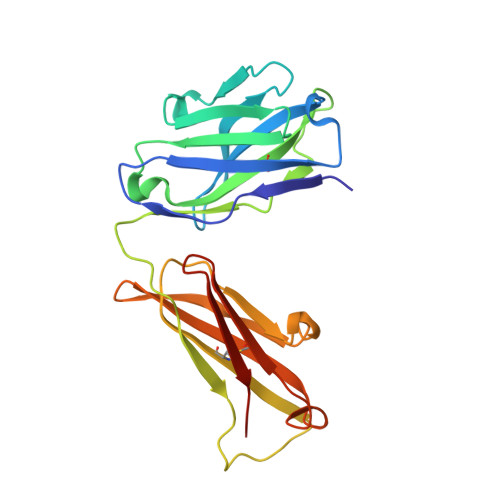
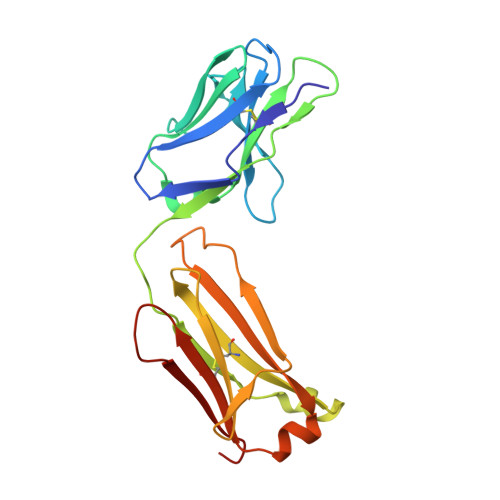
5I66 | pdb_00005i66

X-ray structure of the Fab fragment of 8B6, a murine monoclonal antibody specific for the human serotonin transporter


Experimental Data Snapshot

  • Method: X-RAY DIFFRACTION
  • Resolution: 1.62 Å
  • R-Value Free: 
    0.198 (Depositor), 0.206 (DCC) 
  • R-Value Work: 
    0.178 (Depositor), 0.185 (DCC) 
  • R-Value Observed: 
    0.179 (Depositor) 

Starting Model: experimental
View more details

wwPDB Validation 3D Report Full Report

Validation slider image for 5I66

This is version 1.5 of the entry. See complete history

Literature

X-ray structures and mechanism of the human serotonin transporter.

Coleman, J.A.Green, E.M.Gouaux, E.

(2016) Nature 532: 334-339

  • DOI: https://doi.org/10.1038/nature17629
  • Primary Citation Related Structures: 
    5I66, 5I6X, 5I6Z, 5I71, 5I73, 5I74, 5I75

  • PubMed Abstract: 

    The serotonin transporter (SERT) terminates serotonergic signalling through the sodium- and chloride-dependent reuptake of neurotransmitter into presynaptic neurons. SERT is a target for antidepressant and psychostimulant drugs, which block reuptake and prolong neurotransmitter signalling. Here we report X-ray crystallographic structures of human SERT at 3.15 Å resolution bound to the antidepressants (S)-citalopram or paroxetine. Antidepressants lock SERT in an outward-open conformation by lodging in the central binding site, located between transmembrane helices 1, 3, 6, 8 and 10, directly blocking serotonin binding. We further identify the location of an allosteric site in the complex as residing at the periphery of the extracellular vestibule, interposed between extracellular loops 4 and 6 and transmembrane helices 1, 6, 10 and 11. Occupancy of the allosteric site sterically hinders ligand unbinding from the central site, providing an explanation for the action of (S)-citalopram as an allosteric ligand. These structures define the mechanism of antidepressant action in SERT, and provide blueprints for future drug design.


  • Organizational Affiliation
    • Vollum Institute, Oregon Health &Science University, Portland, Oregon 97239, USA.

Macromolecule Content 

  • Total Structure Weight: 47.41 kDa 
  • Atom Count: 3,604 
  • Modeled Residue Count: 431 
  • Deposited Residue Count: 435 
  • Unique protein chains: 2

Macromolecules

Find similar proteins by:|  3D Structure
Entity ID: 1
MoleculeChains  Sequence LengthOrganismDetailsImage
8B6 antibody, heavy chain221Mus musculusMutation(s): 0 
Find similar proteins by:|  3D Structure
Entity ID: 2
MoleculeChains  Sequence LengthOrganismDetailsImage
8B6 antibody, light chain214Mus musculusMutation(s): 0 

Experimental Data & Validation

Experimental Data

  • Method: X-RAY DIFFRACTION
  • Resolution: 1.62 Å
  • R-Value Free:  0.198 (Depositor), 0.206 (DCC) 
  • R-Value Work:  0.178 (Depositor), 0.185 (DCC) 
  • R-Value Observed: 0.179 (Depositor) 
Space Group: P 43 21 2
Unit Cell:
Length ( Å )Angle ( ˚ )
a = 81.56α = 90
b = 81.56β = 90
c = 142.17γ = 90
Software Package:
Software NamePurpose
PHENIXrefinement
XDSdata reduction
PHASERphasing
XSCALEdata scaling

Structure Validation

View Full Validation Report


Entry History 

& Funding Information

Deposition Data


Funding OrganizationLocationGrant Number
National Institutes of Health/National Institute of General Medical Sciences (NIH/NIGMS)United States--
Howard Hughes Medical Institute (HHMI)United States--

Revision History  (Full details and data files)

  • Version 1.0: 2016-04-13
    Type: Initial release
  • Version 1.1: 2016-04-20
    Changes: Database references
  • Version 1.2: 2016-05-04
    Changes: Database references
  • Version 1.3: 2019-11-20
    Changes: Author supporting evidence, Database references, Derived calculations
  • Version 1.4: 2023-09-27
    Changes: Data collection, Database references, Refinement description
  • Version 1.5: 2024-11-06
    Changes: Structure summary