5I61 | pdb_00005i61

Crystal structure of the RNA-dependent RNA polymerase of a human picorbirnavirus


Experimental Data Snapshot

  • Method: X-RAY DIFFRACTION
  • Resolution: 2.40 Å
  • R-Value Free: 
    0.224 (Depositor), 0.226 (DCC) 
  • R-Value Work: 
    0.170 (Depositor), 0.171 (DCC) 
  • R-Value Observed: 
    0.172 (Depositor) 

wwPDB Validation 3D Report Full Report

Validation slider image for 5I61

This is version 1.4 of the entry. See complete history

Literature

Initiation of RNA Polymerization and Polymerase Encapsidation by a Small dsRNA Virus.

Collier, A.M.Lyytinen, O.L.Guo, Y.R.Toh, Y.Poranen, M.M.Tao, Y.J.

(2016) PLoS Pathog 12: e1005523-e1005523

  • DOI: https://doi.org/10.1371/journal.ppat.1005523
  • Primary Citation Related Structures: 
    5I61, 5I62

  • PubMed Abstract: 

    During the replication cycle of double-stranded (ds) RNA viruses, the viral RNA-dependent RNA polymerase (RdRP) replicates and transcribes the viral genome from within the viral capsid. How the RdRP molecules are packaged within the virion and how they function within the confines of an intact capsid are intriguing questions with answers that most likely vary across the different dsRNA virus families. In this study, we have determined a 2.4 Å resolution structure of an RdRP from the human picobirnavirus (hPBV). In addition to the conserved polymerase fold, the hPBV RdRP possesses a highly flexible 24 amino acid loop structure located near the C-terminus of the protein that is inserted into its active site. In vitro RNA polymerization assays and site-directed mutagenesis showed that: (1) the hPBV RdRP is fully active using both ssRNA and dsRNA templates; (2) the insertion loop likely functions as an assembly platform for the priming nucleotide to allow de novo initiation; (3) RNA transcription by the hPBV RdRP proceeds in a semi-conservative manner; and (4) the preference of virus-specific RNA during transcription is dictated by the lower melting temperature associated with the terminal sequences. Co-expression of the hPBV RdRP and the capsid protein (CP) indicated that, under the conditions used, the RdRP could not be incorporated into the recombinant capsids in the absence of the viral genome. Additionally, the hPBV RdRP exhibited higher affinity towards the conserved 5'-terminal sequence of the viral RNA, suggesting that the RdRP molecules may be encapsidated through their specific binding to the viral RNAs during assembly.


  • Organizational Affiliation
    • Department of BioSciences, Rice University, Houston, Texas, United States of America.

Macromolecule Content 

  • Total Structure Weight: 123.83 kDa 
  • Atom Count: 8,571 
  • Modeled Residue Count: 1,033 
  • Deposited Residue Count: 1,068 
  • Unique protein chains: 1

Macromolecules

Find similar proteins by:|  3D Structure
Entity ID: 1
MoleculeChains  Sequence LengthOrganismDetailsImage
Potential RNA-dependent RNA polymeraseA [auth B],
B [auth A]
534Human picobirnavirus strain Hy005102Mutation(s): 0 
EC: 2.7.7.48
UniProt
Find proteins for Q50LE4 (Human picobirnavirus (strain Human/Thailand/Hy005102/-))
Explore Q50LE4 
Go to UniProtKB:  Q50LE4
Entity Groups
Sequence Clusters30% Identity50% Identity70% Identity90% Identity95% Identity100% Identity
UniProt GroupQ50LE4
Sequence Annotations
Expand
Reference Sequence

Small Molecules

Modified Residues  1 Unique
IDChains TypeFormula2D DiagramParent
MSE
Query on MSE
A [auth B],
B [auth A]
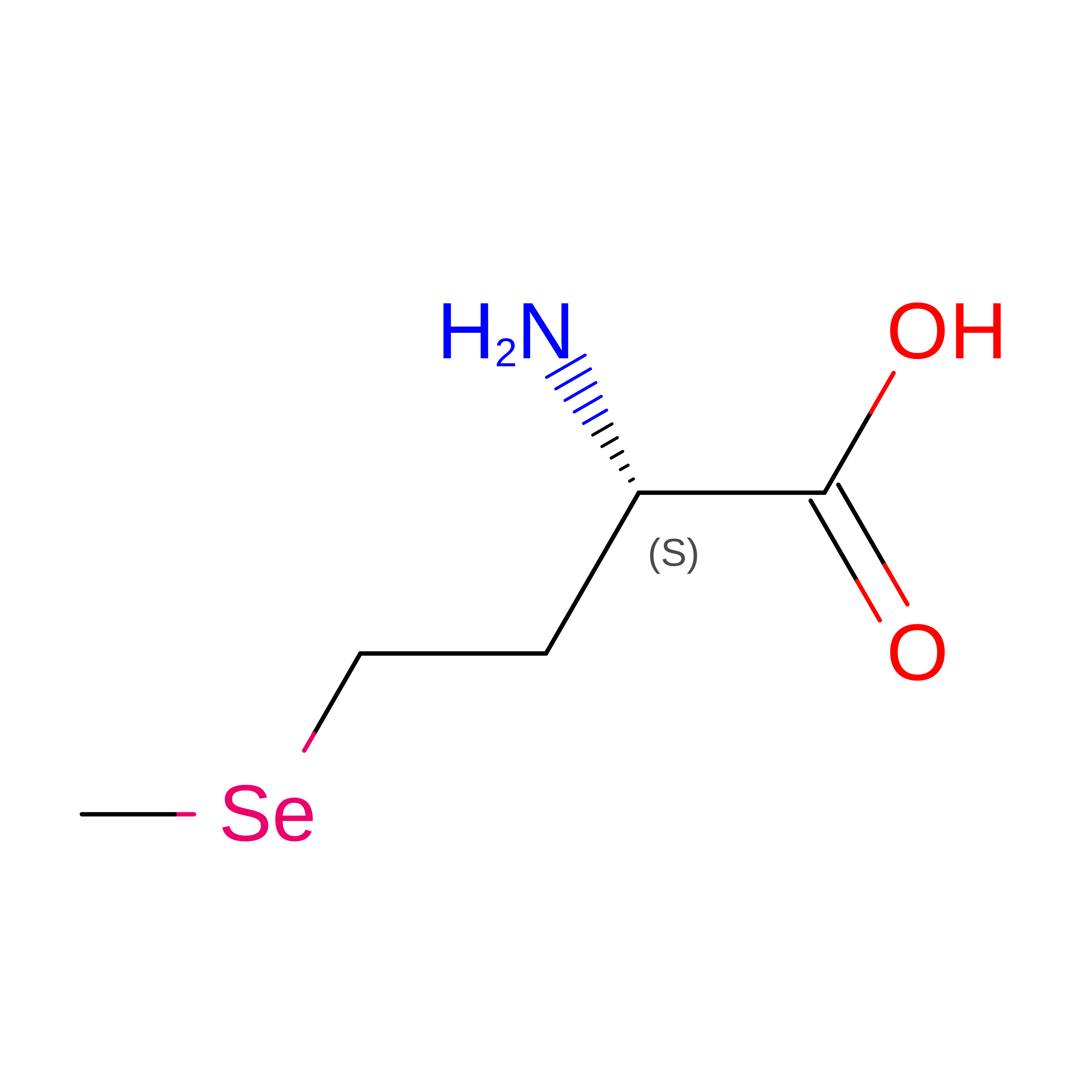
L-PEPTIDE LINKINGC5 H11 N O2 SeMET

Experimental Data & Validation

Experimental Data

  • Method: X-RAY DIFFRACTION
  • Resolution: 2.40 Å
  • R-Value Free:  0.224 (Depositor), 0.226 (DCC) 
  • R-Value Work:  0.170 (Depositor), 0.171 (DCC) 
  • R-Value Observed: 0.172 (Depositor) 
Space Group: P 1 21 1
Unit Cell:
Length ( Å )Angle ( ˚ )
a = 60.756α = 90
b = 78.763β = 91.44
c = 101.449γ = 90
Software Package:
Software NamePurpose
PHENIXrefinement
HKL-2000data scaling
PDB_EXTRACTdata extraction
HKL-2000data reduction
PHENIXphasing

Structure Validation

View Full Validation Report


Entry History 

& Funding Information

Deposition Data


Funding OrganizationLocationGrant Number
National Institutes of Health/National Institute Of Allergy and Infectious Diseases (NIH/NIAID)United StatesAIO67638

Revision History  (Full details and data files)

  • Version 1.0: 2016-03-16
    Type: Initial release
  • Version 1.1: 2016-05-04
    Changes: Database references, Structure summary
  • Version 1.2: 2017-09-20
    Changes: Author supporting evidence, Derived calculations
  • Version 1.3: 2019-12-11
    Changes: Author supporting evidence
  • Version 1.4: 2024-11-06
    Changes: Data collection, Database references, Structure summary