5G4Z | pdb_00005g4z

Structural basis for carboxylic acid recognition by a Cache chemosensory domain.


Experimental Data Snapshot

  • Method: X-RAY DIFFRACTION
  • Resolution: 1.98 Å
  • R-Value Free: 
    0.177 (Depositor), 0.191 (DCC) 
  • R-Value Work: 
    0.157 (Depositor), 0.172 (DCC) 
  • R-Value Observed: 
    0.158 (Depositor) 

Starting Model: experimental
View more details

wwPDB Validation 3D Report Full Report

Validation slider image for 5G4Z

This is version 1.4 of the entry. See complete history

Literature

Structural basis for ligand recognition by a Cache chemosensory domain that mediates carboxylate sensing in Pseudomonas syringae.

Brewster, J.L.McKellar, J.L.Finn, T.J.Newman, J.Peat, T.S.Gerth, M.L.

(2016) Sci Rep 6: 35198-35198

  • DOI: https://doi.org/10.1038/srep35198
  • Primary Citation Related Structures: 
    5G4Y, 5G4Z

  • PubMed Abstract: 

    Chemoreceptors enable bacteria to detect chemical signals in the environment and navigate towards niches that are favourable for survival. The sensor domains of chemoreceptors function as the input modules for chemotaxis systems, and provide sensory specificity by binding specific ligands. Cache-like domains are the most common extracellular sensor module in prokaryotes, however only a handful have been functionally or structurally characterised. Here, we have characterised a chemoreceptor Cache-like sensor domain (PscD-SD) from the plant pathogen Pseudomonas syringae pv. actinidiae (Psa). High-throughput fluorescence thermal shift assays, combined with isothermal thermal titration calorimetry, revealed that PscD-SD binds specifically to C 2 (glycolate and acetate) and C 3 (propionate and pyruvate) carboxylates. We solved the structure of PscD-SD in complex with propionate using X-ray crystallography. The structure reveals the key residues that comprise the ligand binding pocket and dictate the specificity of this sensor domain for C 2 and C 3 carboxylates. We also demonstrate that all four carboxylate ligands are chemoattractants for Psa, but only two of these (acetate and pyruvate) are utilisable carbon sources. This result suggests that in addition to guiding the bacteria towards nutrients, another possible role for carboxylate sensing is in locating potential sites of entry into the host plant.


  • Organizational Affiliation
    • Department of Biochemistry, University of Otago, Dunedin, 9054, New Zealand.

Macromolecule Content 

  • Total Structure Weight: 20.33 kDa 
  • Atom Count: 1,266 
  • Modeled Residue Count: 147 
  • Deposited Residue Count: 179 
  • Unique protein chains: 1

Macromolecules

Find similar proteins by:|  3D Structure
Entity ID: 1
MoleculeChains  Sequence LengthOrganismDetailsImage
Methyl-accepting chemotaxis sensory transducer with Cache sensor179Pseudomonas syringaeMutation(s): 0 
Gene Names: BCD74_10458

Small Molecules

Ligands 2 Unique
IDChains Name / Formula / InChI Key2D Diagram3D Interactions
PGE

Query on PGE


Download:Ideal Coordinates CCD File
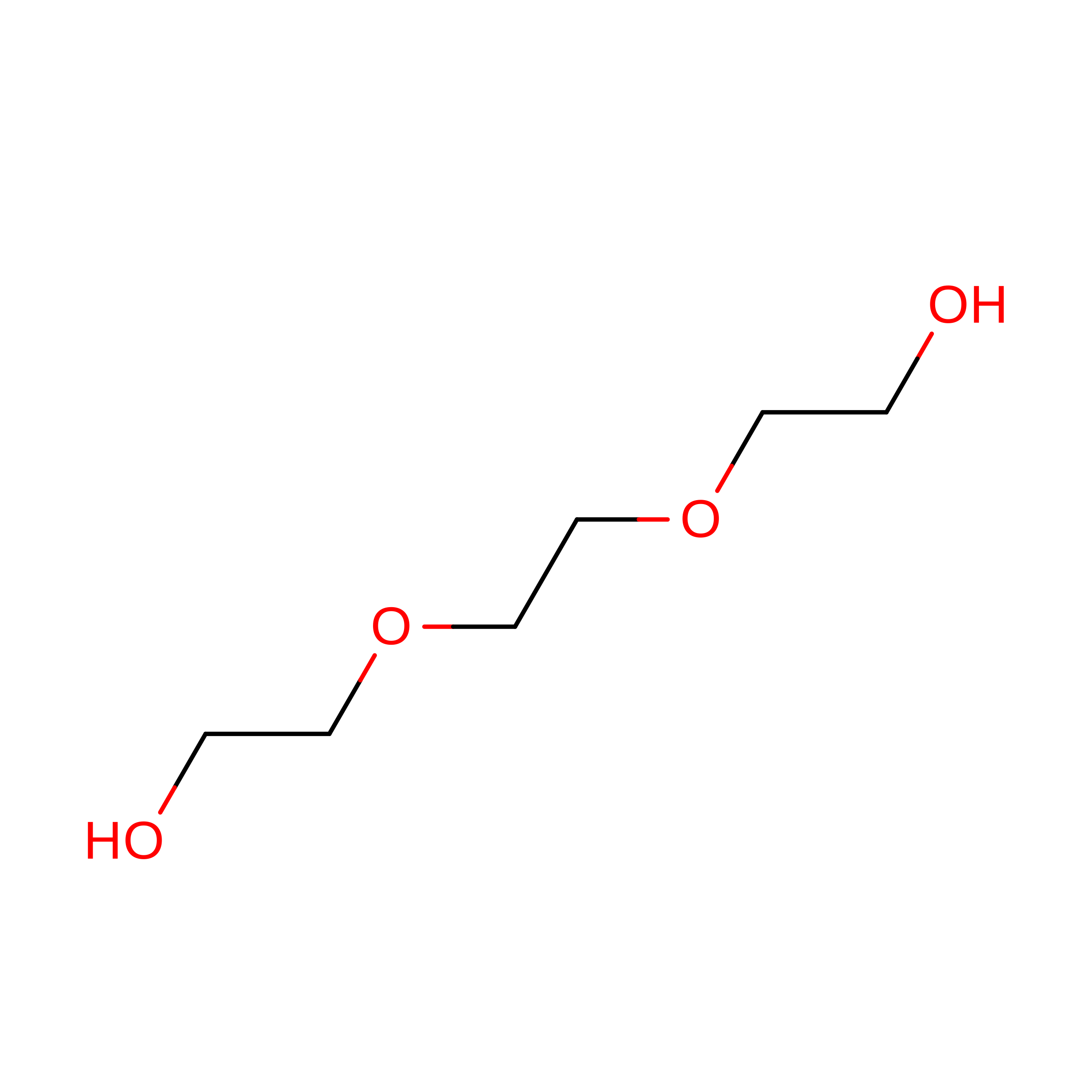
C [auth A]TRIETHYLENE GLYCOL
C6 H14 O4
ZIBGPFATKBEMQZ-UHFFFAOYSA-N
UNL

Query on UNL


Download:Ideal Coordinates CCD File
B [auth A]Unknown ligand
ZIBGPFATKBEMQZ-UHFFFAOYSA-N

Experimental Data & Validation

Experimental Data

  • Method: X-RAY DIFFRACTION
  • Resolution: 1.98 Å
  • R-Value Free:  0.177 (Depositor), 0.191 (DCC) 
  • R-Value Work:  0.157 (Depositor), 0.172 (DCC) 
  • R-Value Observed: 0.158 (Depositor) 
Space Group: P 64
Unit Cell:
Length ( Å )Angle ( ˚ )
a = 73.428α = 90
b = 73.428β = 90
c = 74.923γ = 120
Software Package:
Software NamePurpose
REFMACrefinement
XDSdata reduction
Aimlessdata scaling
PHASERphasing

Structure Validation

View Full Validation Report


Entry History 

Deposition Data

Revision History  (Full details and data files)

  • Version 1.0: 2017-03-29
    Type: Initial release
  • Version 1.1: 2017-04-05
    Changes: Database references
  • Version 1.2: 2019-05-08
    Changes: Data collection, Experimental preparation
  • Version 1.3: 2019-09-25
    Changes: Data collection, Database references, Other, Source and taxonomy, Structure summary
  • Version 1.4: 2024-01-10
    Changes: Data collection, Database references, Refinement description