5G1W | pdb_00005g1w

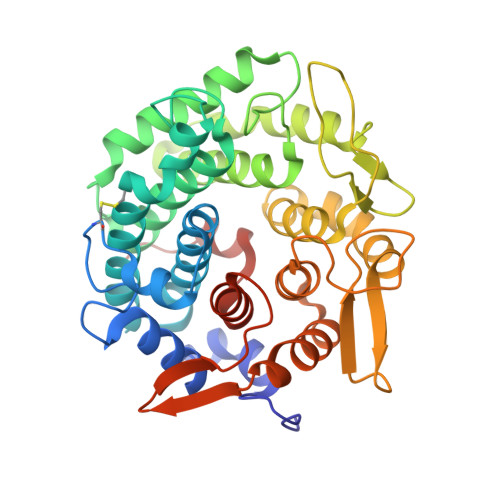
Apo Structure of Linalool Dehydratase-Isomerase


Experimental Data Snapshot

  • Method: X-RAY DIFFRACTION
  • Resolution: 1.76 Å
  • R-Value Free: 
    0.176 (Depositor), 0.187 (DCC) 
  • R-Value Work: 
    0.150 (Depositor), 0.163 (DCC) 
  • R-Value Observed: 
    0.152 (Depositor) 

Starting Model: experimental
View more details

wwPDB Validation 3D Report Full Report

Validation slider image for 5G1W

This is version 2.3 of the entry. See complete history

Literature

Structural and functional insights into asymmetric enzymatic dehydration of alkenols.

Nestl, B.M.Geinitz, C.Popa, S.Rizek, S.Haselbeck, R.J.Stephen, R.Noble, M.A.Fischer, M.P.Ralph, E.C.Hau, H.T.Man, H.Omar, M.Turkenburg, J.P.van Dien, S.Culler, S.J.Grogan, G.Hauer, B.

(2017) Nat Chem Biol 13: 275-281

  • DOI: https://doi.org/10.1038/nchembio.2271
  • Primary Citation Related Structures: 
    5G1U, 5G1V, 5G1W

  • PubMed Abstract: 

    The asymmetric dehydration of alcohols is an important process for the direct synthesis of alkenes. We report the structure and substrate specificity of the bifunctional linalool dehydratase isomerase (LinD) from the bacterium Castellaniella defragrans that catalyzes in nature the hydration of β-myrcene to linalool and the subsequent isomerization to geraniol. Enzymatic kinetic resolutions of truncated and elongated aromatic and aliphatic tertiary alcohols (C5-C15) that contain a specific signature motif demonstrate the broad substrate specificity of LinD. The three-dimensional structure of LinD from Castellaniella defragrans revealed a pentamer with active sites at the protomer interfaces. Furthermore, the structure of LinD in complex with the product geraniol provides initial mechanistic insights into this bifunctional enzyme. Site-directed mutagenesis confirmed active site amino acid residues essential for its dehydration and isomerization activity. These structural and mechanistic insights facilitate the development of hydrating catalysts, enriching the toolbox for novel bond-forming biocatalysis.


  • Organizational Affiliation
    • Institute of Technical Biochemistry, Universitaet Stuttgart, Stuttgart, Germany.

Macromolecule Content 

  • Total Structure Weight: 210.89 kDa 
  • Atom Count: 16,596 
  • Modeled Residue Count: 1,822 
  • Deposited Residue Count: 1,860 
  • Unique protein chains: 1

Macromolecules

Find similar proteins by:|  3D Structure
Entity ID: 1
MoleculeChains  Sequence LengthOrganismDetailsImage
LINALOOL DEHYDRATASE/ISOMERASE
A, B, C, D, E
372Castellaniella defragrans 65PhenMutation(s): 0 
EC: 4.2.1.127 (PDB Primary Data), 5.4.4.4 (PDB Primary Data)
UniProt
Find proteins for E1XUJ2 (Castellaniella defragrans (strain DSM 12143 / CCUG 39792 / 65Phen))
Explore E1XUJ2 
Go to UniProtKB:  E1XUJ2
Entity Groups
Sequence Clusters30% Identity50% Identity70% Identity90% Identity95% Identity100% Identity
UniProt GroupE1XUJ2
Sequence Annotations
Expand
Reference Sequence

Small Molecules

Ligands 2 Unique
IDChains Name / Formula / InChI Key2D Diagram3D Interactions
DXX

Query on DXX


Download:Ideal Coordinates CCD File
J [auth A],
N [auth B]
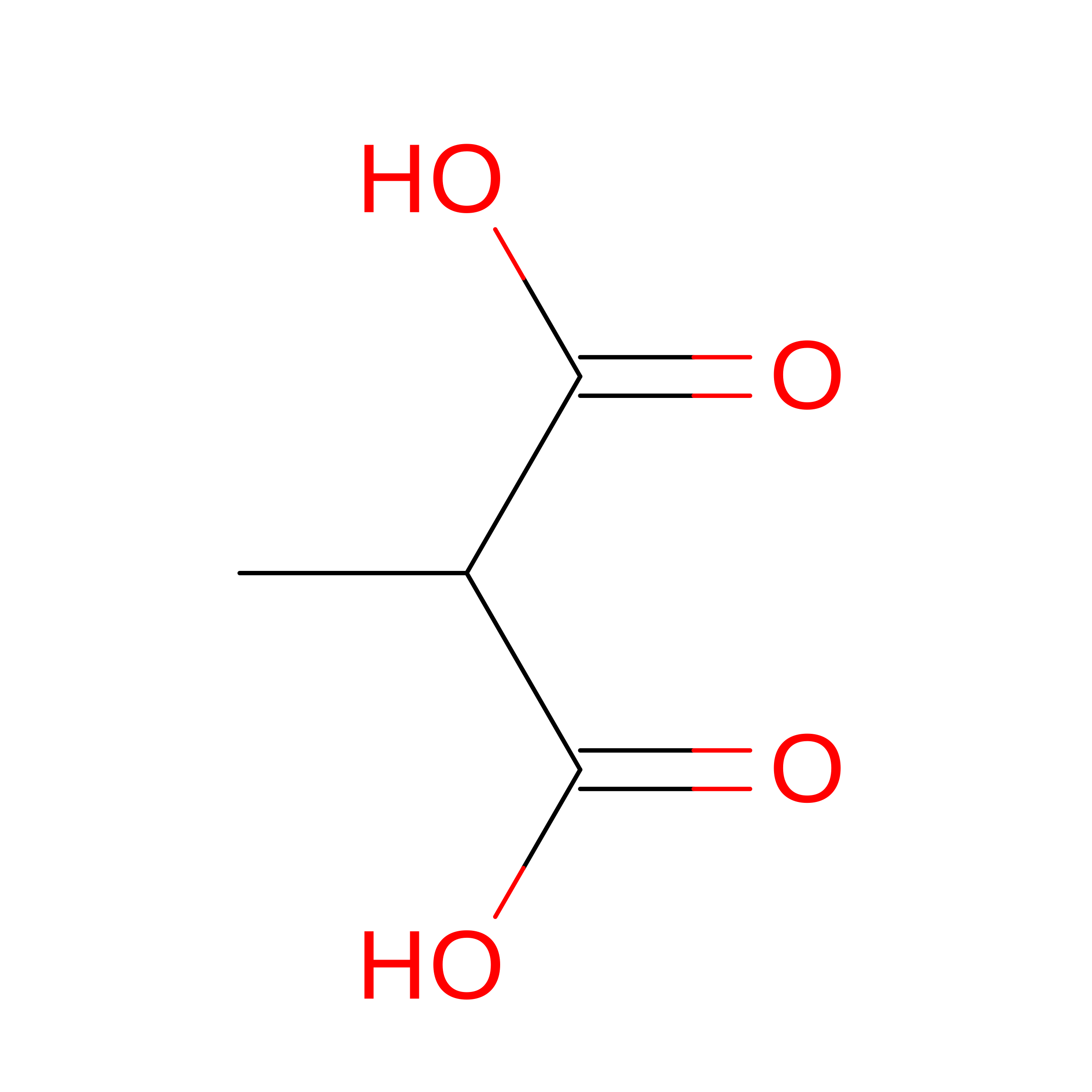
METHYLMALONIC ACID
C4 H6 O4
ZIYVHBGGAOATLY-UHFFFAOYSA-N
EDO

Query on EDO


Download:Ideal Coordinates CCD File
F [auth A]
G [auth A]
H [auth A]
I [auth A]
K [auth B]
F [auth A],
G [auth A],
H [auth A],
I [auth A],
K [auth B],
L [auth B],
M [auth B],
O [auth C],
P [auth D],
Q [auth D],
R [auth E]
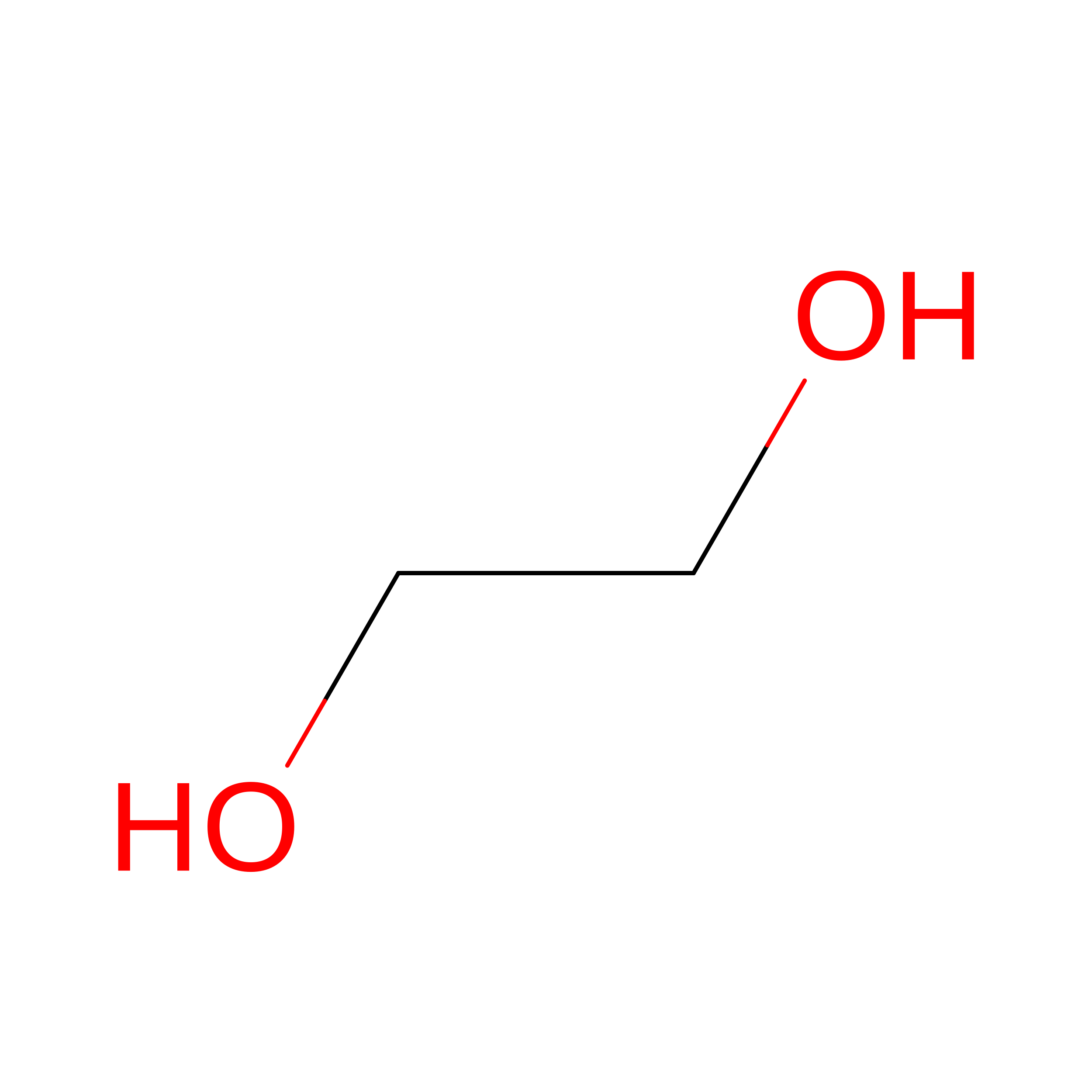
1,2-ETHANEDIOL
C2 H6 O2
LYCAIKOWRPUZTN-UHFFFAOYSA-N

Experimental Data & Validation

Experimental Data

  • Method: X-RAY DIFFRACTION
  • Resolution: 1.76 Å
  • R-Value Free:  0.176 (Depositor), 0.187 (DCC) 
  • R-Value Work:  0.150 (Depositor), 0.163 (DCC) 
  • R-Value Observed: 0.152 (Depositor) 
Space Group: I 1 2 1
Unit Cell:
Length ( Å )Angle ( ˚ )
a = 108.062α = 90
b = 110.148β = 91.32
c = 195.338γ = 90
Software Package:
Software NamePurpose
REFMACrefinement
XDSdata reduction
SCALAdata scaling
MOLREPphasing

Structure Validation

View Full Validation Report


Entry History 

Deposition Data

Revision History  (Full details and data files)

  • Version 1.0: 2017-01-11
    Type: Initial release
  • Version 1.1: 2017-01-18
    Changes: Database references
  • Version 1.2: 2017-02-22
    Changes: Database references
  • Version 2.0: 2022-11-09
    Changes: Atomic model, Database references, Derived calculations, Other, Refinement description
  • Version 2.1: 2024-05-01
    Changes: Data collection, Refinement description
  • Version 2.2: 2024-10-09
    Changes: Structure summary
  • Version 2.3: 2024-11-06
    Changes: Structure summary