5FN8 | pdb_00005fn8

Crystal structure of rat CD45 extracellular region, domains d3-d4


Experimental Data Snapshot

  • Method: X-RAY DIFFRACTION
  • Resolution: 2.45 Å
  • R-Value Free: 
    0.236 (Depositor), 0.243 (DCC) 
  • R-Value Work: 
    0.214 (Depositor), 0.219 (DCC) 
  • R-Value Observed: 
    0.215 (Depositor) 

wwPDB Validation 3D Report Full Report

Validation slider image for 5FN8

Ligand Structure Quality Assessment 


This is version 1.5 of the entry. See complete history

Literature

Initiation of T Cell Signaling by Cd45 Segregation at 'Close Contacts'.

Chang, V.T.Fernandes, R.A.Ganzinger, K.A.Lee, S.F.Siebold, C.Mccoll, J.Jonsson, P.Palayret, M.Harlos, K.Coles, C.H.Jones, E.Y.Lui, Y.Huang, E.Gilbert, R.J.Klenerman, D.Aricescu, A.R.Davis, S.J.

(2016) Nat Immunol 17: 574

  • DOI: https://doi.org/10.1038/ni.3392
  • Primary Citation Related Structures: 
    5FMV, 5FN6, 5FN7, 5FN8

  • PubMed Abstract: 

    It has been proposed that the local segregation of kinases and the tyrosine phosphatase CD45 underpins T cell antigen receptor (TCR) triggering, but how such segregation occurs and whether it can initiate signaling is unclear. Using structural and biophysical analysis, we show that the extracellular region of CD45 is rigid and extends beyond the distance spanned by TCR-ligand complexes, implying that sites of TCR-ligand engagement would sterically exclude CD45. We also show that the formation of 'close contacts', new structures characterized by spontaneous CD45 and kinase segregation at the submicron-scale, initiates signaling even when TCR ligands are absent. Our work reveals the structural basis for, and the potent signaling effects of, local CD45 and kinase segregation. TCR ligands have the potential to heighten signaling simply by holding receptors in close contacts.


  • Organizational Affiliation
    • Radcliffe Department of Medicine and MRC Human Immunology Unit, John Radcliffe Hospital, University of Oxford, Oxford OX3 9DS, United Kingdom.

Macromolecule Content 

  • Total Structure Weight: 44.39 kDa 
  • Atom Count: 2,975 
  • Modeled Residue Count: 356 
  • Deposited Residue Count: 380 
  • Unique protein chains: 1

Macromolecules

Find similar proteins by:|  3D Structure
Entity ID: 1
MoleculeChains  Sequence LengthOrganismDetailsImage
RECEPTOR-TYPE TYROSINE-PROTEIN PHOSPHATASE C
A, B
190Rattus norvegicusMutation(s): 0 
EC: 3.1.3.48
UniProt
Find proteins for P04157 (Rattus norvegicus)
Explore P04157 
Go to UniProtKB:  P04157
Entity Groups
Sequence Clusters30% Identity50% Identity70% Identity90% Identity95% Identity100% Identity
UniProt GroupP04157
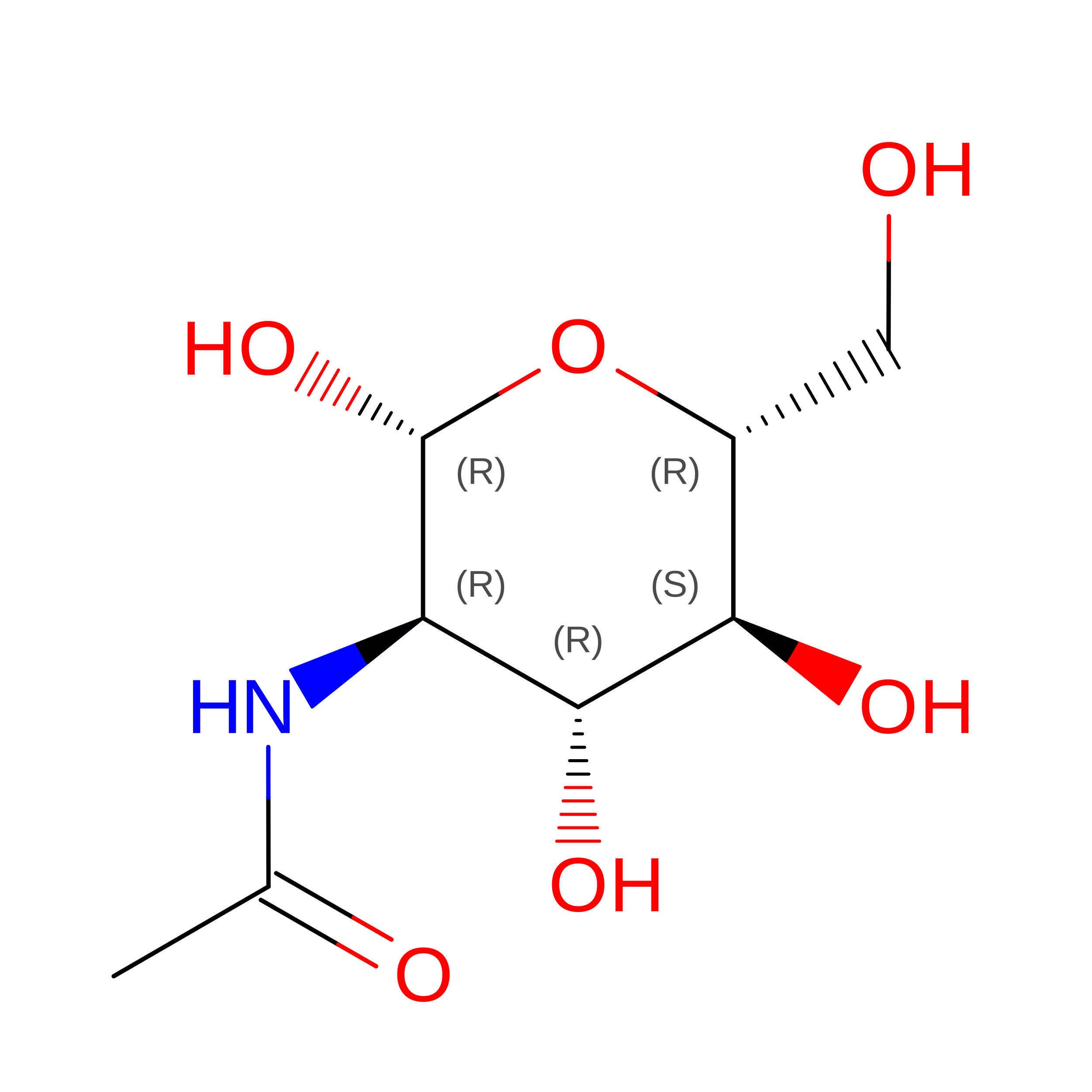
Glycosylation
Glycosylation Sites: 3Go to GlyGen: P04157-1
Sequence Annotations
Expand
Reference Sequence

Small Molecules

Experimental Data & Validation

Experimental Data

  • Method: X-RAY DIFFRACTION
  • Resolution: 2.45 Å
  • R-Value Free:  0.236 (Depositor), 0.243 (DCC) 
  • R-Value Work:  0.214 (Depositor), 0.219 (DCC) 
  • R-Value Observed: 0.215 (Depositor) 
Space Group: I 2 2 2
Unit Cell:
Length ( Å )Angle ( ˚ )
a = 84.41α = 90
b = 131.16β = 90
c = 141.31γ = 90
Software Package:
Software NamePurpose
xia2data reduction
xia2data scaling
SHELXDphasing
autoSHARPphasing
BUSTERrefinement

Structure Validation

View Full Validation Report


Ligand Structure Quality Assessment 


Entry History 

Revision History  (Full details and data files)

  • Version 1.0: 2016-03-23
    Type: Initial release
  • Version 1.1: 2016-03-30
    Changes: Database references
  • Version 1.2: 2016-04-27
    Changes: Database references, Other, Refinement description
  • Version 1.3: 2016-05-04
    Changes: Database references
  • Version 1.4: 2020-07-29
    Type: Remediation
    Reason: Carbohydrate remediation
    Changes: Data collection, Derived calculations, Other, Structure summary
  • Version 1.5: 2024-11-20
    Changes: Data collection, Database references, Structure summary