5FB7 | pdb_00005fb7

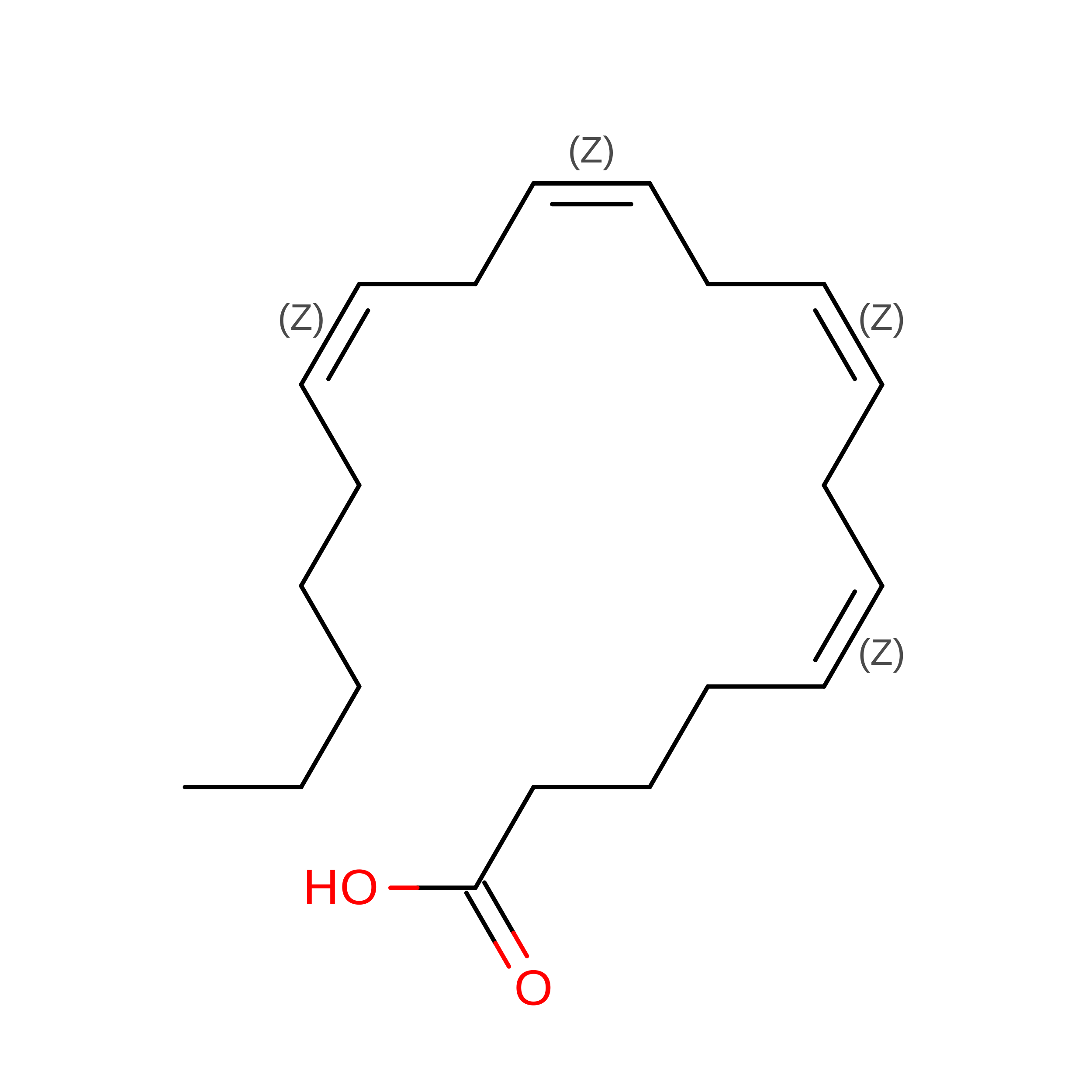
Ligand binding domain 2 of Penicillium marneffei MP1 protein complexed with multiple arachidonic acids


Experimental Data Snapshot

  • Method: X-RAY DIFFRACTION
  • Resolution: 1.50 Å
  • R-Value Free: 
    0.217 (Depositor), 0.217 (DCC) 
  • R-Value Work: 
    0.191 (Depositor), 0.191 (DCC) 
  • R-Value Observed: 
    0.192 (Depositor) 

Starting Model: experimental
View more details

wwPDB Validation 3D Report Full Report

Validation slider image for 5FB7

Ligand Structure Quality Assessment 


This is version 1.3 of the entry. See complete history

Literature

Talaromyces marneffei Mp1p Is a Virulence Factor that Binds and Sequesters a Key Proinflammatory Lipid to Dampen Host Innate Immune Response

Sze, K.H.Lam, W.H.Zhang, H.Ke, Y.H.Tse, M.K.Woo, P.C.Lau, S.K.Lau, C.C.Cai, J.P.Tung, E.T.Lo, R.K.Xu, S.Kao, R.Y.Hao, Q.Yuen, K.Y.

(2017) Cell Chem Biol 24: 182-194

  • DOI: https://doi.org/10.1016/j.chembiol.2016.12.014
  • Primary Citation Related Structures: 
    5CSD, 5FB7

  • PubMed Abstract: 

    Talaromyces (Penicillium) marneffei is one of the leading causes of systemic mycosis in immunosuppressed or AIDS patients in Southeast Asia. How this intracellular pathogen evades the host immune defense remains unclear. We provide evidence that T. marneffei depletes levels of a key proinflammatory lipid mediator arachidonic acid (AA) to evade the host innate immune defense. Mechanistically, an abundant secretory mannoprotein Mp1p, shown previously to be a virulence factor, does so by binding AA with high affinity via a long hydrophobic central cavity found in the LBD2 domain. This sequesters a critical proinflammatory signaling lipid, and we see evidence that AA, AA's downstream metabolites, and the cytokines interleukin-6 and tumor necrosis factor α are downregulated in T. marneffei-infected J774 macrophages. Given that Mp1p-LBD2 homologs are identified in other fungal pathogens, we expect that this novel class of fatty-acid-binding proteins sequestering key proinflammatory lipid mediators represents a general virulence mechanism of pathogenic fungi.


  • Organizational Affiliation
    • State Key Laboratory of Emerging Infectious Diseases, The University of Hong Kong, Hong Kong SAR, China; Department of Microbiology, The University of Hong Kong, Hong Kong SAR, China; Research Centre of Infection and Immunology, The University of Hong Kong, Hong Kong SAR, China; Carol Yu Centre for Infection, The University of Hong Kong, Hong Kong SAR, China.

Macromolecule Content 

  • Total Structure Weight: 68.84 kDa 
  • Atom Count: 5,317 
  • Modeled Residue Count: 612 
  • Deposited Residue Count: 620 
  • Unique protein chains: 1

Macromolecules

Find similar proteins by:|  3D Structure
Entity ID: 1
MoleculeChains  Sequence LengthOrganismDetailsImage
Envelope glycoprotein
A, B, C, D
155Talaromyces marneffei PM1Mutation(s): 0 
Gene Names: GQ26_0022220
Membrane Entity: Yes 
UniProt
Find proteins for A0A093VKV7 (Talaromyces marneffei PM1)
Explore A0A093VKV7 
Go to UniProtKB:  A0A093VKV7
Entity Groups
Sequence Clusters30% Identity50% Identity70% Identity90% Identity95% Identity100% Identity
UniProt GroupA0A093VKV7
Sequence Annotations
Expand
Reference Sequence

Small Molecules

Binding Affinity Annotations 
IDSourceBinding Affinity
ACD BindingDB:  5FB7 ΔG: min: -6.07e+1, max: 26.98 (kJ/mol) from 12 assay(s)

Experimental Data & Validation

Experimental Data

  • Method: X-RAY DIFFRACTION
  • Resolution: 1.50 Å
  • R-Value Free:  0.217 (Depositor), 0.217 (DCC) 
  • R-Value Work:  0.191 (Depositor), 0.191 (DCC) 
  • R-Value Observed: 0.192 (Depositor) 
Space Group: C 1 2 1
Unit Cell:
Length ( Å )Angle ( ˚ )
a = 59.239α = 90
b = 98.495β = 90.01
c = 100.12γ = 90
Software Package:
Software NamePurpose
REFMACrefinement
DENZOdata collection
SCALEPACKdata scaling
PHASERphasing
PDB_EXTRACTdata extraction
HKL-2000data reduction

Structure Validation

View Full Validation Report


Ligand Structure Quality Assessment 


Entry History 

Deposition Data

Revision History  (Full details and data files)

  • Version 1.0: 2016-12-14
    Type: Initial release
  • Version 1.1: 2017-02-01
    Changes: Database references
  • Version 1.2: 2017-03-08
    Changes: Database references
  • Version 1.3: 2023-11-08
    Changes: Data collection, Database references, Refinement description