Download Mendeley
Measuring and modeling diffuse scattering in protein X-ray crystallography.
Van Benschoten, A.H., Liu, L., Gonzalez, A., Brewster, A.S., Sauter, N.K., Fraser, J.S., Wall, M.E.(2016) Proc Natl Acad Sci U S A 113: 4069-4074
- PubMed: 27035972 Search on PubMedSearch on PubMed Central
- DOI: https://doi.org/10.1073/pnas.1524048113
- Primary Citation Related Structures:
5F66, 5F6M - PubMed Abstract:
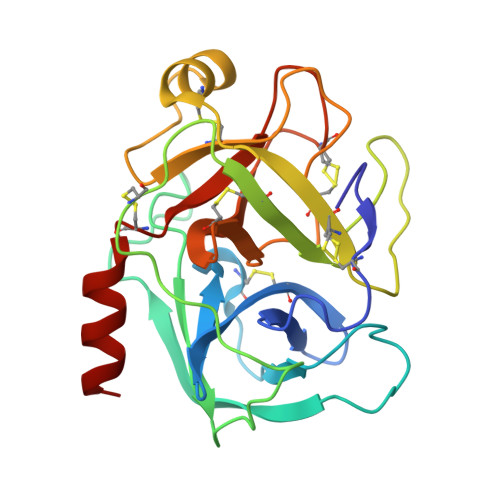
X-ray diffraction has the potential to provide rich information about the structural dynamics of macromolecules. To realize this potential, both Bragg scattering, which is currently used to derive macromolecular structures, and diffuse scattering, which reports on correlations in charge density variations, must be measured. Until now, measurement of diffuse scattering from protein crystals has been scarce because of the extra effort of collecting diffuse data. Here, we present 3D measurements of diffuse intensity collected from crystals of the enzymes cyclophilin A and trypsin. The measurements were obtained from the same X-ray diffraction images as the Bragg data, using best practices for standard data collection. To model the underlying dynamics in a practical way that could be used during structure refinement, we tested translation-libration-screw (TLS), liquid-like motions (LLM), and coarse-grained normal-modes (NM) models of protein motions. The LLM model provides a global picture of motions and was refined against the diffuse data, whereas the TLS and NM models provide more detailed and distinct descriptions of atom displacements, and only used information from the Bragg data. Whereas different TLS groupings yielded similar Bragg intensities, they yielded different diffuse intensities, none of which agreed well with the data. In contrast, both the LLM and NM models agreed substantially with the diffuse data. These results demonstrate a realistic path to increase the number of diffuse datasets available to the wider biosciences community and indicate that dynamics-inspired NM structural models can simultaneously agree with both Bragg and diffuse scattering.
- Department of Bioengineering and Therapeutic Sciences, University of California, San Francisco, CA 94158;
Organizational Affiliation: