5EYX | pdb_00005eyx

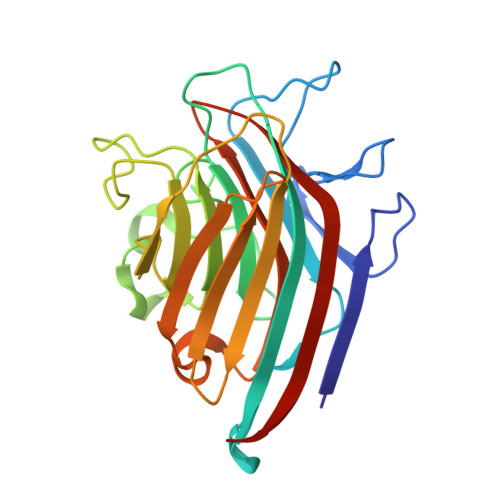
Monoclinic Form of Centrolobium tomentosum seed lectin (CTL) complexed with Man1-3Man-OMe.


Experimental Data Snapshot

  • Method: X-RAY DIFFRACTION
  • Resolution: 2.25 Å
  • R-Value Free: 
    0.237 (Depositor), 0.236 (DCC) 
  • R-Value Work: 
    0.186 (Depositor), 0.185 (DCC) 
  • R-Value Observed: 
    0.188 (Depositor) 

wwPDB Validation 3D Report Full Report

Validation slider image for 5EYX

Ligand Structure Quality Assessment 


This is version 2.1 of the entry. See complete history

Literature

Structural analysis of Centrolobium tomentosum seed lectin with inflammatory activity.

Almeida, A.C.Osterne, V.J.Santiago, M.Q.Pinto-Junior, V.R.Silva-Filho, J.C.Lossio, C.F.Nascimento, F.L.Almeida, R.P.Teixeira, C.S.Leal, R.B.Delatorre, P.Rocha, B.A.Assreuy, A.M.Nascimento, K.S.Cavada, B.S.

(2016) Arch Biochem Biophys 596: 73-83

  • DOI: https://doi.org/10.1016/j.abb.2016.03.001
  • Primary Citation Related Structures: 
    5EYX, 5EYY

  • PubMed Abstract: 

    A glycosylated lectin (CTL) with specificity for mannose and glucose has been detected and purified from seeds of Centrolobium tomentosum, a legume plant from Dalbergieae tribe. It was isolated by mannose-sepharose affinity chromatography. The primary structure was determined by tandem mass spectrometry and consists of 245 amino acids, similar to other Dalbergieae lectins. CTL structures were solved from two crystal forms, a monoclinic and a tetragonal, diffracted at 2.25 and 1.9 Å, respectively. The carbohydrate recognition domain (CRD), metal-binding site and glycosylation site were characterized, and the structural basis for mannose/glucose-binding was elucidated. The lectin adopts the canonical dimeric organization of legume lectins. CTL showed acute inflammatory effect in paw edema model. The protein was subjected to ligand screening (dimannosides and trimannoside) by molecular docking, and interactions were compared with similar lectins possessing the same ligand specificity. This is the first crystal structure of mannose/glucose native seed lectin with proinflammatory activity isolated from the Centrolobium genus.


  • Organizational Affiliation
    • Laboratório de Moléculas Biologicamente Ativas - BioMol-Lab, Departamento de Bioquímica e Biologia Molecular, Universidade Federal do Ceará, Fortaleza, Ceará, Brazil.

Macromolecule Content 

  • Total Structure Weight: 55.51 kDa 
  • Atom Count: 4,144 
  • Modeled Residue Count: 480 
  • Deposited Residue Count: 490 
  • Unique protein chains: 1

Macromolecules

Find similar proteins by:|  3D Structure
Entity ID: 1
MoleculeChains  Sequence LengthOrganismDetailsImage
Centrolobium tomentosum lectin
A, B
245Centrolobium tomentosumMutation(s): 0 
UniProt
Find proteins for C0HJX1 (Centrolobium tomentosum)
Explore C0HJX1 
Go to UniProtKB:  C0HJX1
Entity Groups
Sequence Clusters30% Identity50% Identity70% Identity90% Identity95% Identity100% Identity
UniProt GroupC0HJX1
Glycosylation
Glycosylation Sites: 1
Sequence Annotations
Expand
Reference Sequence

Oligosaccharides

Help  
Entity ID: 2
MoleculeChains Length2D Diagram GlycosylationD Interactions
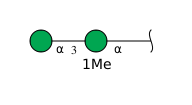
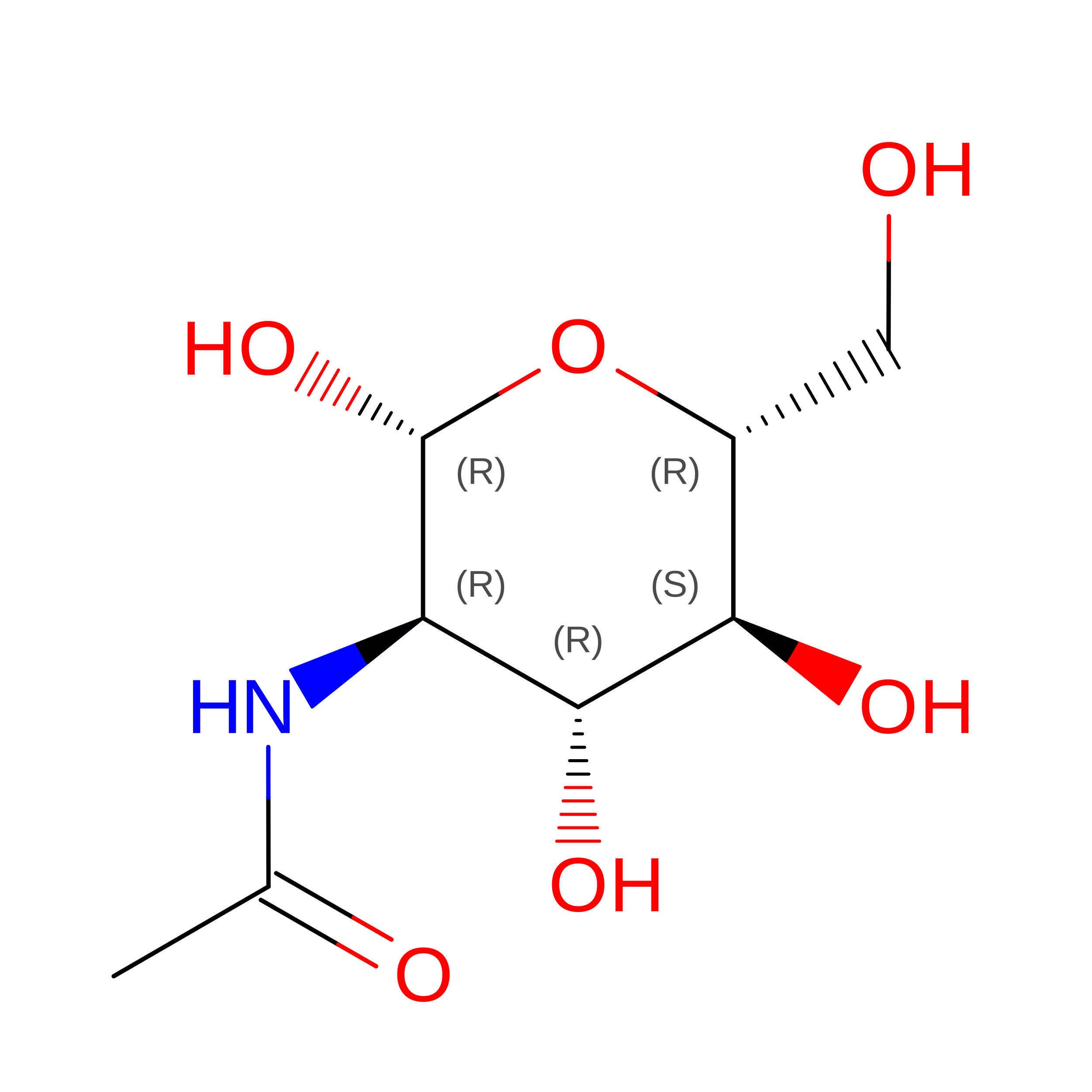
alpha-D-mannopyranose-(1-3)-methyl alpha-D-mannopyranoside
C, D
2N/A
Glycosylation Resources
GlyTouCan: G59594NN
GlyCosmos: G59594NN

Experimental Data & Validation

Experimental Data

  • Method: X-RAY DIFFRACTION
  • Resolution: 2.25 Å
  • R-Value Free:  0.237 (Depositor), 0.236 (DCC) 
  • R-Value Work:  0.186 (Depositor), 0.185 (DCC) 
  • R-Value Observed: 0.188 (Depositor) 
Space Group: C 1 2 1
Unit Cell:
Length ( Å )Angle ( ˚ )
a = 145.84α = 90
b = 41.55β = 102.4
c = 94.64γ = 90
Software Package:
Software NamePurpose
PHENIXrefinement
MOSFLMdata reduction
SCALAdata scaling
MOLREPphasing

Structure Validation

View Full Validation Report


Ligand Structure Quality Assessment 


Entry History 

Revision History  (Full details and data files)

  • Version 1.0: 2016-03-16
    Type: Initial release
  • Version 1.1: 2016-03-30
    Changes: Database references
  • Version 2.0: 2020-07-29
    Type: Remediation
    Reason: Carbohydrate remediation
    Changes: Atomic model, Data collection, Database references, Derived calculations, Non-polymer description, Structure summary
  • Version 2.1: 2024-10-23
    Changes: Data collection, Database references, Structure summary