5E7L | pdb_00005e7l

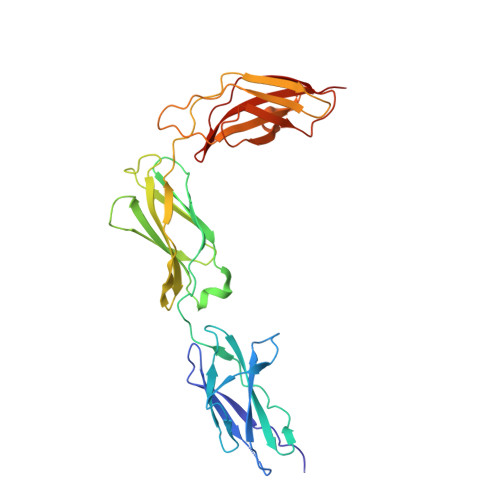
Crystal structure of mouse CNTN2 FN1-FN3 domains


Experimental Data Snapshot

  • Method: X-RAY DIFFRACTION
  • Resolution: 2.00 Å
  • R-Value Free: 
    0.226 (Depositor), 0.228 (DCC) 
  • R-Value Work: 
    0.191 (Depositor), 0.194 (DCC) 
  • R-Value Observed: 
    0.193 (Depositor) 

wwPDB Validation 3D Report Full Report

Validation slider image for 5E7L

This is version 1.4 of the entry. See complete history

Literature

Structural Basis for Interactions Between Contactin Family Members and Protein-tyrosine Phosphatase Receptor Type G in Neural Tissues.

Nikolaienko, R.M.Hammel, M.Dubreuil, V.Zalmai, R.Hall, D.R.Mehzabeen, N.Karuppan, S.J.Harroch, S.Stella, S.L.Bouyain, S.

(2016) J Biological Chem 291: 21335-21349

  • DOI: https://doi.org/10.1074/jbc.M116.742163
  • Primary Citation Related Structures: 
    5E4I, 5E4Q, 5E4S, 5E52, 5E53, 5E55, 5E5R, 5E5U, 5E7L, 5I99

  • PubMed Abstract: 

    Protein-tyrosine phosphatase receptor type G (RPTPγ/PTPRG) interacts in vitro with contactin-3-6 (CNTN3-6), a group of glycophosphatidylinositol-anchored cell adhesion molecules involved in the wiring of the nervous system. In addition to PTPRG, CNTNs associate with multiple transmembrane proteins and signal inside the cell via cis-binding partners to alleviate the absence of an intracellular region. Here, we use comprehensive biochemical and structural analyses to demonstrate that PTPRG·CNTN3-6 complexes share similar binding affinities and a conserved arrangement. Furthermore, as a first step to identifying PTPRG·CNTN complexes in vivo, we found that PTPRG and CNTN3 associate in the outer segments of mouse rod photoreceptor cells. In particular, PTPRG and CNTN3 form cis-complexes at the surface of photoreceptors yet interact in trans when expressed on the surfaces of apposing cells. Further structural analyses suggest that all CNTN ectodomains adopt a bent conformation and might lie parallel to the cell surface to accommodate these cis and trans binding modes. Taken together, these studies identify a PTPRG·CNTN complex in vivo and provide novel insights into PTPRG- and CNTN-mediated signaling.


  • Organizational Affiliation
    • From the Division of Molecular Biology and Biochemistry, School of Biological Sciences, University of Missouri-Kansas City, Kansas City, Missouri 64110.

Macromolecule Content 

  • Total Structure Weight: 32.99 kDa 
  • Atom Count: 2,491 
  • Modeled Residue Count: 302 
  • Deposited Residue Count: 305 
  • Unique protein chains: 1

Macromolecules

Find similar proteins by:|  3D Structure
Entity ID: 1
MoleculeChains  Sequence LengthOrganismDetailsImage
Contactin-2305Mus musculusMutation(s): 0 
Gene Names: Cntn2Tax
UniProt
Find proteins for Q61330 (Mus musculus)
Explore Q61330 
Go to UniProtKB:  Q61330
Entity Groups
Sequence Clusters30% Identity50% Identity70% Identity90% Identity95% Identity100% Identity
UniProt GroupQ61330
Sequence Annotations
Expand
Reference Sequence

Experimental Data & Validation

Experimental Data

  • Method: X-RAY DIFFRACTION
  • Resolution: 2.00 Å
  • R-Value Free:  0.226 (Depositor), 0.228 (DCC) 
  • R-Value Work:  0.191 (Depositor), 0.194 (DCC) 
  • R-Value Observed: 0.193 (Depositor) 
Space Group: P 21 21 2
Unit Cell:
Length ( Å )Angle ( ˚ )
a = 124.39α = 90
b = 40.674β = 90
c = 82.599γ = 90
Software Package:
Software NamePurpose
PHENIXrefinement
HKL-2000data collection
HKL-2000data reduction
HKL-2000data scaling
SOLVEphasing
PDB_EXTRACTdata extraction
Cootmodel building

Structure Validation

View Full Validation Report


Entry History 

& Funding Information

Deposition Data


Funding OrganizationLocationGrant Number
National Institutes of Health/National Institute of General Medical Sciences (NIH/NIGMS)United StatesGM088806

Revision History  (Full details and data files)

  • Version 1.0: 2016-08-31
    Type: Initial release
  • Version 1.1: 2016-11-23
    Changes: Database references
  • Version 1.2: 2017-09-27
    Changes: Author supporting evidence, Database references
  • Version 1.3: 2019-12-25
    Changes: Author supporting evidence
  • Version 1.4: 2024-03-06
    Changes: Data collection, Database references