5E5F | pdb_00005e5f

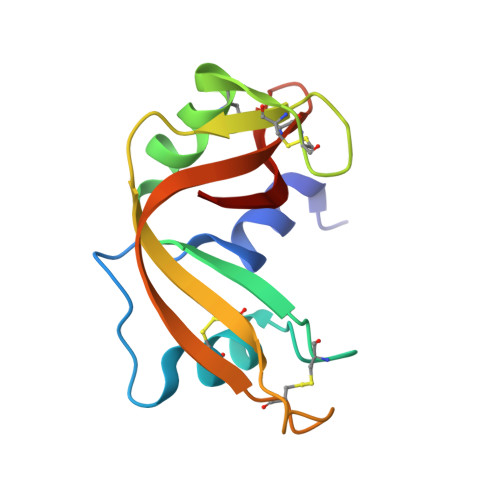
X-ray structure of the complex between RNase A and compound 4-PF6 ([(PPh3)Au(mi-pbi)Pt(Me)(DMSO)][PF6]), the heterobimetallic derivative obtained in the reaction between the organometallic compound [Pt(pbi)(Me)(DMSO)], pbi=2-(2'-pyridil)benzimidazole (compound 3) and the gold(I) compound [Au(Ph3P)][PF6]


Experimental Data Snapshot

  • Method: X-RAY DIFFRACTION
  • Resolution: 1.68 Å
  • R-Value Free: 
    0.234 (Depositor), 0.234 (DCC) 
  • R-Value Work: 
    0.183 (Depositor), 0.192 (DCC) 
  • R-Value Observed: 
    0.186 (Depositor) 

wwPDB Validation 3D Report Full Report

Validation slider image for 5E5F

This is version 2.2 of the entry. See complete history

Literature

Cytotoxic properties of a new organometallic platinum(ii) complex and its gold(i) heterobimetallic derivatives.

Serratrice, M.Maiore, L.Zucca, A.Stoccoro, S.Landini, I.Mini, E.Massai, L.Ferraro, G.Merlino, A.Messori, L.Cinellu, M.A.

(2015) Dalton Trans 45: 579-590

  • DOI: https://doi.org/10.1039/c5dt02714d
  • Primary Citation Related Structures: 
    5E5E, 5E5F

  • PubMed Abstract: 

    A novel platinum(ii) organometallic complex, [Pt(pbi)(Me)(DMSO)], bearing the 2-(2'-pyridyl)-benzimidazole (pbiH) ligand, was synthesized and fully characterized. Interestingly, the reaction of this organometallic platinum(ii) complex with two distinct gold(i) phosphane compounds afforded the corresponding heterobimetallic derivatives with the pbi ligand bridging the two metal centers. The antiproliferative properties in vitro of [Pt(pbi)(Me)(DMSO)] and its gold(i) derivatives as well as those of the known coordination platinum(ii) and palladium(ii) complexes with the same ligand, of the general formula [MCl2(pbiH)], were comparatively evaluated against A2780 cancer cells, either sensitive or resistant to cisplatin. A superior biological activity of the organometallic compound clearly emerged compared to the corresponding platinum(ii) complex; the antiproliferative effects are further enhanced upon attaching the gold(i) triphenylphosphine moiety to the organometallic Pt compound. Remarkably, these novel metal species are able to overcome nearly complete resistance to cisplatin. Significant mechanistic insight into the study compounds was gained after investigating their reactions with a few representative biomolecules by electrospray mass spectrometry and X-ray crystallography. The obtained results are comprehensively discussed.


  • Organizational Affiliation
    • Department of Chemistry and Pharmacy, University of Sassari, via Vienna 2, 07100 Sassari, Italy. cinellu@uniss.it.

Macromolecule Content 

  • Total Structure Weight: 27.77 kDa 
  • Atom Count: 2,118 
  • Modeled Residue Count: 248 
  • Deposited Residue Count: 248 
  • Unique protein chains: 1

Macromolecules

Find similar proteins by:|  3D Structure
Entity ID: 1
MoleculeChains  Sequence LengthOrganismDetailsImage
Ribonuclease pancreatic
A, B
124Bos taurusMutation(s): 0 
EC: 3.1.27.5 (PDB Primary Data), 4.6.1.18 (UniProt)
UniProt
Find proteins for P61823 (Bos taurus)
Explore P61823 
Go to UniProtKB:  P61823
Entity Groups
Sequence Clusters30% Identity50% Identity70% Identity90% Identity95% Identity100% Identity
UniProt GroupP61823
Sequence Annotations
Expand
Reference Sequence

Experimental Data & Validation

Experimental Data

  • Method: X-RAY DIFFRACTION
  • Resolution: 1.68 Å
  • R-Value Free:  0.234 (Depositor), 0.234 (DCC) 
  • R-Value Work:  0.183 (Depositor), 0.192 (DCC) 
  • R-Value Observed: 0.186 (Depositor) 
Space Group: C 1 2 1
Unit Cell:
Length ( Å )Angle ( ˚ )
a = 99.487α = 90
b = 31.215β = 90.69
c = 69.012γ = 90
Software Package:
Software NamePurpose
REFMACrefinement
HKL-2000data reduction
HKL-2000data scaling
PHASERphasing

Structure Validation

View Full Validation Report


Entry History 

Deposition Data

  • Released Date: 2015-12-09 
  • Deposition Author(s): Merlino, A.

Revision History  (Full details and data files)

  • Version 1.0: 2015-12-09
    Type: Initial release
  • Version 1.1: 2016-01-13
    Changes: Database references
  • Version 2.0: 2019-10-02
    Changes: Atomic model, Data collection, Derived calculations
  • Version 2.1: 2019-11-20
    Changes: Derived calculations
  • Version 2.2: 2024-10-23
    Changes: Data collection, Database references, Structure summary