5DSC | pdb_00005dsc

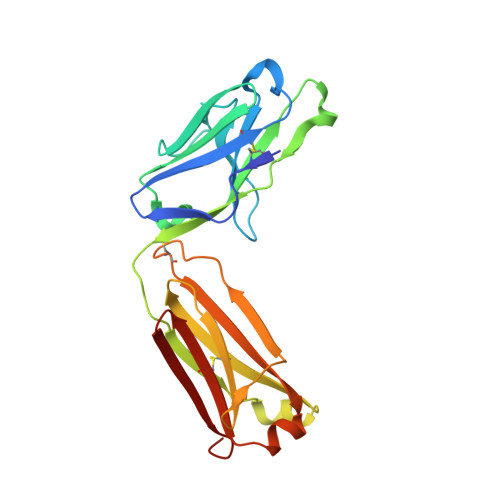
Context-independent anti-hypusine antibody FabHpu24.B in complex with hypusine


Experimental Data Snapshot

  • Method: X-RAY DIFFRACTION
  • Resolution: 2.40 Å
  • R-Value Free: 
    0.248 (Depositor), 0.248 (DCC) 
  • R-Value Work: 
    0.207 (Depositor), 0.209 (DCC) 
  • R-Value Observed: 
    0.209 (Depositor) 

Starting Model: experimental
View more details

wwPDB Validation 3D Report Full Report

Validation slider image for 5DSC

This is version 2.2 of the entry. See complete history

Literature

Structural Analysis and Optimization of Context-Independent Anti-Hypusine Antibodies.

Zhai, Q.He, M.Song, A.Deshayes, K.Dixit, V.M.Carter, P.J.

(2016) J Mol Biology 428: 603-617

  • DOI: https://doi.org/10.1016/j.jmb.2016.01.006
  • Primary Citation Related Structures: 
    5DRN, 5DS8, 5DSC, 5DTF, 5DUB

  • PubMed Abstract: 

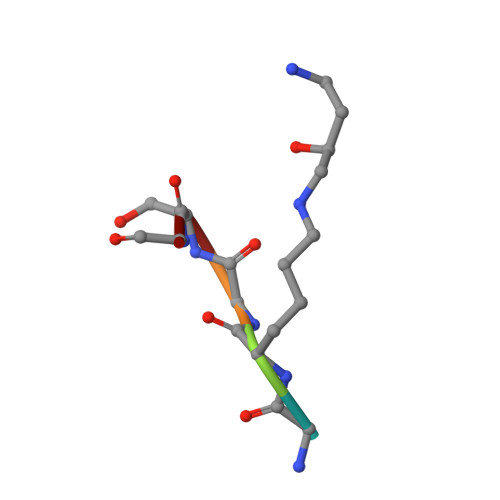
    Context-independent anti-hypusine antibodies that bind to the post-translational modification (PTM), hypusine, with minimal dependence on flanking amino acid sequences, were identified. The antibodies bind to both hypusine and deoxyhypusine or selectively to hypusine but not to deoxyhypusine. Phage display was used to further enhance the affinity of the antibodies. Affinity maturation of these anti-hypusine antibodies improved their performance in affinity capture of the only currently known hypusinated protein, eukaryotic translation initiation factor 5A. These anti-hypusine antibodies may have utility in the identification of novel hypusinated proteins. Crystal structures of the corresponding Fab fragments were determined in complex with hypusine- or deoxyhypusine-containing peptides. The hypusine or deoxyhypusine moiety was found to reside in a deep pocket formed between VH and VL domains of the Fab fragments. Interaction between the antibodies and hypusine includes an extensive hydrogen bond network. These are, to our knowledge, the first reported structures of context-independent anti-PTM antibodies in complex with the corresponding PTM.


  • Organizational Affiliation
    • Department of Antibody Engineering, Genentech Inc., 1 DNA Way, South San Francisco, CA 94080, USA.

Macromolecule Content 

  • Total Structure Weight: 188.08 kDa 
  • Atom Count: 13,055 
  • Modeled Residue Count: 1,710 
  • Deposited Residue Count: 1,776 
  • Unique protein chains: 3

Macromolecules

Find similar proteins by:|  3D Structure
Entity ID: 1
MoleculeChains  Sequence LengthOrganismDetailsImage
Fab Hpu24.B Heavy ChainA,
C,
E,
G [auth H]
224Oryctolagus cuniculusMutation(s): 0 
Find similar proteins by:|  3D Structure
Entity ID: 2
MoleculeChains  Sequence LengthOrganismDetailsImage
Fab Hou24.B Light ChainB,
D,
F,
H [auth L]
215Oryctolagus cuniculusMutation(s): 0 
Find similar proteins by:  Sequence   |   3D Structure  
Entity ID: 3
MoleculeChains  Sequence LengthOrganismDetailsImage
Peptide: GLY-HPU-GLY-SER-GLYI [auth P],
J [auth Q],
K [auth M],
L [auth N]
5synthetic constructMutation(s): 0 

Small Molecules

Modified Residues  2 Unique
IDChains TypeFormula2D DiagramParent
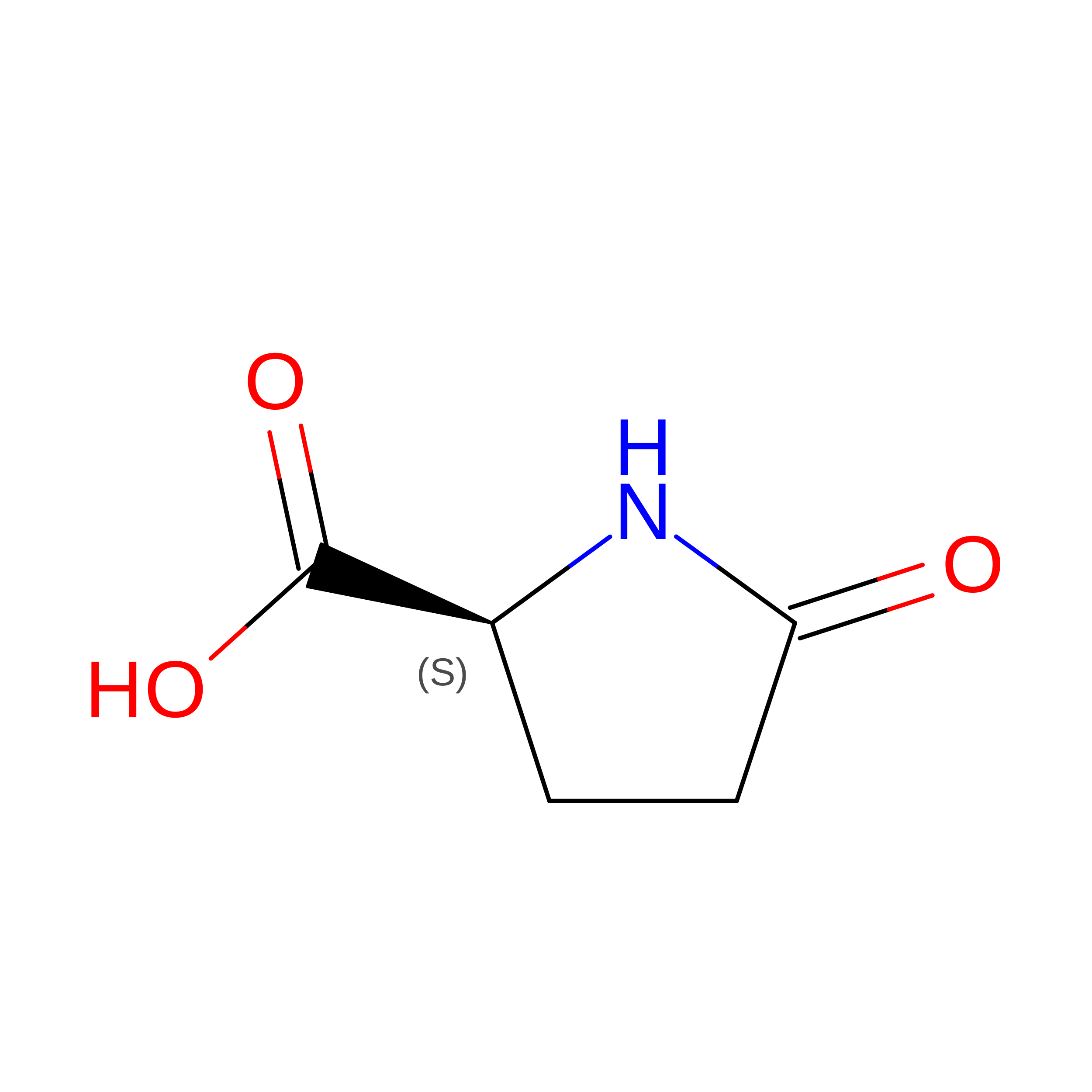
PCA
Query on PCA
A,
C,
E,
G [auth H]
L-PEPTIDE LINKINGC5 H7 N O3GLN
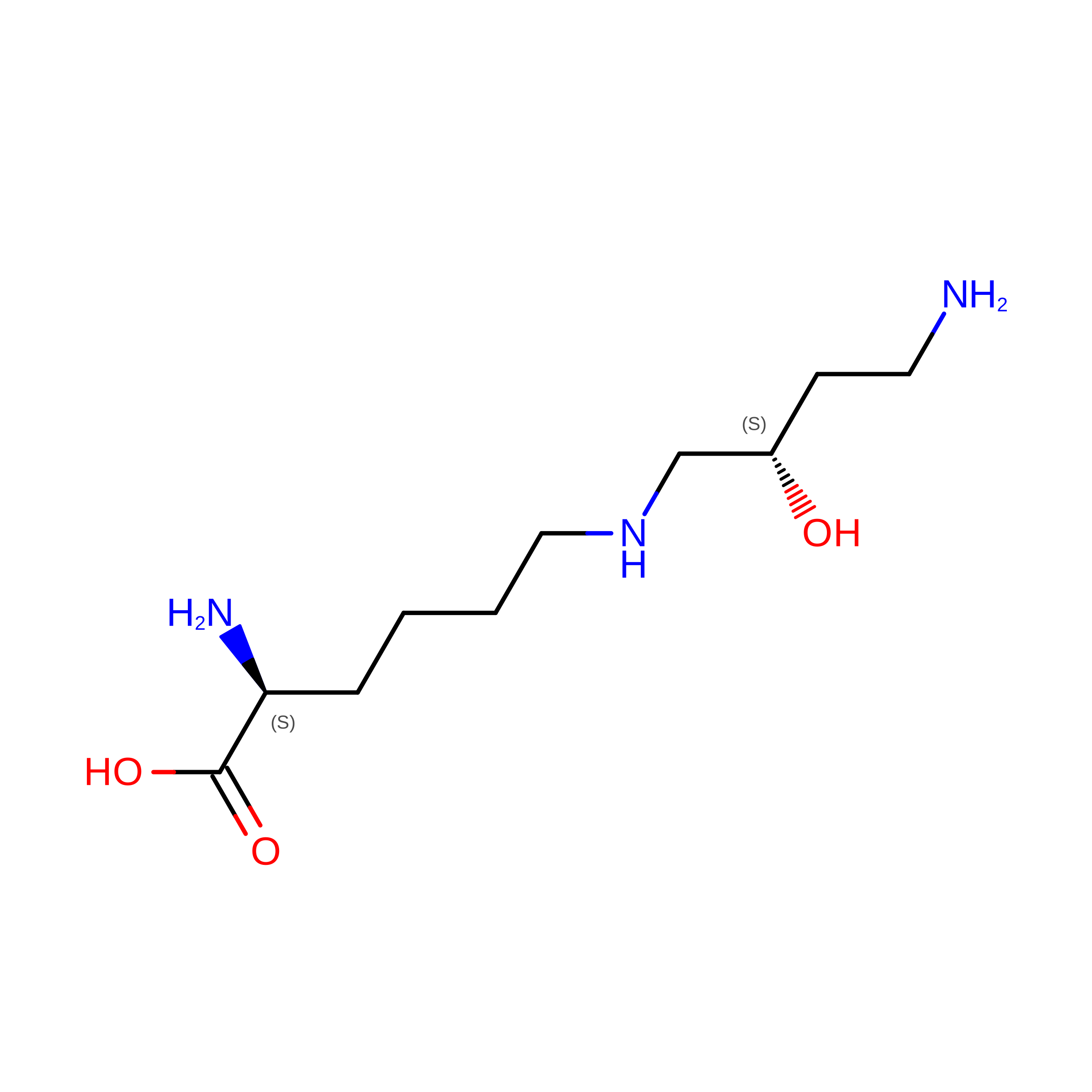
5CT
Query on 5CT
I [auth P],
J [auth Q],
K [auth M],
L [auth N]
PEPTIDE LINKINGC10 H23 N3 O3LYS

Experimental Data & Validation

Experimental Data

  • Method: X-RAY DIFFRACTION
  • Resolution: 2.40 Å
  • R-Value Free:  0.248 (Depositor), 0.248 (DCC) 
  • R-Value Work:  0.207 (Depositor), 0.209 (DCC) 
  • R-Value Observed: 0.209 (Depositor) 
Space Group: P 1 21 1
Unit Cell:
Length ( Å )Angle ( ˚ )
a = 69.082α = 90
b = 167.945β = 99.68
c = 84.927γ = 90
Software Package:
Software NamePurpose
HKL-2000data reduction
HKL-2000data scaling
PHENIXrefinement
PDB_EXTRACTdata extraction

Structure Validation

View Full Validation Report


Entry History 

Deposition Data

Revision History  (Full details and data files)

  • Version 1.0: 2016-01-20
    Type: Initial release
  • Version 1.1: 2016-02-03
    Changes: Database references
  • Version 1.2: 2016-03-02
    Changes: Database references
  • Version 1.3: 2016-05-04
    Changes: Non-polymer description
  • Version 2.0: 2023-09-27
    Changes: Data collection, Database references, Derived calculations, Polymer sequence, Refinement description
  • Version 2.1: 2023-11-15
    Changes: Data collection, Derived calculations
  • Version 2.2: 2024-11-06
    Changes: Structure summary