5DQ8 | pdb_00005dq8

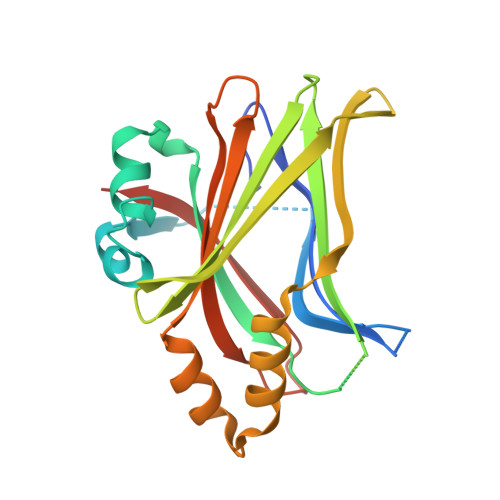
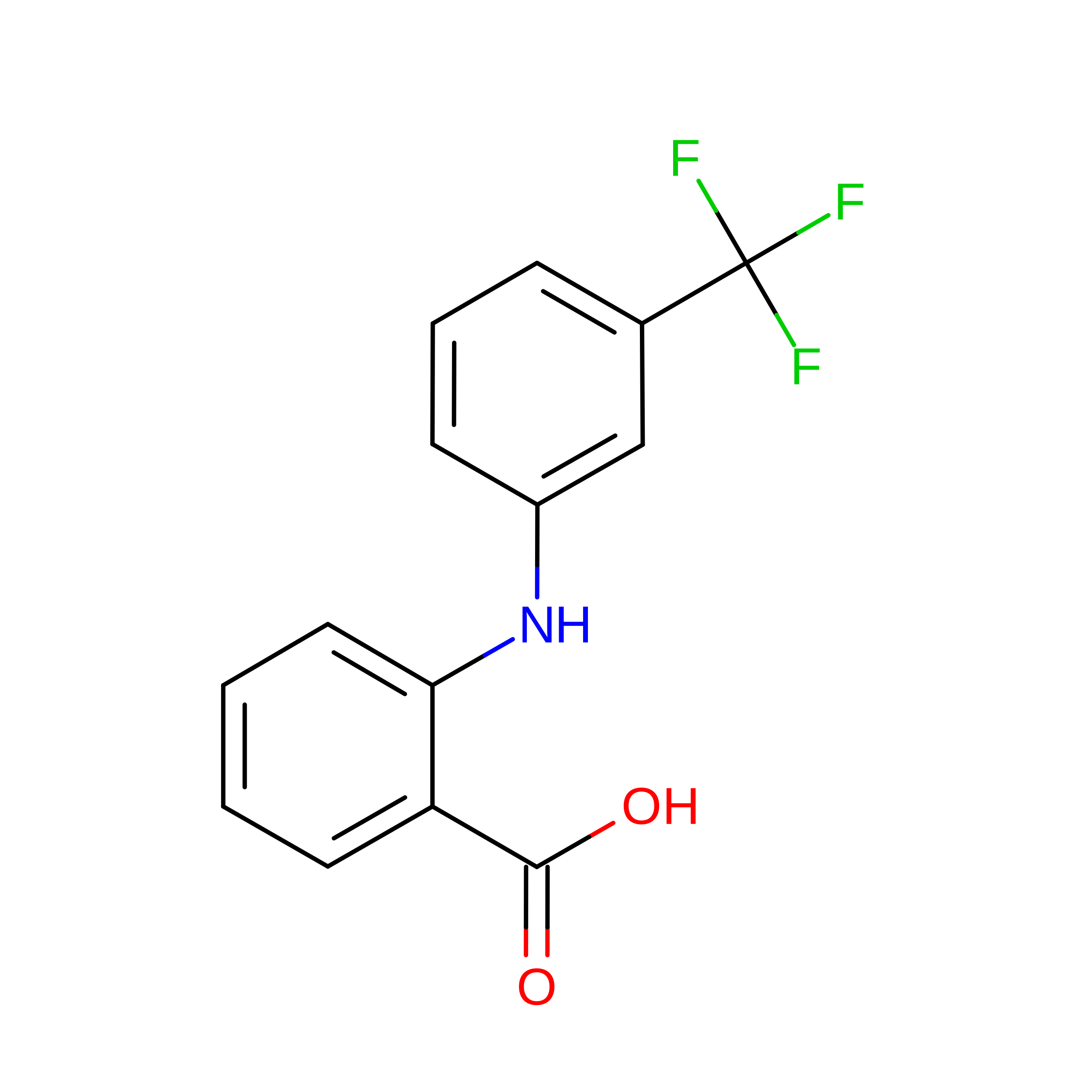
Crystal structure of human transcription factor TEAD2 in complex with flufenamic acid


Experimental Data Snapshot

  • Method: X-RAY DIFFRACTION
  • Resolution: 2.31 Å
  • R-Value Free: 
    0.232 (Depositor), 0.235 (DCC) 
  • R-Value Work: 
    0.171 (Depositor), 0.174 (DCC) 
  • R-Value Observed: 
    0.173 (Depositor) 

Starting Model: experimental
View more details

wwPDB Validation 3D Report Full Report

Validation slider image for 5DQ8

Ligand Structure Quality Assessment 


This is version 1.4 of the entry. See complete history

Literature

Targeting the Central Pocket in Human Transcription Factor TEAD as a Potential Cancer Therapeutic Strategy.

Pobbati, A.V.Han, X.Hung, A.W.Weiguang, S.Huda, N.Chen, G.Y.Kang, C.Chia, C.S.Luo, X.Hong, W.Poulsen, A.

(2015) Structure 23: 2076-2086

  • DOI: https://doi.org/10.1016/j.str.2015.09.009
  • Primary Citation Related Structures: 
    5DQ8, 5DQE

  • PubMed Abstract: 

    The human TEAD family of transcription factors (TEAD1-4) is required for YAP-mediated transcription in the Hippo pathway. Hyperactivation of TEAD's co-activator YAP contributes to tissue overgrowth and human cancers, suggesting that pharmacological interference of TEAD-YAP activity may be an effective strategy for anticancer therapy. Here we report the discovery of a central pocket in the YAP-binding domain (YBD) of TEAD that is targetable by small-molecule inhibitors. Our X-ray crystallography studies reveal that flufenamic acid, a non-steroidal anti-inflammatory drug (NSAID), binds to the central pocket of TEAD2 YBD. Our biochemical and functional analyses further demonstrate that binding of NSAIDs to TEAD inhibits TEAD-YAP-dependent transcription, cell migration, and proliferation, indicating that the central pocket is important for TEAD function. Therefore, our studies discover a novel way of targeting TEAD transcription factors and set the stage for therapeutic development of specific TEAD-YAP inhibitors against human cancers.


  • Organizational Affiliation
    • Institute of Molecular and Cell Biology, A(∗)STAR, 61 Biopolis Drive, Singapore 138673, Singapore. Electronic address: ajaybabuvp@imcb.a-star.edu.sg.

Macromolecule Content 

  • Total Structure Weight: 55.82 kDa 
  • Atom Count: 3,446 
  • Modeled Residue Count: 401 
  • Deposited Residue Count: 480 
  • Unique protein chains: 1

Macromolecules

Find similar proteins by:|  3D Structure
Entity ID: 1
MoleculeChains  Sequence LengthOrganismDetailsImage
Transcriptional enhancer factor TEF-4
A, B
240Homo sapiensMutation(s): 0 
Gene Names: TEAD2TEF4
UniProt & NIH Common Fund Data Resources
Find proteins for Q15562 (Homo sapiens)
Explore Q15562 
Go to UniProtKB:  Q15562
PHAROS:  Q15562
GTEx:  ENSG00000074219 
Entity Groups
Sequence Clusters30% Identity50% Identity70% Identity90% Identity95% Identity100% Identity
UniProt GroupQ15562
Sequence Annotations
Expand
Reference Sequence

Small Molecules

Binding Affinity Annotations 
IDSourceBinding Affinity
FLF BindingDB:  5DQ8 Kd: 7.30e+4 (nM) from 1 assay(s)

Experimental Data & Validation

Experimental Data

  • Method: X-RAY DIFFRACTION
  • Resolution: 2.31 Å
  • R-Value Free:  0.232 (Depositor), 0.235 (DCC) 
  • R-Value Work:  0.171 (Depositor), 0.174 (DCC) 
  • R-Value Observed: 0.173 (Depositor) 
Space Group: C 1 2 1
Unit Cell:
Length ( Å )Angle ( ˚ )
a = 120.819α = 90
b = 61.446β = 117.55
c = 80.416γ = 90
Software Package:
Software NamePurpose
PHENIXrefinement
Cootmodel building
HKL-3000phasing
PHASERphasing
HKL-3000data reduction
HKL-3000data scaling

Structure Validation

View Full Validation Report


Ligand Structure Quality Assessment 


Entry History 

& Funding Information

Deposition Data


Funding OrganizationLocationGrant Number
National Institutes of Health/National Institute of General Medical Sciences (NIH/NIGMS)United StatesR01GM107415

Revision History  (Full details and data files)

  • Version 1.0: 2015-11-25
    Type: Initial release
  • Version 1.1: 2017-09-20
    Changes: Author supporting evidence, Database references, Derived calculations, Refinement description
  • Version 1.2: 2018-05-16
    Changes: Data collection, Database references
  • Version 1.3: 2019-12-25
    Changes: Author supporting evidence
  • Version 1.4: 2023-09-27
    Changes: Data collection, Database references, Refinement description