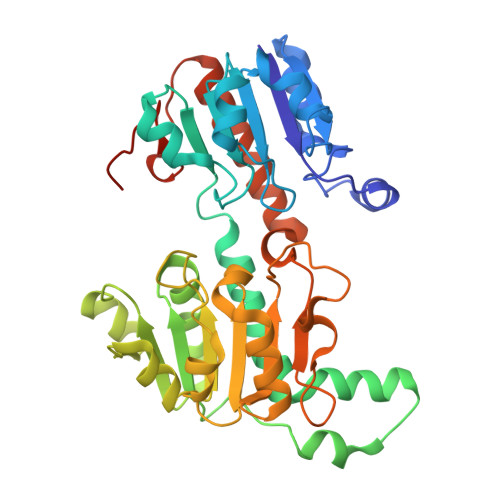
5DNA | pdb_00005dna

Crystal structure of Candida boidinii formate dehydrogenase


Experimental Data Snapshot

  • Method: X-RAY DIFFRACTION
  • Resolution: 1.75 Å
  • R-Value Free: 
    0.182 (Depositor), 0.183 (DCC) 
  • R-Value Work: 
    0.143 (Depositor), 0.145 (DCC) 
  • R-Value Observed: 
    0.145 (Depositor) 

Starting Model: experimental
View more details

wwPDB Validation 3D Report Full Report

Validation slider image for 5DNA

This is version 1.2 of the entry. See complete history

Literature

Structural and Kinetic Studies of Formate Dehydrogenase from Candida boidinii.

Guo, Q.Gakhar, L.Wickersham, K.Francis, K.Vardi-Kilshtain, A.Major, D.T.Cheatum, C.M.Kohen, A.

(2016) Biochemistry 55: 2760-2771

  • DOI: https://doi.org/10.1021/acs.biochem.6b00181
  • Primary Citation Related Structures: 
    5DN9, 5DNA

  • PubMed Abstract: 

    The structure of formate dehydrogenase from Candida boidinii (CbFDH) is of both academic and practical interests. First, this enzyme represents a unique model system for studies on the role of protein dynamics in catalysis, but so far these studies have been limited by the availability of structural information. Second, CbFDH and its mutants can be used in various industrial applications (e.g., CO2 fixation or nicotinamide recycling systems), and the lack of structural information has been a limiting factor in commercial development. Here, we report the crystallization and structural determination of both holo- and apo-CbFDH. The free-energy barrier for the catalyzed reaction was computed and indicates that this structure indeed represents a catalytically competent form of the enzyme. Complementing kinetic examinations demonstrate that the recombinant CbFDH has a well-organized reactive state. Finally, a fortuitous observation has been made: the apoenzyme crystal was obtained under cocrystallization conditions with a saturating concentration of both the cofactor (NAD(+)) and inhibitor (azide), which has a nanomolar dissociation constant. It was found that the fraction of the apoenzyme present in the solution is less than 1.7 × 10(-7) (i.e., the solution is 99.9999% holoenzyme). This is an extreme case where the crystal structure represents an insignificant fraction of the enzyme in solution, and a mechanism rationalizing this phenomenon is presented.


  • Organizational Affiliation
    • Department of Chemistry, University of Iowa , Iowa City, Iowa 52242, United States.

Macromolecule Content 

  • Total Structure Weight: 161.94 kDa 
  • Atom Count: 12,881 
  • Modeled Residue Count: 1,415 
  • Deposited Residue Count: 1,456 
  • Unique protein chains: 1

Macromolecules

Find similar proteins by:|  3D Structure
Entity ID: 1
MoleculeChains  Sequence LengthOrganismDetailsImage
FORMATE DEHYDROGENASE
A, B, C, D
364[Candida] boidiniiMutation(s): 0 
Gene Names: FDH
EC: 1.2.1.2 (PDB Primary Data), 1.17.1.9 (UniProt)
UniProt
Find proteins for A0A0A1EQY0 (Candida boidinii)
Explore A0A0A1EQY0 
Go to UniProtKB:  A0A0A1EQY0
Entity Groups
Sequence Clusters30% Identity50% Identity70% Identity90% Identity95% Identity100% Identity
UniProt GroupA0A0A1EQY0
Sequence Annotations
Expand
Reference Sequence

Experimental Data & Validation

Experimental Data

  • Method: X-RAY DIFFRACTION
  • Resolution: 1.75 Å
  • R-Value Free:  0.182 (Depositor), 0.183 (DCC) 
  • R-Value Work:  0.143 (Depositor), 0.145 (DCC) 
  • R-Value Observed: 0.145 (Depositor) 
Space Group: P 1
Unit Cell:
Length ( Å )Angle ( ˚ )
a = 53.711α = 78.11
b = 68.514β = 89.66
c = 109.458γ = 81.24
Software Package:
Software NamePurpose
PHENIXrefinement
REFMACrefinement
Cootmodel building
XDSdata reduction
PHASERphasing
StructureStudiodata collection
SCALAdata scaling

Structure Validation

View Full Validation Report


Entry History 

Deposition Data

Revision History  (Full details and data files)

  • Version 1.0: 2016-05-04
    Type: Initial release
  • Version 1.1: 2016-05-25
    Changes: Database references
  • Version 1.2: 2023-09-27
    Changes: Data collection, Database references, Derived calculations, Refinement description