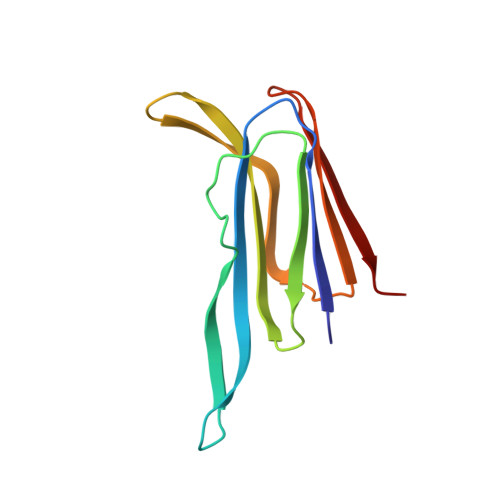
5CR8 | pdb_00005cr8

Structure of the membrane-binding domain of pneumolysin


Experimental Data Snapshot

  • Method: X-RAY DIFFRACTION
  • Resolution: 2.05 Å
  • R-Value Free: 
    0.273 (Depositor), 0.272 (DCC) 
  • R-Value Work: 
    0.224 (Depositor), 0.231 (DCC) 
  • R-Value Observed: 
    0.226 (Depositor) 

Starting Model: experimental
View more details

wwPDB Validation 3D Report Full Report

Validation slider image for 5CR8

This is version 1.1 of the entry. See complete history

Literature

The Crystal Structure of Pneumolysin at 2.0 angstrom Resolution Reveals the Molecular Packing of the Pre-pore Complex.

Marshall, J.E.Faraj, B.H.Gingras, A.R.Lonnen, R.Sheikh, M.A.El-Mezgueldi, M.Moody, P.C.Andrew, P.W.Wallis, R.

(2015) Sci Rep 5: 13293-13293

  • DOI: https://doi.org/10.1038/srep13293
  • Primary Citation Related Structures: 
    5CR6, 5CR8

  • PubMed Abstract: 

    Pneumolysin is a cholesterol-dependent cytolysin (CDC) and virulence factor of Streptococcus pneumoniae. It kills cells by forming pores assembled from oligomeric rings in cholesterol-containing membranes. Cryo-EM has revealed the structures of the membrane-surface bound pre-pore and inserted-pore oligomers, however the molecular contacts that mediate these oligomers are unknown because high-resolution information is not available. Here we have determined the crystal structure of full-length pneumolysin at 1.98 Å resolution. In the structure, crystal contacts demonstrate the likely interactions that enable polymerisation on the cell membrane and the molecular packing of the pre-pore complex. The hemolytic activity is abrogated in mutants that disrupt these intermolecular contacts, highlighting their importance during pore formation. An additional crystal structure of the membrane-binding domain alone suggests that changes in the conformation of a tryptophan rich-loop at the base of the toxin promote monomer-monomer interactions upon membrane binding by creating new contacts. Notably, residues at the interface are conserved in other members of the CDC family, suggesting a common mechanism for pore and pre-pore assembly.


  • Organizational Affiliation
    • Department of Infection, Immunity and Inflammation, University of Leicester, PO Box 138, Leicester, LE1 9HN UK.

Macromolecule Content 

  • Total Structure Weight: 26.43 kDa 
  • Atom Count: 2,035 
  • Modeled Residue Count: 226 
  • Deposited Residue Count: 226 
  • Unique protein chains: 1

Macromolecules

Find similar proteins by:|  3D Structure
Entity ID: 1
MoleculeChains  Sequence LengthOrganismDetailsImage
PneumolysinA [auth D],
B [auth A]
113Streptococcus pneumoniaeMutation(s): 0 
Gene Names: ply
Membrane Entity: Yes 
UniProt
Find proteins for Q04IN8 (Streptococcus pneumoniae serotype 2 (strain D39 / NCTC 7466))
Explore Q04IN8 
Go to UniProtKB:  Q04IN8
Entity Groups
Sequence Clusters30% Identity50% Identity70% Identity90% Identity95% Identity100% Identity
UniProt GroupQ04IN8
Sequence Annotations
Expand
Reference Sequence

Experimental Data & Validation

Experimental Data

  • Method: X-RAY DIFFRACTION
  • Resolution: 2.05 Å
  • R-Value Free:  0.273 (Depositor), 0.272 (DCC) 
  • R-Value Work:  0.224 (Depositor), 0.231 (DCC) 
  • R-Value Observed: 0.226 (Depositor) 
Space Group: I 1 2 1
Unit Cell:
Length ( Å )Angle ( ˚ )
a = 48.68α = 90
b = 47.68β = 101.39
c = 97.539γ = 90
Software Package:
Software NamePurpose
Aimlessdata scaling
PHASERphasing
PHENIXrefinement
PDB_EXTRACTdata extraction
XDSdata reduction

Structure Validation

View Full Validation Report


Entry History 

Deposition Data

Revision History  (Full details and data files)

  • Version 1.0: 2015-09-16
    Type: Initial release
  • Version 1.1: 2024-01-10
    Changes: Data collection, Database references, Refinement description