5C6E | pdb_00005c6e

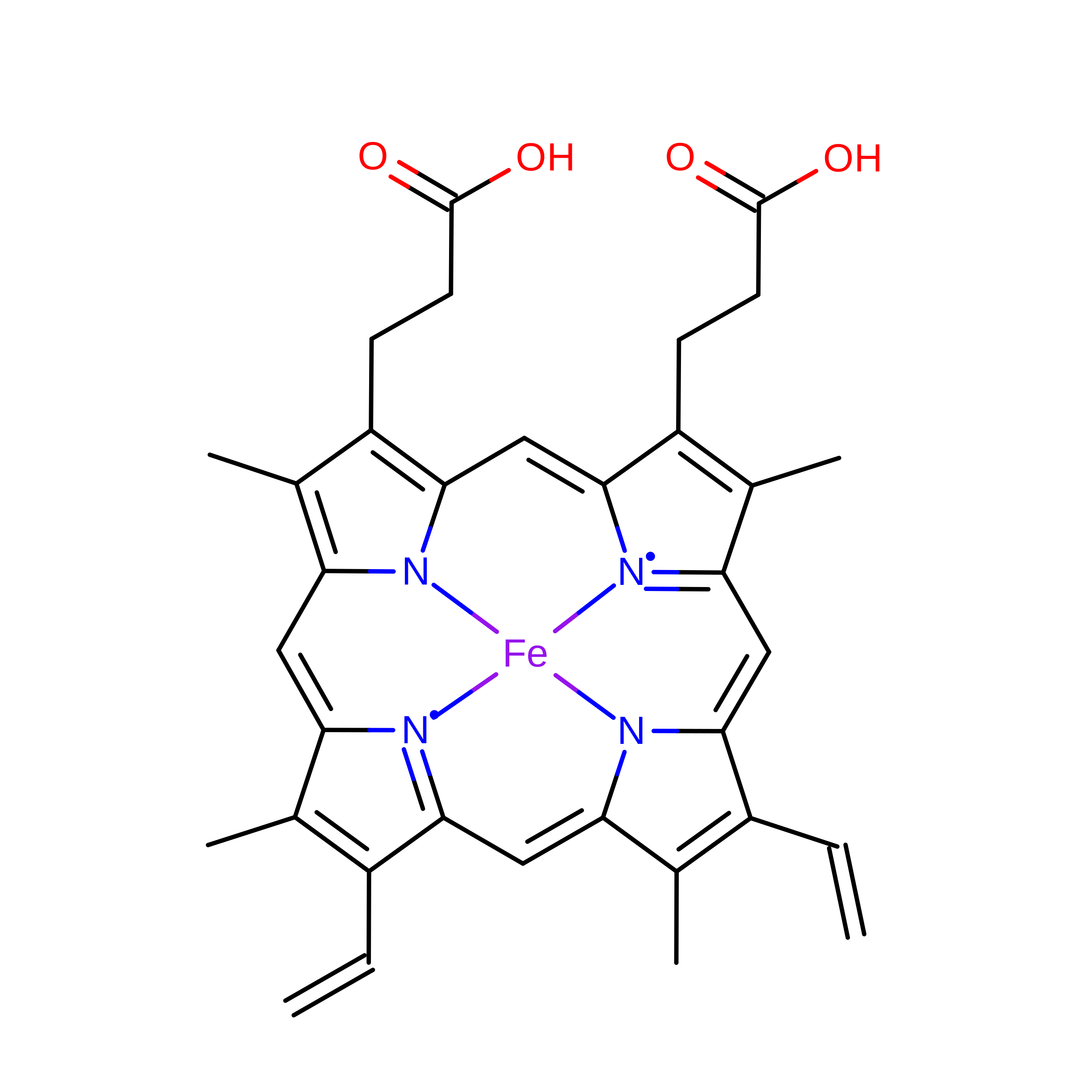
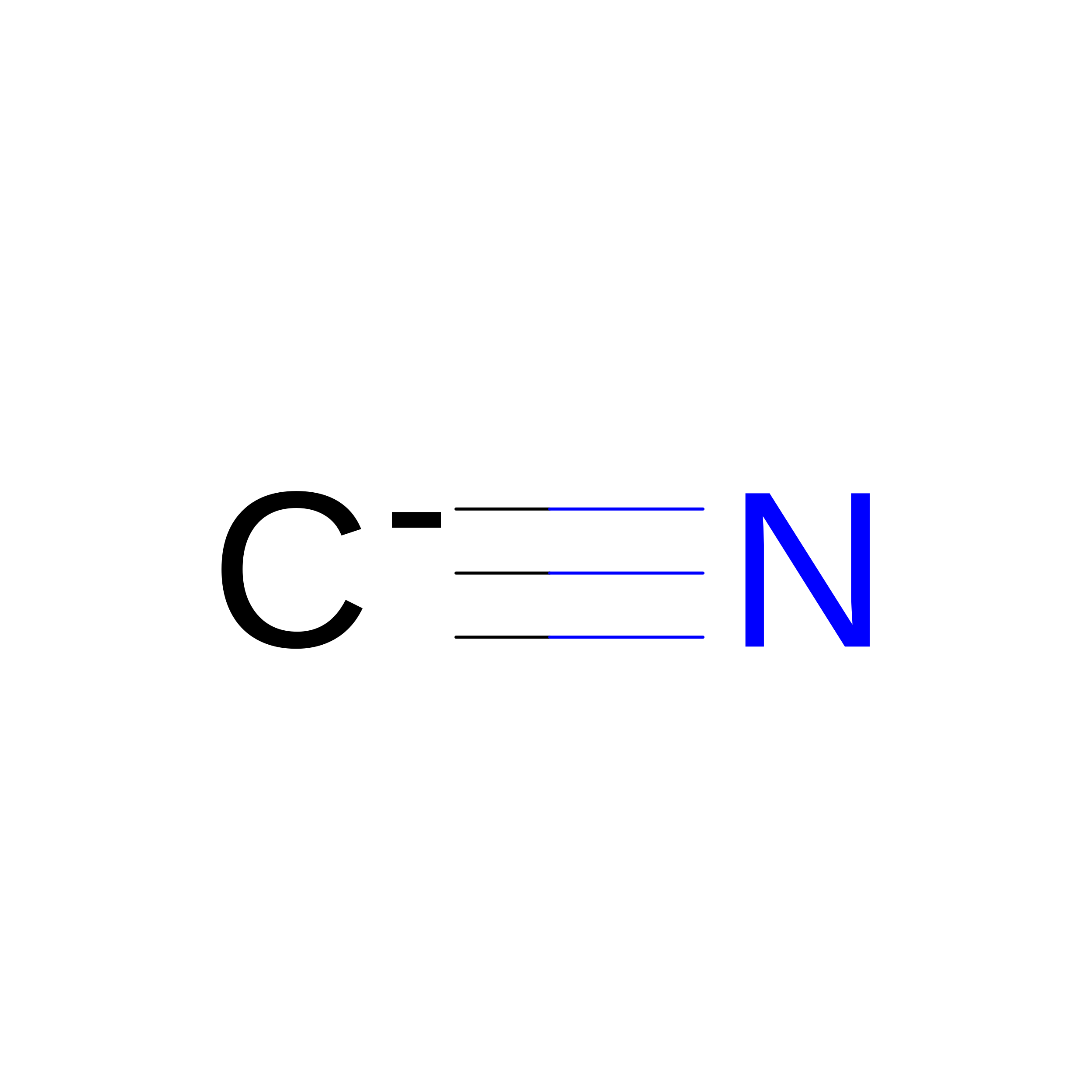
Joint X-ray/neutron structure of equine cyanomet hemoglobin in R state


Experimental Data Snapshot

  • Method: X-RAY DIFFRACTION
  • Resolution: 1.70 Å
  • R-Value Free: 
    0.233 (Depositor), 0.219 (DCC) 
  • R-Value Work: 
    0.210 (Depositor), 0.196 (DCC) 

  • Method: NEUTRON DIFFRACTION
  • Resolution: 2.00 Å
  • R-Value Free: 
    0.334 (Depositor) 
  • R-Value Work: 
    0.301 (Depositor) 

wwPDB Validation 3D Report Full Report

Currently 5C6E does not have a validation slider image.


This is version 1.6 of the entry. See complete history

Literature

Visualizing the Bohr effect in hemoglobin: neutron structure of equine cyanomethemoglobin in the R state and comparison with human deoxyhemoglobin in the T state.

Dajnowicz, S.Seaver, S.Hanson, B.L.Fisher, S.Z.Langan, P.Kovalevsky, A.Y.Mueser, T.C.

(2016) Acta Crystallogr D Struct Biol 72: 892-903

  • DOI: https://doi.org/10.1107/S2059798316009049
  • Primary Citation Related Structures: 
    5C6E

  • PubMed Abstract: 

    Neutron crystallography provides direct visual evidence of the atomic positions of deuterium-exchanged H atoms, enabling the accurate determination of the protonation/deuteration state of hydrated biomolecules. Comparison of two neutron structures of hemoglobins, human deoxyhemoglobin (T state) and equine cyanomethemoglobin (R state), offers a direct observation of histidine residues that are likely to contribute to the Bohr effect. Previous studies have shown that the T-state N-terminal and C-terminal salt bridges appear to have a partial instead of a primary overall contribution. Four conserved histidine residues [αHis72(EF1), αHis103(G10), αHis89(FG1), αHis112(G19) and βHis97(FG4)] can become protonated/deuterated from the R to the T state, while two histidine residues [αHis20(B1) and βHis117(G19)] can lose a proton/deuteron. αHis103(G10), located in the α1:β1 dimer interface, appears to be a Bohr group that undergoes structural changes: in the R state it is singly protonated/deuterated and hydrogen-bonded through a water network to βAsn108(G10) and in the T state it is doubly protonated/deuterated with the network uncoupled. The very long-term H/D exchange of the amide protons identifies regions that are accessible to exchange as well as regions that are impermeable to exchange. The liganded relaxed state (R state) has comparable levels of exchange (17.1% non-exchanged) compared with the deoxy tense state (T state; 11.8% non-exchanged). Interestingly, the regions of non-exchanged protons shift from the tetramer interfaces in the T-state interface (α1:β2 and α2:β1) to the cores of the individual monomers and to the dimer interfaces (α1:β1 and α2:β2) in the R state. The comparison of regions of stability in the two states allows a visualization of the conservation of fold energy necessary for ligand binding and release.


  • Organizational Affiliation
    • Department of Chemistry and Biochemistry, University of Toledo, Toledo, Ohio, USA.

Macromolecule Content 

  • Total Structure Weight: 32.46 kDa 
  • Atom Count: 2,416 
  • Modeled Residue Count: 287 
  • Deposited Residue Count: 287 
  • Unique protein chains: 2

Macromolecules

Find similar proteins by:|  3D Structure
Entity ID: 1
MoleculeChains  Sequence LengthOrganismDetailsImage
Hemoglobin subunit alpha141Equus caballusMutation(s): 0 
UniProt
Find proteins for P01958 (Equus caballus)
Explore P01958 
Go to UniProtKB:  P01958
Entity Groups
Sequence Clusters30% Identity50% Identity70% Identity90% Identity95% Identity100% Identity
UniProt GroupP01958
Sequence Annotations
Expand
Reference Sequence
Find similar proteins by:|  3D Structure
Entity ID: 2
MoleculeChains  Sequence LengthOrganismDetailsImage
Hemoglobin subunit beta146Equus caballusMutation(s): 0 
UniProt
Find proteins for P02062 (Equus caballus)
Explore P02062 
Go to UniProtKB:  P02062
Entity Groups
Sequence Clusters30% Identity50% Identity70% Identity90% Identity95% Identity100% Identity
UniProt GroupP02062
Sequence Annotations
Expand
Reference Sequence

Experimental Data & Validation

Experimental Data

  • Method: X-RAY DIFFRACTION
  • Resolution: 1.70 Å
  • R-Value Free:  0.233 (Depositor), 0.219 (DCC) 
  • R-Value Work:  0.210 (Depositor), 0.196 (DCC) 
  • Method: NEUTRON DIFFRACTION
  • Resolution: 2.00 Å
  • R-Value Free:  0.334 (Depositor) 
  • R-Value Work:  0.301 (Depositor) 
Space Group: C 1 2 1
Unit Cell:
Length ( Å )Angle ( ˚ )
a = 108.86α = 90
b = 63.16β = 110.75
c = 54.71γ = 90
Software Package:
Software NamePurpose
MOSFLMdata reduction
SCALAdata scaling
CNSphasing
nCNSrefinement

Structure Validation

View Full Validation Report

Currently 5C6E does not have a validation slider image.


Entry History 

& Funding Information

Deposition Data


Funding OrganizationLocationGrant Number
National Institutes of Health/National Institute of General Medical Sciences (NIH/NIGMS)United States1R01GM071939-01
National Science Foundation (NSF, United States)United States446218

Revision History  (Full details and data files)

  • Version 1.0: 2016-06-22
    Type: Initial release
  • Version 1.1: 2016-07-13
    Changes: Database references
  • Version 1.2: 2017-09-20
    Changes: Author supporting evidence, Derived calculations, Refinement description
  • Version 1.3: 2018-04-25
    Changes: Data collection
  • Version 1.4: 2019-11-27
    Changes: Author supporting evidence
  • Version 1.5: 2024-03-06
    Changes: Data collection, Database references
  • Version 1.6: 2025-11-12
    Changes: Data collection, Structure summary