5C5Y | pdb_00005c5y

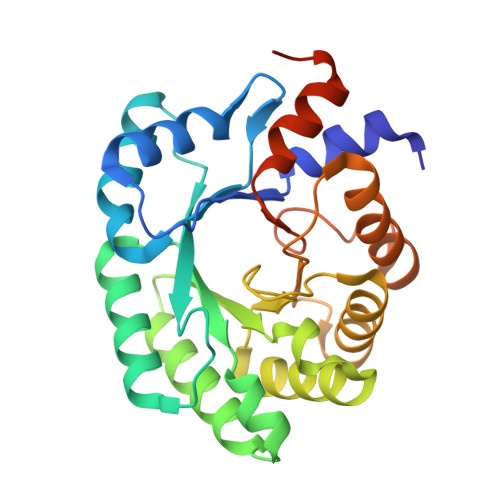
Crystal structure of deoxyribose-phosphate aldolase from Colwellia psychrerythraea (hexagonal form)


Experimental Data Snapshot

  • Method: X-RAY DIFFRACTION
  • Resolution: 2.10 Å
  • R-Value Free: 
    0.199 (Depositor), 0.202 (DCC) 
  • R-Value Work: 
    0.173 (Depositor), 0.177 (DCC) 
  • R-Value Observed: 
    0.174 (Depositor) 

Starting Model: experimental
View more details

wwPDB Validation 3D Report Full Report

Validation slider image for 5C5Y

This is version 1.2 of the entry. See complete history

Literature

Trading off stability against activity in extremophilic aldolases.

Dick, M.Weiergraber, O.H.Classen, T.Bisterfeld, C.Bramski, J.Gohlke, H.Pietruszka, J.

(2016) Sci Rep 6: 17908-17908

  • DOI: https://doi.org/10.1038/srep17908
  • Primary Citation Related Structures: 
    5C2X, 5C5Y, 5C6M

  • PubMed Abstract: 

    Understanding enzyme stability and activity in extremophilic organisms is of great biotechnological interest, but many questions are still unsolved. Using 2-deoxy-D-ribose-5-phosphate aldolase (DERA) as model enzyme, we have evaluated structural and functional characteristics of different orthologs from psychrophilic, mesophilic and hyperthermophilic organisms. We present the first crystal structures of psychrophilic DERAs, revealing a dimeric organization resembling their mesophilic but not their thermophilic counterparts. Conversion into monomeric proteins showed that the native dimer interface contributes to stability only in the hyperthermophilic enzymes. Nevertheless, introduction of a disulfide bridge in the interface of a psychrophilic DERA did confer increased thermostability, suggesting a strategy for rational design of more durable enzyme variants. Constraint network analysis revealed particularly sparse interactions between the substrate pocket and its surrounding α-helices in psychrophilic DERAs, which indicates that a more flexible active center underlies their high turnover numbers.


  • Organizational Affiliation
    • Institute of Bioorganic Chemistry, Heinrich-Heine-Universität Düsseldorf im Forschungszentrum Jülich, and Bioeconomy Science Center (BioSC), Jülich, Germany.

Macromolecule Content 

  • Total Structure Weight: 113.69 kDa 
  • Atom Count: 7,875 
  • Modeled Residue Count: 986 
  • Deposited Residue Count: 1,052 
  • Unique protein chains: 1

Macromolecules

Find similar proteins by:|  3D Structure
Entity ID: 1
MoleculeChains  Sequence LengthOrganismDetailsImage
Deoxyribose-phosphate aldolase
A, B, C, D
263Colwellia psychrerythraea 34HMutation(s): 0 
Gene Names: deoCCPS_1972
EC: 4.1.2.4
UniProt
Find proteins for Q483R4 (Colwellia psychrerythraea (strain 34H / ATCC BAA-681))
Explore Q483R4 
Go to UniProtKB:  Q483R4
Entity Groups
Sequence Clusters30% Identity50% Identity70% Identity90% Identity95% Identity100% Identity
UniProt GroupQ483R4
Sequence Annotations
Expand
Reference Sequence

Experimental Data & Validation

Experimental Data

  • Method: X-RAY DIFFRACTION
  • Resolution: 2.10 Å
  • R-Value Free:  0.199 (Depositor), 0.202 (DCC) 
  • R-Value Work:  0.173 (Depositor), 0.177 (DCC) 
  • R-Value Observed: 0.174 (Depositor) 
Space Group: P 61 2 2
Unit Cell:
Length ( Å )Angle ( ˚ )
a = 115.84α = 90
b = 115.84β = 90
c = 400.1γ = 120
Software Package:
Software NamePurpose
XSCALEdata scaling
MOLREPphasing
PHENIXrefinement
XDSdata reduction

Structure Validation

View Full Validation Report


Entry History 

Deposition Data

Revision History  (Full details and data files)

  • Version 1.0: 2016-02-03
    Type: Initial release
  • Version 1.1: 2024-01-10
    Changes: Data collection, Database references, Refinement description
  • Version 1.2: 2025-10-01
    Changes: Advisory, Derived calculations, Structure summary