5B6G | pdb_00005b6g

Protein-protein interaction


Experimental Data Snapshot

  • Method: X-RAY DIFFRACTION
  • Resolution: 1.99 Å
  • R-Value Free: 
    0.215 (Depositor), 0.215 (DCC) 
  • R-Value Work: 
    0.170 (Depositor), 0.178 (DCC) 
  • R-Value Observed: 
    0.172 (Depositor) 

Starting Model: experimental
View more details

wwPDB Validation 3D Report Full Report

Validation slider image for 5B6G

This is version 1.2 of the entry. See complete history

Literature

Peptidomimetic inhibitors of APC-Asef interaction block colorectal cancer migration.

Jiang, H.Deng, R.Yang, X.Shang, J.Lu, S.Zhao, Y.Song, K.Liu, X.Zhang, Q.Chen, Y.Chinn, Y.E.Wu, G.Li, J.Chen, G.Yu, J.Zhang, J.

(2017) Nat Chem Biol 13: 994-1001

  • DOI: https://doi.org/10.1038/nchembio.2442
  • Primary Citation Related Structures: 
    5B6G, 5IZ6, 5IZ8, 5IZ9, 5IZA

  • PubMed Abstract: 

    The binding of adenomatous polyposis coli (APC) to its receptor Asef relieves the negative intramolecular regulation of Asef and leads to aberrant cell migration in human colorectal cancer. Because of its crucial role in metastatic dissemination, the interaction between APC and Asef is an attractive target for anti-colorectal-cancer therapy. We rationally designed a series of peptidomimetics that act as potent inhibitors of the APC interface. Crystal structures and biochemical and cellular assays showed that the peptidomimetics in the APC pocket inhibited the migration of colorectal cells by disrupting APC-Asef interaction. By using the peptidomimetic inhibitor as a chemical probe, we found that CDC42 was the downstream GTPase involved in APC-stimulated Asef activation in colorectal cancer cells. Our work demonstrates the feasibility of exploiting APC-Asef interaction to regulate the migration of colorectal cancer cells, and provides what to our knowledge is the first class of protein-protein interaction inhibitors available for the development of cancer therapeutics targeting APC-Asef signaling.


  • Organizational Affiliation
    • Department of Pathophysiology, Key Laboratory of Cell Differentiation and Apoptosis of Ministry of Education, Shanghai Jiao-Tong University School of Medicine, Shanghai, China.

Macromolecule Content 

  • Total Structure Weight: 40.38 kDa 
  • Atom Count: 2,969 
  • Modeled Residue Count: 340 
  • Deposited Residue Count: 363 
  • Unique protein chains: 2

Macromolecules

Find similar proteins by:|  3D Structure
Entity ID: 1
MoleculeChains  Sequence LengthOrganismDetailsImage
Adenomatous polyposis coli protein354Homo sapiensMutation(s): 0 
Gene Names: APCDP2.5
UniProt & NIH Common Fund Data Resources
Find proteins for P25054 (Homo sapiens)
Explore P25054 
Go to UniProtKB:  P25054
PHAROS:  P25054
GTEx:  ENSG00000134982 
Entity Groups
Sequence Clusters30% Identity50% Identity70% Identity90% Identity95% Identity100% Identity
UniProt GroupP25054
Sequence Annotations
Expand
Reference Sequence
Find similar proteins by:  Sequence   |   3D Structure  
Entity ID: 2
MoleculeChains  Sequence LengthOrganismDetailsImage
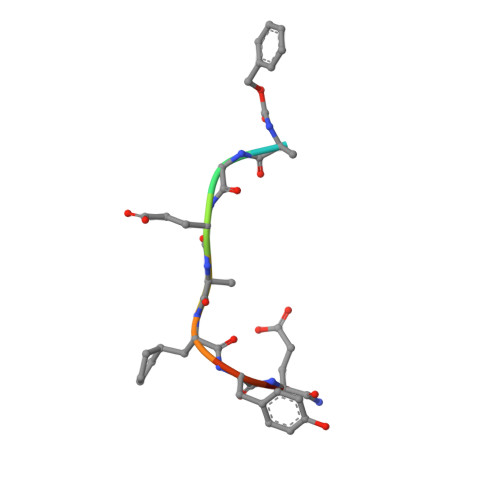
PHQ-ALA-GLY-GLU-ALA-XYC-TYR-GLU9Homo sapiensMutation(s): 0 

Small Molecules

Modified Residues  1 Unique
IDChains TypeFormula2D DiagramParent
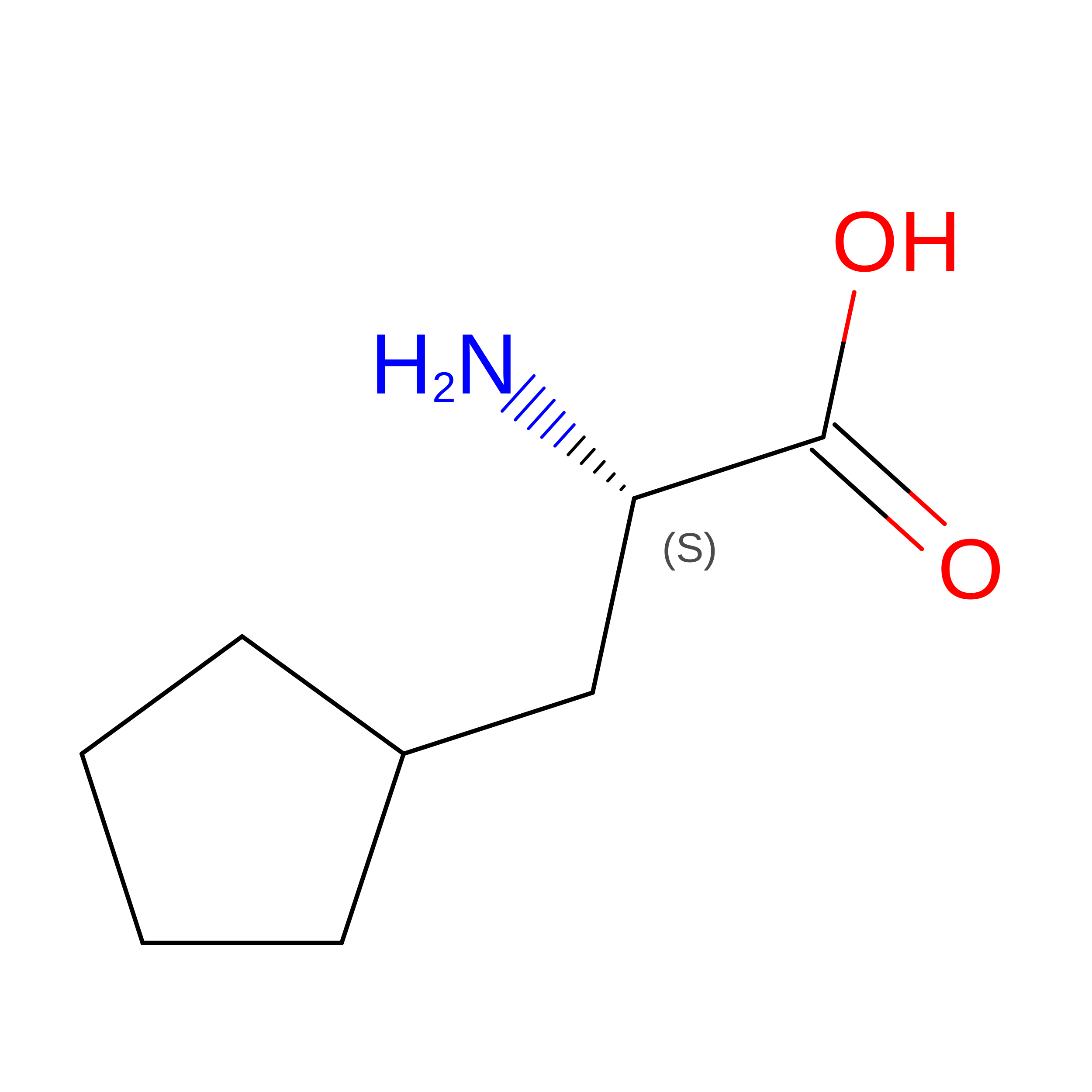
XYC
Query on XYC
B
L-PEPTIDE LINKINGC8 H15 N O2ALA

Experimental Data & Validation

Experimental Data

  • Method: X-RAY DIFFRACTION
  • Resolution: 1.99 Å
  • R-Value Free:  0.215 (Depositor), 0.215 (DCC) 
  • R-Value Work:  0.170 (Depositor), 0.178 (DCC) 
  • R-Value Observed: 0.172 (Depositor) 
Space Group: P 1 21 1
Unit Cell:
Length ( Å )Angle ( ˚ )
a = 51.448α = 90
b = 63.691β = 95.76
c = 52.641γ = 90
Software Package:
Software NamePurpose
REFMACrefinement
HKL-3000data reduction
HKL-3000data scaling
PHASERphasing

Structure Validation

View Full Validation Report


Entry History 

& Funding Information

Deposition Data


Funding OrganizationLocationGrant Number
National Natural Science Foundation of ChinaChina81322046, 81473137, 81302698

Revision History  (Full details and data files)

  • Version 1.0: 2017-05-31
    Type: Initial release
  • Version 1.1: 2019-01-23
    Changes: Data collection, Database references
  • Version 1.2: 2023-11-08
    Changes: Data collection, Database references, Refinement description