5B2H | pdb_00005b2h

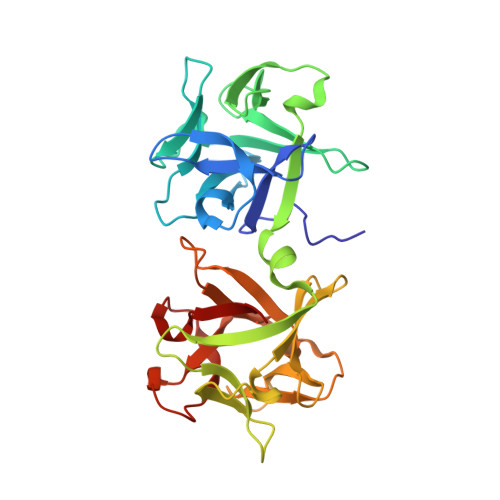
Crystal structure of HA33 from Clostridium botulinum serotype C strain Yoichi


Experimental Data Snapshot

  • Method: X-RAY DIFFRACTION
  • Resolution: 2.20 Å
  • R-Value Free: 
    0.213 (Depositor), 0.215 (DCC) 
  • R-Value Work: 
    0.184 (Depositor), 0.191 (DCC) 
  • R-Value Observed: 
    0.186 (Depositor) 

Starting Model: experimental
View more details

wwPDB Validation 3D Report Full Report

Validation slider image for 5B2H

This is version 1.3 of the entry. See complete history

Literature

Conformational divergence in the HA-33/HA-17 trimer of serotype C and D botulinum toxin complex

Sagane, Y.Hayashi, S.Akiyama, T.Matsumoto, T.Hasegawa, K.Yamano, A.Suzuki, T.Niwa, K.Watanabe, T.Yajima, S.

(2016) Biochem Biophys Res Commun 476: 280-285

  • DOI: https://doi.org/10.1016/j.bbrc.2016.05.113
  • Primary Citation Related Structures: 
    5B2H

  • PubMed Abstract: 

    Clostridium botulinum produces a large toxin complex (L-TC) comprising botulinum neurotoxin associated with auxiliary nontoxic proteins. A complex of 33- and 17-kDa hemagglutinins (an HA-33/HA-17 trimer) enhances L-TC transport across the intestinal epithelial cell layer via binding HA-33 to a sugar on the cell surface. At least two subtypes of serotype C/D HA-33 exhibit differing preferences for the sugars sialic acid and galactose. Here, we compared the three-dimensional structures of the galactose-binding HA-33 and HA-33/HA-17 trimers produced by the C-Yoichi strain. Comparisons of serotype C/D HA-33 sequences reveal a variable region with relatively low sequence similarity across the C. botulinum strains; the variability of this region may influence the manner of sugar-recognition by HA-33. Crystal structures of sialic acid- and galactose-binding HA-33 are broadly similar in appearance. However, small-angle X-ray scattering revealed distinct solution structures for HA-33/HA-17 trimers. A structural change in the C-terminal variable region of HA-33 might cause a dramatic shift in the conformation and sugar-recognition mode of HA-33/HA-17 trimer.


  • Organizational Affiliation
    • Department of Food and Cosmetic Science, Faculty of Bioindustry, Tokyo University of Agriculture, 196 Yasaka, Abashiri 099-2493, Japan. Electronic address: y3sagane@bioindustry.nodai.ac.jp.

Macromolecule Content 

  • Total Structure Weight: 65.84 kDa 
  • Atom Count: 4,960 
  • Modeled Residue Count: 566 
  • Deposited Residue Count: 566 
  • Unique protein chains: 1

Macromolecules

Find similar proteins by:|  3D Structure
Entity ID: 1
MoleculeChains  Sequence LengthOrganismDetailsImage
HA-33
A, B
283Clostridium botulinumMutation(s): 0 
Gene Names: ha-33
UniProt
Find proteins for Q93HT5 (Clostridium botulinum)
Explore Q93HT5 
Go to UniProtKB:  Q93HT5
Entity Groups
Sequence Clusters30% Identity50% Identity70% Identity90% Identity95% Identity100% Identity
UniProt GroupQ93HT5
Sequence Annotations
Expand
Reference Sequence

Small Molecules

Ligands 1 Unique
IDChains Name / Formula / InChI Key2D Diagram3D Interactions
PGE

Query on PGE


Download:Ideal Coordinates CCD File
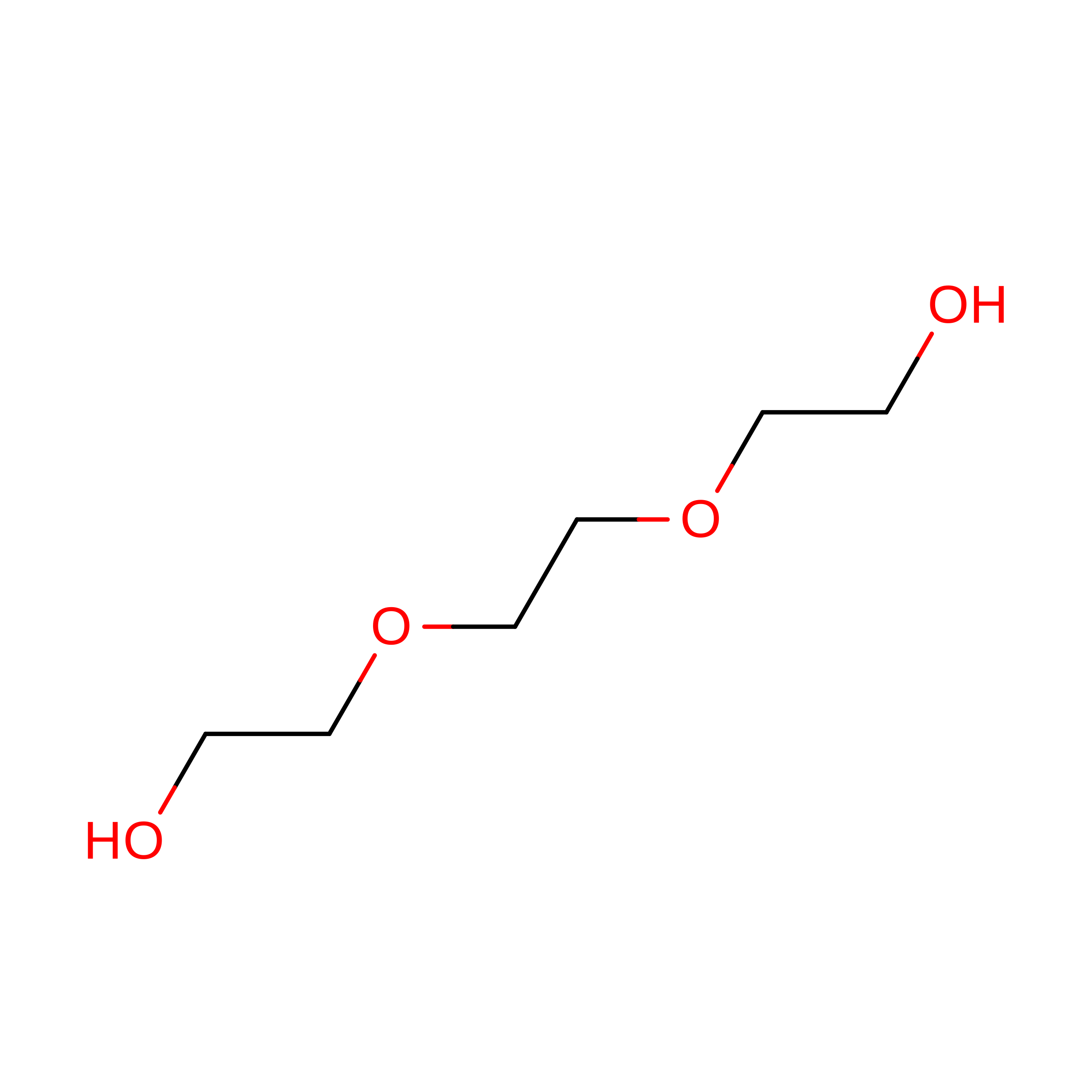
C [auth B]TRIETHYLENE GLYCOL
C6 H14 O4
ZIBGPFATKBEMQZ-UHFFFAOYSA-N

Experimental Data & Validation

Experimental Data

  • Method: X-RAY DIFFRACTION
  • Resolution: 2.20 Å
  • R-Value Free:  0.213 (Depositor), 0.215 (DCC) 
  • R-Value Work:  0.184 (Depositor), 0.191 (DCC) 
  • R-Value Observed: 0.186 (Depositor) 
Space Group: H 3
Unit Cell:
Length ( Å )Angle ( ˚ )
a = 142.517α = 90
b = 142.517β = 90
c = 126.794γ = 120
Software Package:
Software NamePurpose
HKL-2000data collection
HKL-2000data scaling
REFMACrefinement
PDB_EXTRACTdata extraction
Cootmodel building

Structure Validation

View Full Validation Report


Entry History 

Deposition Data

Revision History  (Full details and data files)

  • Version 1.0: 2016-06-15
    Type: Initial release
  • Version 1.1: 2016-07-20
    Changes: Database references
  • Version 1.2: 2020-02-26
    Changes: Data collection, Database references, Derived calculations
  • Version 1.3: 2023-11-08
    Changes: Data collection, Database references, Refinement description