5AOQ | pdb_00005aoq

Structural basis of neurohormone perception by the receptor tyrosine kinase Torso


Experimental Data Snapshot

  • Method: X-RAY DIFFRACTION
  • Resolution: 2.70 Å
  • R-Value Free: 
    0.362 (Depositor), 0.368 (DCC) 
  • R-Value Work: 
    0.342 (Depositor), 0.346 (DCC) 
  • R-Value Observed: 
    0.343 (Depositor) 

wwPDB Validation 3D Report Full Report

Validation slider image for 5AOQ

This is version 3.1 of the entry. See complete history

Literature

Structural Basis of Neurohormone Perception by the Receptor Tyrosine Kinase Torso.

Jenni, S.Goyal, Y.von Grotthuss, M.Shvartsman, S.Y.Klein, D.E.

(2015) Mol Cell 60: 941

  • DOI: https://doi.org/10.1016/j.molcel.2015.10.026
  • Primary Citation Related Structures: 
    5AOQ

  • PubMed Abstract: 

    In insects, brain-derived Prothoracicotropic hormone (PTTH) activates the receptor tyrosine kinase (RTK) Torso to initiate metamorphosis through the release of ecdysone. We have determined the crystal structure of silkworm PTTH in complex with the ligand-binding region of Torso. Here we show that ligand-induced Torso dimerization results from the sequential and negatively cooperative formation of asymmetric heterotetramers. Mathematical modeling of receptor activation based upon our biophysical studies shows that ligand pulses are "buffered" at low receptor levels, leading to a sustained signal. By contrast, high levels of Torso develop the signal intensity and duration of a noncooperative system. We propose that this may allow Torso to coordinate widely different functions from a single ligand by tuning receptor levels. Phylogenic analysis indicates that Torso is found outside arthropods, including human parasitic roundworms. Together, our findings provide mechanistic insight into how this receptor system, with roles in embryonic and adult development, is regulated.


  • Organizational Affiliation
    • Department of Biological Chemistry and Molecular Pharmacology, Harvard Medical School, Boston, MA 02115, USA.

Macromolecule Content 

  • Total Structure Weight: 90.03 kDa 
  • Atom Count: 5,305 
  • Modeled Residue Count: 640 
  • Deposited Residue Count: 762 
  • Unique protein chains: 2

Macromolecules

Find similar proteins by:|  3D Structure
Entity ID: 1
MoleculeChains  Sequence LengthOrganismDetailsImage
TORSO
A, B
272Bombyx moriMutation(s): 0 
EC: 2.7.10.1
UniProt
Find proteins for D2IYS2 (Bombyx mori)
Explore D2IYS2 
Go to UniProtKB:  D2IYS2
Entity Groups
Sequence Clusters30% Identity50% Identity70% Identity90% Identity95% Identity100% Identity
UniProt GroupD2IYS2
Glycosylation
Glycosylation Sites: 1
Sequence Annotations
Expand
Reference Sequence
Find similar proteins by:|  3D Structure
Entity ID: 2
MoleculeChains  Sequence LengthOrganismDetailsImage
PREPROPTTHC [auth L],
D [auth M]
109Bombyx moriMutation(s): 1 
UniProt
Find proteins for P17219 (Bombyx mori)
Explore P17219 
Go to UniProtKB:  P17219
Entity Groups
Sequence Clusters30% Identity50% Identity70% Identity90% Identity95% Identity100% Identity
UniProt GroupP17219
Sequence Annotations
Expand
Reference Sequence

Oligosaccharides

Help  
Entity ID: 3
MoleculeChains Length2D Diagram GlycosylationD Interactions
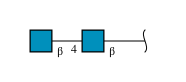
2-acetamido-2-deoxy-beta-D-glucopyranose-(1-4)-2-acetamido-2-deoxy-beta-D-glucopyranoseE [auth C],
F [auth D]
2N-Glycosylation
Glycosylation Resources
GlyTouCan: G42666HT
GlyCosmos: G42666HT
GlyGen: G42666HT

Experimental Data & Validation

Experimental Data

  • Method: X-RAY DIFFRACTION
  • Resolution: 2.70 Å
  • R-Value Free:  0.362 (Depositor), 0.368 (DCC) 
  • R-Value Work:  0.342 (Depositor), 0.346 (DCC) 
  • R-Value Observed: 0.343 (Depositor) 
Space Group: P 21 21 21
Unit Cell:
Length ( Å )Angle ( ˚ )
a = 53.42α = 90
b = 90.96β = 90
c = 244.28γ = 90
Software Package:
Software NamePurpose
PHASERmodel building
XDSdata reduction
XSCALEdata scaling
SHELXDphasing
SHARPphasing
RESOLVEphasing
PHASERphasing
PHENIXphasing

Structure Validation

View Full Validation Report


Entry History 

Deposition Data

Revision History  (Full details and data files)

  • Version 1.0: 2015-11-25
    Type: Initial release
  • Version 1.1: 2016-01-13
    Changes: Database references
  • Version 2.0: 2017-12-13
    Changes: Atomic model, Database references
  • Version 3.0: 2020-07-29
    Type: Remediation
    Reason: Carbohydrate remediation
    Changes: Atomic model, Data collection, Derived calculations, Other, Structure summary
  • Version 3.1: 2024-11-13
    Changes: Data collection, Database references, Structure summary