5ADZ | pdb_00005adz

Ether Lipid-Generating Enzyme AGPS in complex with inhibitor 1a


Experimental Data Snapshot

  • Method: X-RAY DIFFRACTION
  • Resolution: 2.20 Å
  • R-Value Free: 
    0.253 (Depositor), 0.256 (DCC) 
  • R-Value Work: 
    0.195 (Depositor), 0.200 (DCC) 
  • R-Value Observed: 
    0.196 (Depositor) 

Starting Model: experimental
View more details

wwPDB Validation 3D Report Full Report

Validation slider image for 5ADZ

Ligand Structure Quality Assessment 


This is version 1.2 of the entry. See complete history

Literature

Discovery of Inhibitors for the Ether Lipid-Generating Enzyme Agps as Anti-Cancer Agents.

Piano, V.Benjamin, D.I.Valente, S.Nenci, S.Marrocco, B.Mai, A.Aliverti, A.Nomura, D.K.Mattevi, A.

(2015) ACS Chem Biol 10: 2589

  • DOI: https://doi.org/10.1021/acschembio.5b00466
  • Primary Citation Related Structures: 
    5ADZ, 5AE1, 5AE2, 5AE3

  • PubMed Abstract: 

    Dysregulated ether lipid metabolism is an important hallmark of cancer cells. Previous studies have reported that lowering ether lipid levels by genetic ablation of the ether lipid-generating enzyme alkyl-glycerone phosphate synthase (AGPS) lowers key structural and oncogenic ether lipid levels and alters fatty acid, glycerophospholipid, and eicosanoid metabolism to impair cancer pathogenicity, indicating that AGPS may be a potential therapeutic target for cancer. In this study, we have performed a small-molecule screen to identify candidate AGPS inhibitors. We have identified several lead AGPS inhibitors and have structurally characterized their interactions with the enzyme and show that these inhibitors bind to distinct portions of the active site. We further show that the lead AGPS inhibitor 1a selectively lowers ether lipid levels in several types of human cancer cells and impairs their cellular survival and migration. We provide here the first report of in situ-active pharmacological tools for inhibiting AGPS, which may provide chemical scaffolds for future AGPS inhibitor development for cancer therapy.


  • Organizational Affiliation
    • Department of Biology and Biotechnology, University of Pavia , via Ferrata 9, 27100 Pavia, Italy.

Macromolecule Content 

  • Total Structure Weight: 296.21 kDa 
  • Atom Count: 18,475 
  • Modeled Residue Count: 2,217 
  • Deposited Residue Count: 2,632 
  • Unique protein chains: 1

Macromolecules

Find similar proteins by:|  3D Structure
Entity ID: 1
MoleculeChains  Sequence LengthOrganismDetailsImage
ALKYLDIHYDROXYACETONEPHOSPHATE SYNTHASE, PEROXISOMAL
A, B, C, D
658Cavia porcellusMutation(s): 0 
EC: 2.5.1.26
UniProt
Find proteins for P97275 (Cavia porcellus)
Explore P97275 
Go to UniProtKB:  P97275
Entity Groups
Sequence Clusters30% Identity50% Identity70% Identity90% Identity95% Identity100% Identity
UniProt GroupP97275
Sequence Annotations
Expand
Reference Sequence

Small Molecules

Ligands 2 Unique
IDChains Name / Formula / InChI Key2D Diagram3D Interactions
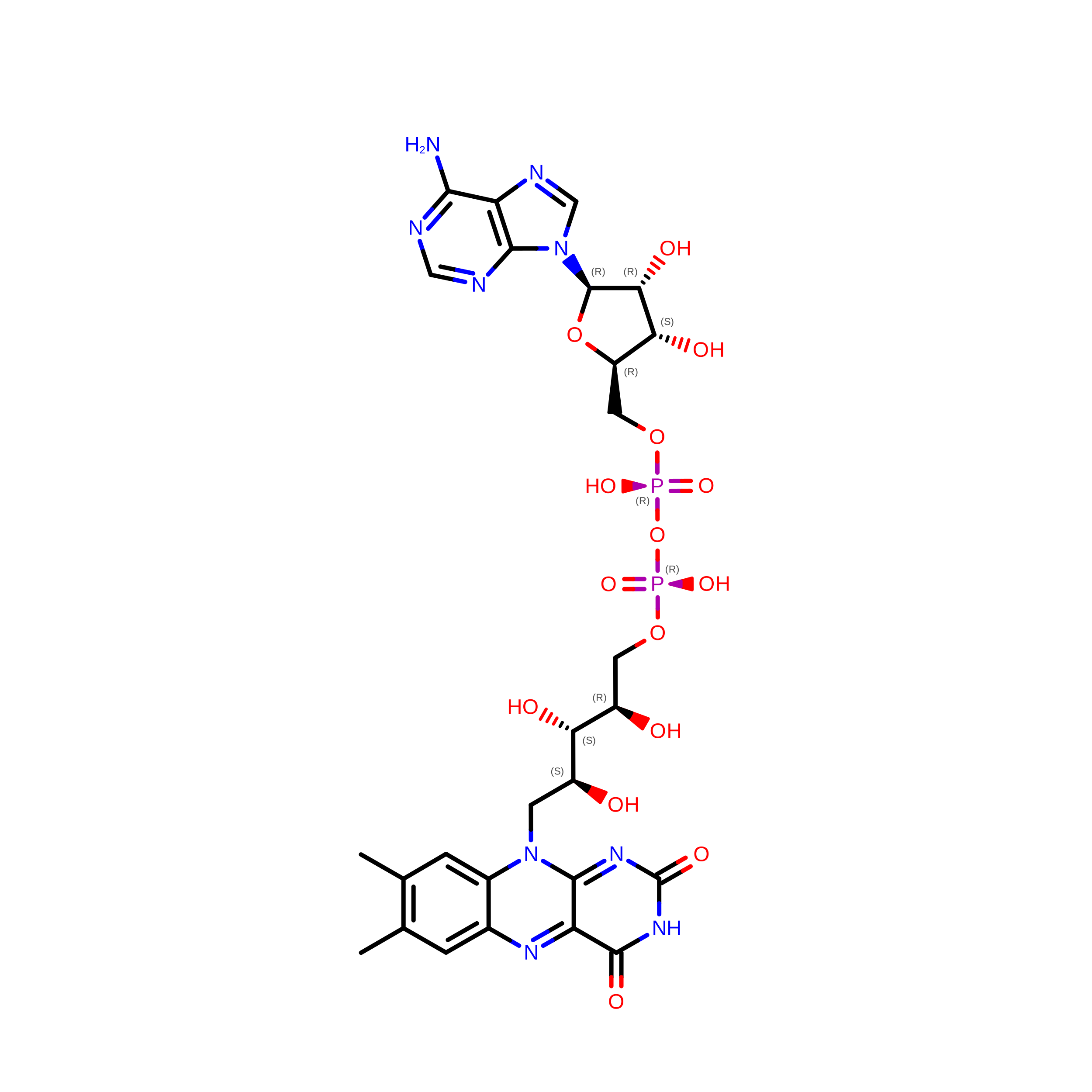
FAD

Query on FAD


Download:Ideal Coordinates CCD File
E [auth A],
G [auth B],
I [auth C],
K [auth D]
FLAVIN-ADENINE DINUCLEOTIDE
C27 H33 N9 O15 P2
VWWQXMAJTJZDQX-UYBVJOGSSA-N
KQS

Query on KQS


Download:Ideal Coordinates CCD File
F [auth A],
H [auth B],
J [auth C],
L [auth D]
(3S)-3-(2-fluorophenyl)-N-((2-oxo-2,3-dihydro-1H-benzo[d]imidazol-5-yl)methyl)butanamide)
C18 H18 F N3 O2
JYQMTEASQYBLAO-NSHDSACASA-N

Experimental Data & Validation

Experimental Data

  • Method: X-RAY DIFFRACTION
  • Resolution: 2.20 Å
  • R-Value Free:  0.253 (Depositor), 0.256 (DCC) 
  • R-Value Work:  0.195 (Depositor), 0.200 (DCC) 
  • R-Value Observed: 0.196 (Depositor) 
Space Group: P 1
Unit Cell:
Length ( Å )Angle ( ˚ )
a = 61.06α = 90.57
b = 99.61β = 90.04
c = 107.97γ = 94.76
Software Package:
Software NamePurpose
REFMACrefinement
MOSFLMdata reduction
Aimlessdata scaling
PHASERphasing

Structure Validation

View Full Validation Report


Ligand Structure Quality Assessment 


Entry History 

Deposition Data

Revision History  (Full details and data files)

  • Version 1.0: 2015-09-23
    Type: Initial release
  • Version 1.1: 2015-12-02
    Changes: Database references
  • Version 1.2: 2024-01-10
    Changes: Data collection, Database references, Derived calculations, Other, Refinement description