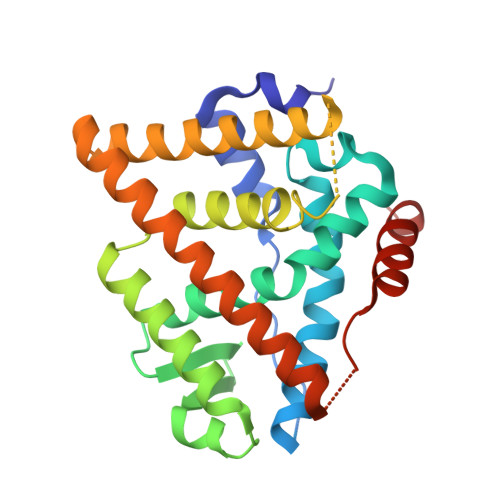
5AAU | pdb_00005aau

Optimization of a novel binding motif to to (E)-3-(3,5-difluoro-4-((1R,3R)-2-(2-fluoro-2-methylpropyl)-3-methyl-2,3,4,9-tetrahydro-1H- pyrido(3,4-b)indol-1-yl)phenyl)acrylic acid (AZD9496), a potent and orally bioavailable selective estrogen receptor downregulator and antagonist


Experimental Data Snapshot

  • Method: X-RAY DIFFRACTION
  • Resolution: 1.90 Å
  • R-Value Free: 
    0.226 (Depositor), 0.249 (DCC) 
  • R-Value Work: 
    0.173 (Depositor), 0.203 (DCC) 
  • R-Value Observed: 
    0.176 (Depositor) 

Starting Model: other
View more details

wwPDB Validation 3D Report Full Report

Validation slider image for 5AAU

Ligand Structure Quality Assessment 


This is version 1.3 of the entry. See complete history

Literature

Optimization of a Novel Binding Motif to (E)-3-(3,5-Difluoro-4-((1R,3R)-2-(2-Fluoro-2-Methylpropyl)-3-Methyl-2, 3,4,9-Tetrahydro-1H-Pyrido[3,4-B]Indol-1-Yl)Phenyl)Acrylic Acid (Azd9496), a Potent and Orally Bioavailable Selective Estrogen Receptor Downregulator and Antagonist.

De Savi, C.Bradbury, R.H.Rabow, A.A.Norman, R.A.De Almeida, C.Andrews, D.M.Ballard, P.Buttar, D.Callis, R.Currie, G.S.Davies, C.Donald, C.Feron, L.Hayter, B.R.Hussain, S.Karoutchi, G.Lamont, S.Macfaul, P.A.Moss, T.A.Pearson, S.Tonge, M.Walker, G.Weir, H.Wilson, Z.

(2015) J Med Chem 58: 8128

  • DOI: https://doi.org/10.1021/acs.jmedchem.5b00984
  • Primary Citation Related Structures: 
    5AAU, 5AAV, 5ACC

  • PubMed Abstract: 

    The discovery of an orally bioavailable selective estrogen receptor downregulator (SERD) with equivalent potency and preclinical pharmacology to the intramuscular SERD fulvestrant is described. A directed screen identified the 1-aryl-2,3,4,9-tetrahydro-1H-pyrido[3,4-b]indole motif as a novel, druglike ER ligand. Aided by crystal structures of novel ligands bound to an ER construct, medicinal chemistry iterations led to (E)-3-(3,5-difluoro-4-((1R,3R)-2-(2-fluoro-2-methylpropyl)-3-methyl-2,3,4,9-tetrahydro-1H-pyrido[3,4-b]indol-1-yl)phenyl)acrylic acid (30b, AZD9496), a clinical candidate with high oral bioavailability across preclinical species that is currently being evaluated in phase I clinical trials for the treatment of advanced estrogen receptor (ER) positive breast cancer.


  • Organizational Affiliation
    • Oncology iMed, AstraZeneca, Mereside, Alderley Park, Macclesfield SK10 4TG, U.K.

Macromolecule Content 

  • Total Structure Weight: 58.05 kDa 
  • Atom Count: 3,901 
  • Modeled Residue Count: 451 
  • Deposited Residue Count: 504 
  • Unique protein chains: 1

Macromolecules

Find similar proteins by:|  3D Structure
Entity ID: 1
MoleculeChains  Sequence LengthOrganismDetailsImage
ESTROGEN RECEPTOR
A, B
252Homo sapiensMutation(s): 3 
UniProt & NIH Common Fund Data Resources
Find proteins for P03372 (Homo sapiens)
Explore P03372 
Go to UniProtKB:  P03372
PHAROS:  P03372
GTEx:  ENSG00000091831 
Entity Groups
Sequence Clusters30% Identity50% Identity70% Identity90% Identity95% Identity100% Identity
UniProt GroupP03372
Sequence Annotations
Expand
Reference Sequence

Small Molecules

Ligands 1 Unique
IDChains Name / Formula / InChI Key2D Diagram3D Interactions
XBR

Query on XBR


Download:Ideal Coordinates CCD File
C [auth A],
D [auth B]
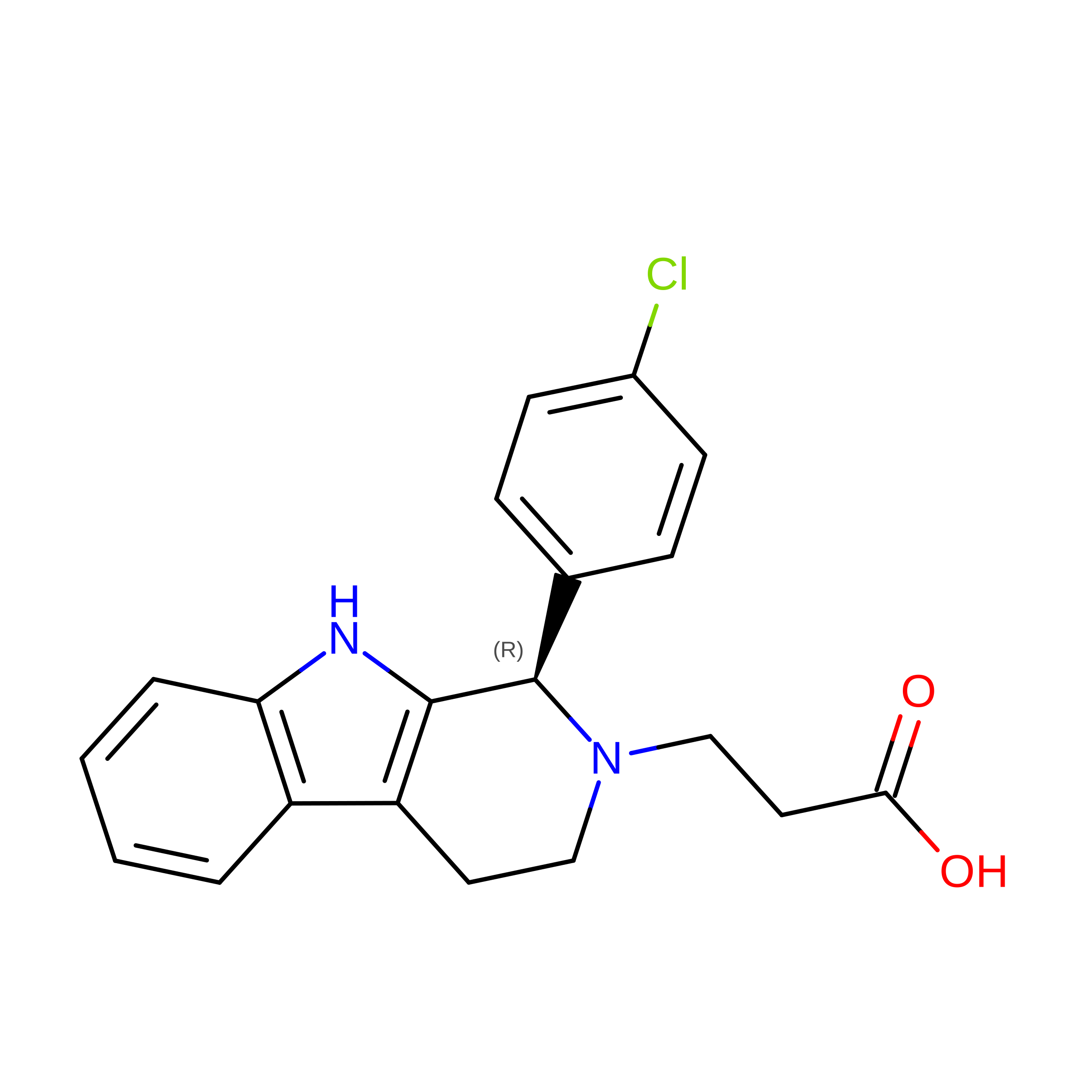
3-(1-(4-Chlorophenyl)-3,4-dihydro-1H-pyrido(3,4-b)indol-2(9H)-yl)propanoic acid
C20 H19 Cl N2 O2
LVUWGHOKMIGPFO-HXUWFJFHSA-N

Experimental Data & Validation

Experimental Data

  • Method: X-RAY DIFFRACTION
  • Resolution: 1.90 Å
  • R-Value Free:  0.226 (Depositor), 0.249 (DCC) 
  • R-Value Work:  0.173 (Depositor), 0.203 (DCC) 
  • R-Value Observed: 0.176 (Depositor) 
Space Group: C 1 2 1
Unit Cell:
Length ( Å )Angle ( ˚ )
a = 106.407α = 90
b = 51.396β = 93.66
c = 85.181γ = 90
Software Package:
Software NamePurpose
REFMACrefinement
MOSFLMdata reduction
SCALAdata scaling
AMoREphasing

Structure Validation

View Full Validation Report


Ligand Structure Quality Assessment 


Entry History 

Revision History  (Full details and data files)

  • Version 1.0: 2015-10-14
    Type: Initial release
  • Version 1.1: 2015-11-04
    Changes: Database references
  • Version 1.2: 2016-10-12
    Changes: Database references
  • Version 1.3: 2024-05-01
    Changes: Data collection, Database references, Derived calculations, Other, Refinement description