5A10 | pdb_00005a10

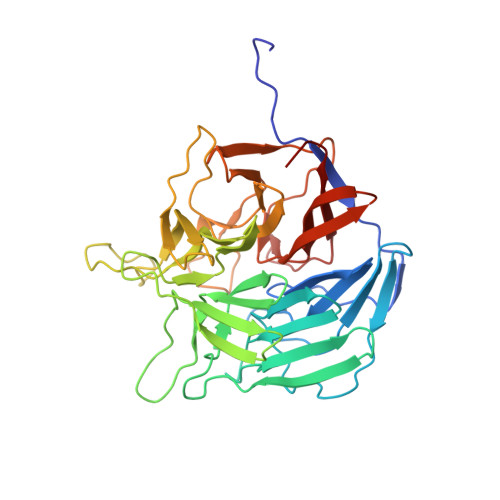
The crystal structure of Ta-TFP, a thiocyanate-forming protein involved in glucosinolate breakdown (space group C2)


Experimental Data Snapshot

  • Method: X-RAY DIFFRACTION
  • Resolution: 1.42 Å
  • R-Value Free: 
    0.176 (Depositor), 0.183 (DCC) 
  • R-Value Work: 
    0.157 (Depositor), 0.167 (DCC) 
  • R-Value Observed: 
    0.158 (Depositor) 

Starting Model: experimental
View more details

wwPDB Validation 3D Report Full Report

Validation slider image for 5A10

This is version 1.3 of the entry. See complete history

Literature

The Crystal Structure of the Thiocyanate-Forming Protein from Thlaspi Arvense, a Kelch Protein Involved in Glucosinolate Breakdown.

Gumz, F.Krausze, J.Eisenschmidt, D.Backenkohler, A.Barleben, L.Brandt, W.Wittstock, U.

(2015) Plant Mol Biol 89: 67

  • DOI: https://doi.org/10.1007/s11103-015-0351-9
  • Primary Citation Related Structures: 
    5A10, 5A11

  • PubMed Abstract: 

    Kelch repeat-containing proteins are involved in diverse cellular processes, but only a small subset of plant kelch proteins has been functionally characterized. Thiocyanate-forming protein (TFP) from field-penny cress, Thlaspi arvense (Brassicaceae), is a representative of specifier proteins, a group of kelch proteins involved in plant specialized metabolism. As components of the glucosinolate-myrosinase system of the Brassicaceae, specifier proteins determine the profile of bioactive products formed when plant tissue is disrupted and glucosinolates are hydrolyzed by myrosinases. Here, we describe the crystal structure of TaTFP at a resolution of 1.4 Å. TaTFP crystallized as homodimer. Each monomer forms a six-blade β-propeller with a wide "top" and a narrower "bottom" opening with distinct strand-connecting loops protruding far beyond the lower propeller surface. Molecular modeling and mutational analysis identified residues for glucosinolate aglucone and Fe(2+) cofactor binding within these loops. As the first experimentally determined structure of a plant kelch protein, the crystal structure of TaTFP not only enables more detailed mechanistic studies on glucosinolate breakdown product formation, but also provides a new basis for research on the diverse roles and mechanisms of other kelch proteins in plants.


  • Organizational Affiliation
    • Institute of Pharmaceutical Biology, Technische Universität Braunschweig, Mendelssohnstr. 1, 38106, Braunschweig, Germany.

Macromolecule Content 

  • Total Structure Weight: 39.83 kDa 
  • Atom Count: 3,154 
  • Modeled Residue Count: 352 
  • Deposited Residue Count: 356 
  • Unique protein chains: 1

Macromolecules

Find similar proteins by:|  3D Structure
Entity ID: 1
MoleculeChains  Sequence LengthOrganismDetailsImage
THIOCYANATE FORMING PROTEIN356Thlaspi arvenseMutation(s): 0 
EC: 4.8.1.8
UniProt
Find proteins for G1FNI6 (Thlaspi arvense)
Explore G1FNI6 
Go to UniProtKB:  G1FNI6
Entity Groups
Sequence Clusters30% Identity50% Identity70% Identity90% Identity95% Identity100% Identity
UniProt GroupG1FNI6
Sequence Annotations
Expand
Reference Sequence

Experimental Data & Validation

Experimental Data

  • Method: X-RAY DIFFRACTION
  • Resolution: 1.42 Å
  • R-Value Free:  0.176 (Depositor), 0.183 (DCC) 
  • R-Value Work:  0.157 (Depositor), 0.167 (DCC) 
  • R-Value Observed: 0.158 (Depositor) 
Space Group: C 1 2 1
Unit Cell:
Length ( Å )Angle ( ˚ )
a = 119.39α = 90
b = 48.96β = 109.71
c = 68.27γ = 90
Software Package:
Software NamePurpose
PHENIXrefinement
XDSdata reduction
XDSdata scaling
PHASERphasing

Structure Validation

View Full Validation Report


Entry History 

Deposition Data

Revision History  (Full details and data files)

  • Version 1.0: 2015-08-26
    Type: Initial release
  • Version 1.1: 2015-09-02
    Changes: Data collection
  • Version 1.2: 2015-09-30
    Changes: Database references
  • Version 1.3: 2024-01-10
    Changes: Data collection, Database references, Derived calculations, Other, Refinement description