4RRL | pdb_00004rrl

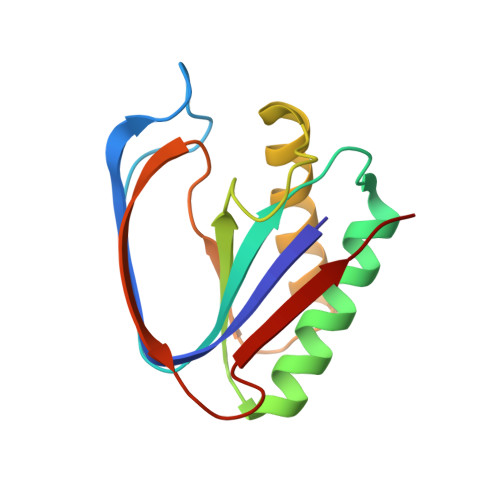
E129A mutant of N-terminal editing domain of threonyl-tRNA synthetase from Aeropyrum pernix with L-Ser3AA


Experimental Data Snapshot

  • Method: X-RAY DIFFRACTION
  • Resolution: 1.97 Å
  • R-Value Free: 
    0.236 (Depositor), 0.237 (DCC) 
  • R-Value Work: 
    0.185 (Depositor), 0.185 (DCC) 
  • R-Value Observed: 
    0.187 (Depositor) 

wwPDB Validation 3D Report Full Report

Validation slider image for 4RRL

Ligand Structure Quality Assessment 


This is version 1.2 of the entry. See complete history

Literature

Specificity and catalysis hardwired at the RNA-protein interface in a translational proofreading enzyme.

Ahmad, S.Muthukumar, S.Kuncha, S.K.Routh, S.B.Yerabham, A.S.Hussain, T.Kamarthapu, V.Kruparani, S.P.Sankaranarayanan, R.

(2015) Nat Commun 6: 7552-7552

  • DOI: https://doi.org/10.1038/ncomms8552
  • Primary Citation Related Structures: 
    4RR6, 4RR7, 4RR8, 4RR9, 4RRA, 4RRB, 4RRC, 4RRD, 4RRF, 4RRG, 4RRH, 4RRI, 4RRJ, 4RRK, 4RRL, 4RRM, 4RRQ, 4RRR

  • PubMed Abstract: 

    Proofreading modules of aminoacyl-tRNA synthetases are responsible for enforcing a high fidelity during translation of the genetic code. They use strategically positioned side chains for specifically targeting incorrect aminoacyl-tRNAs. Here, we show that a unique proofreading module possessing a D-aminoacyl-tRNA deacylase fold does not use side chains for imparting specificity or for catalysis, the two hallmark activities of enzymes. We show, using three distinct archaea, that a side-chain-stripped recognition site is fully capable of solving a subtle discrimination problem. While biochemical probing establishes that RNA plays the catalytic role, mechanistic insights from multiple high-resolution snapshots reveal that differential remodelling of the catalytic core at the RNA-peptide interface provides the determinants for correct proofreading activity. The functional crosstalk between RNA and protein elucidated here suggests how primordial enzyme functions could have emerged on RNA-peptide scaffolds before recruitment of specific side chains.


  • Organizational Affiliation
    • Centre for Cellular and Molecular Biology, Council of Scientific and Industrial Research, Uppal Road, Hyderabad 500007, India.

Macromolecule Content 

  • Total Structure Weight: 15.43 kDa 
  • Atom Count: 1,161 
  • Modeled Residue Count: 136 
  • Deposited Residue Count: 136 
  • Unique protein chains: 1

Macromolecules

Find similar proteins by:|  3D Structure
Entity ID: 1
MoleculeChains  Sequence LengthOrganismDetailsImage
Probable threonine--tRNA ligase 2136Aeropyrum pernix K1Mutation(s): 1 
Gene Names: thrS2APE_0117.1
EC: 6.1.1.3
UniProt
Find proteins for Q9YFY3 (Aeropyrum pernix (strain ATCC 700893 / DSM 11879 / JCM 9820 / NBRC 100138 / K1))
Explore Q9YFY3 
Go to UniProtKB:  Q9YFY3
Entity Groups
Sequence Clusters30% Identity50% Identity70% Identity90% Identity95% Identity100% Identity
UniProt GroupQ9YFY3
Sequence Annotations
Expand
Reference Sequence

Small Molecules

Ligands 1 Unique
IDChains Name / Formula / InChI Key2D Diagram3D Interactions
A3S

Query on A3S


Download:Ideal Coordinates CCD File
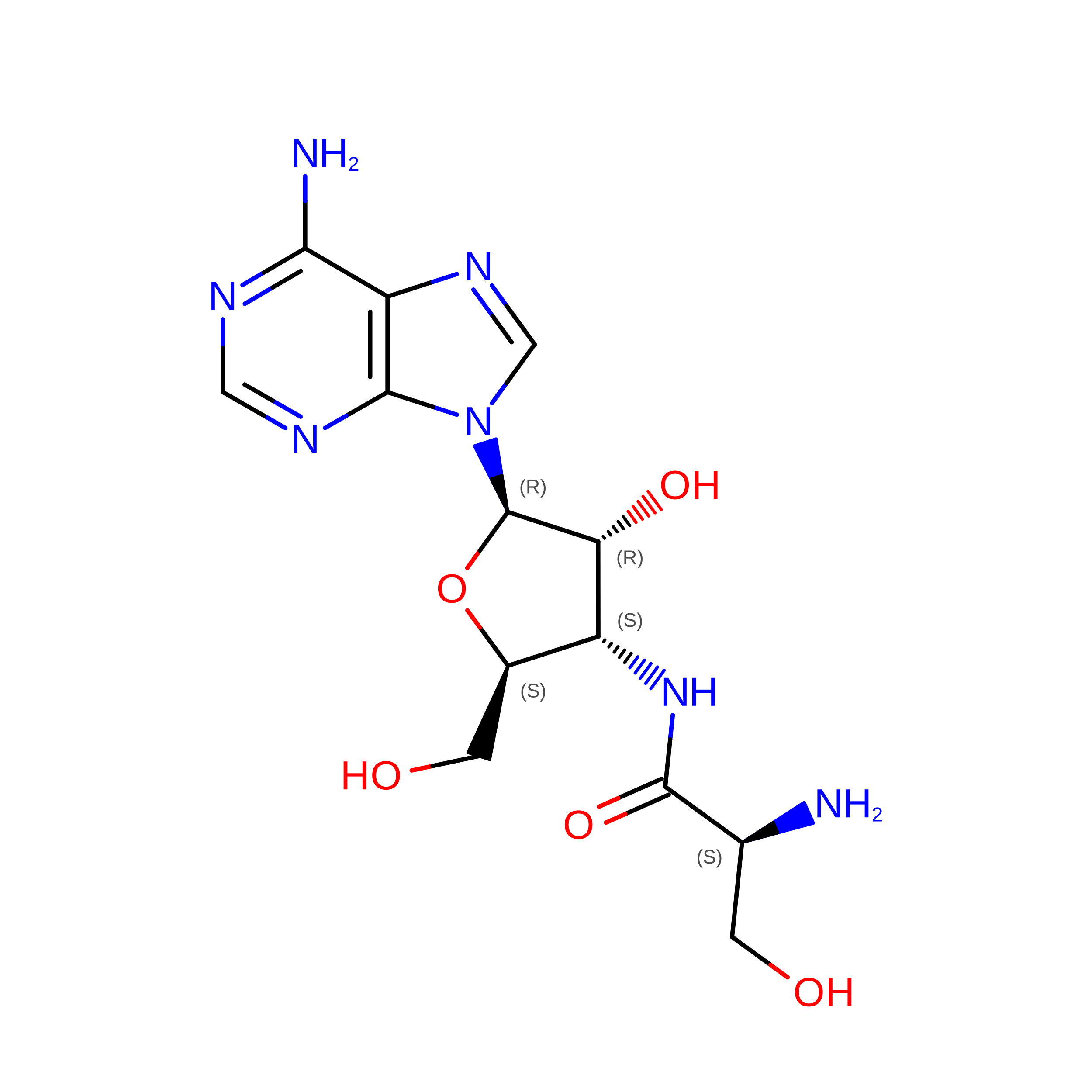
B [auth A]SERINE-3'-AMINOADENOSINE
C13 H19 N7 O5
ITDKSTILAWHDJI-AYEBZEFBSA-N

Experimental Data & Validation

Experimental Data

  • Method: X-RAY DIFFRACTION
  • Resolution: 1.97 Å
  • R-Value Free:  0.236 (Depositor), 0.237 (DCC) 
  • R-Value Work:  0.185 (Depositor), 0.185 (DCC) 
  • R-Value Observed: 0.187 (Depositor) 
Space Group: P 41 21 2
Unit Cell:
Length ( Å )Angle ( ˚ )
a = 47.023α = 90
b = 47.023β = 90
c = 112.514γ = 90
Software Package:
Software NamePurpose
AUTOMARdata collection
MOLREPphasing
PHASERphasing
REFMACrefinement
HKL-2000data reduction
HKL-2000data scaling

Structure Validation

View Full Validation Report


Ligand Structure Quality Assessment 


Entry History 

Deposition Data

Revision History  (Full details and data files)

  • Version 1.0: 2015-07-15
    Type: Initial release
  • Version 1.1: 2017-11-22
    Changes: Refinement description
  • Version 1.2: 2024-02-28
    Changes: Data collection, Database references, Derived calculations