4M00 | pdb_00004m00

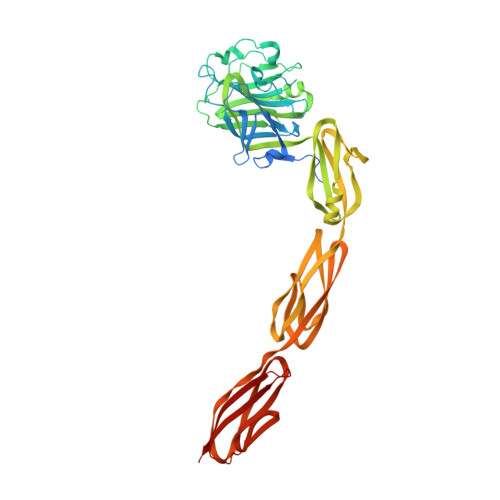
Crystal structure of the ligand binding region of staphylococcal adhesion SraP


Experimental Data Snapshot

  • Method: X-RAY DIFFRACTION
  • Resolution: 2.05 Å
  • R-Value Free: 
    0.206 (Depositor), 0.206 (DCC) 
  • R-Value Work: 
    0.181 (Depositor), 0.180 (DCC) 
  • R-Value Observed: 
    0.182 (Depositor) 

Starting Model: experimental
View more details

wwPDB Validation 3D Report Full Report

Validation slider image for 4M00

This is version 3.0 of the entry. See complete history

Literature

Structural Insights into SraP-Mediated Staphylococcus aureus Adhesion to Host Cells

Yang, Y.H.Jiang, Y.L.Zhang, J.Wang, L.Bai, X.H.Zhang, S.J.Ren, Y.M.Li, N.Zhang, Y.H.Zhang, Z.Gong, Q.Mei, Y.Xue, T.Zhang, J.R.Chen, Y.Zhou, C.Z.

(2014) PLoS Pathog 10: e1004169-e1004169

  • DOI: https://doi.org/10.1371/journal.ppat.1004169
  • Primary Citation Related Structures: 
    4M00, 4M01, 4M02, 4M03

  • PubMed Abstract: 

    Staphylococcus aureus, a Gram-positive bacterium causes a number of devastating human diseases, such as infective endocarditis, osteomyelitis, septic arthritis and sepsis. S. aureus SraP, a surface-exposed serine-rich repeat glycoprotein (SRRP), is required for the pathogenesis of human infective endocarditis via its ligand-binding region (BR) adhering to human platelets. It remains unclear how SraP interacts with human host. Here we report the 2.05 Å crystal structure of the BR of SraP, revealing an extended rod-like architecture of four discrete modules. The N-terminal legume lectin-like module specifically binds to N-acetylneuraminic acid. The second module adopts a β-grasp fold similar to Ig-binding proteins, whereas the last two tandem repetitive modules resemble eukaryotic cadherins but differ in calcium coordination pattern. Under the conditions tested, small-angle X-ray scattering and molecular dynamic simulation indicated that the three C-terminal modules function as a relatively rigid stem to extend the N-terminal lectin module outwards. Structure-guided mutagenesis analyses, in addition to a recently identified trisaccharide ligand of SraP, enabled us to elucidate that SraP binding to sialylated receptors promotes S. aureus adhesion to and invasion into host epithelial cells. Our findings have thus provided novel structural and functional insights into the SraP-mediated host-pathogen interaction of S. aureus.


  • Organizational Affiliation
    • Hefei National Laboratory for Physical Sciences at the Microscale and School of Life Sciences, University of Science and Technology of China, Hefei Anhui, People's Republic of China.

Macromolecule Content 

  • Total Structure Weight: 57.02 kDa 
  • Atom Count: 4,331 
  • Modeled Residue Count: 501 
  • Deposited Residue Count: 541 
  • Unique protein chains: 1

Macromolecules

Find similar proteins by:|  3D Structure
Entity ID: 1
MoleculeChains  Sequence LengthOrganismDetailsImage
Serine-rich adhesin for platelets541Staphylococcus aureus subsp. aureus NCTC 8325Mutation(s): 0 
Gene Names: sraP
UniProt
Find proteins for Q2FUW1 (Staphylococcus aureus (strain NCTC 8325 / PS 47))
Explore Q2FUW1 
Go to UniProtKB:  Q2FUW1
Entity Groups
Sequence Clusters30% Identity50% Identity70% Identity90% Identity95% Identity100% Identity
UniProt GroupQ2FUW1
Sequence Annotations
Expand
Reference Sequence

Oligosaccharides

Help  
Entity ID: 2
MoleculeChains Length2D Diagram GlycosylationD Interactions
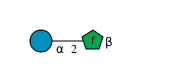
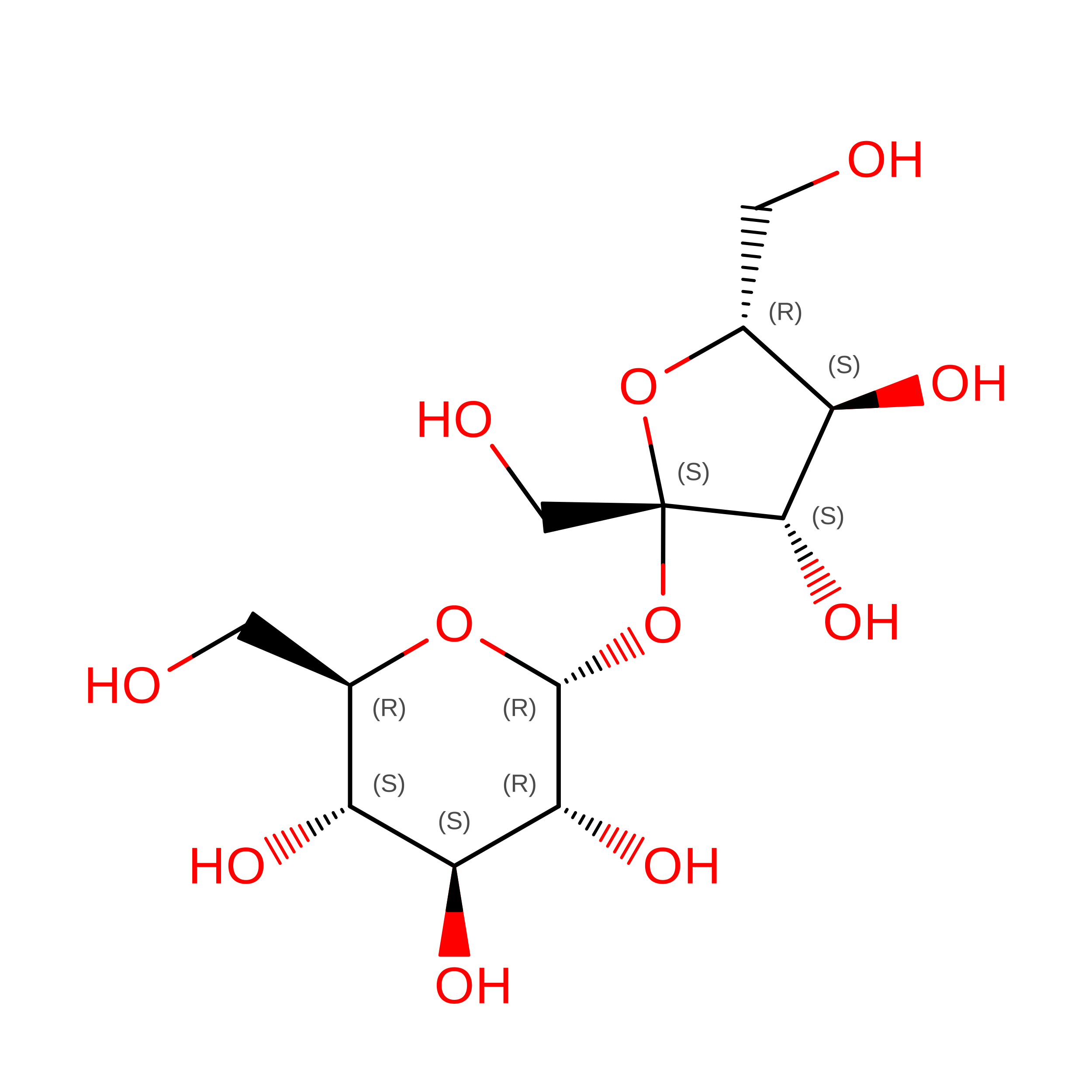
beta-D-fructofuranose-(2-1)-alpha-D-glucopyranose
B
2N/A
Glycosylation Resources
GlyTouCan: G05551OP
GlyCosmos: G05551OP

Biologically Interesting Molecules (External Reference) 

1 Unique

Experimental Data & Validation

Experimental Data

  • Method: X-RAY DIFFRACTION
  • Resolution: 2.05 Å
  • R-Value Free:  0.206 (Depositor), 0.206 (DCC) 
  • R-Value Work:  0.181 (Depositor), 0.180 (DCC) 
  • R-Value Observed: 0.182 (Depositor) 
Space Group: P 32 2 1
Unit Cell:
Length ( Å )Angle ( ˚ )
a = 118.018α = 90
b = 118.018β = 90
c = 136.407γ = 120
Software Package:
Software NamePurpose
HKL-2000data collection
MOLREPphasing
REFMACrefinement
HKL-2000data reduction
SCALAdata scaling

Structure Validation

View Full Validation Report


Entry History 

Deposition Data

Revision History  (Full details and data files)

  • Version 1.0: 2014-06-18
    Type: Initial release
  • Version 2.0: 2020-07-29
    Type: Remediation
    Reason: Carbohydrate remediation
    Changes: Atomic model, Data collection, Database references, Derived calculations, Non-polymer description, Structure summary
  • Version 2.1: 2023-11-08
    Changes: Data collection, Database references, Refinement description, Structure summary
  • Version 3.0: 2026-02-11
    Changes: Atomic model, Data collection, Derived calculations, Structure summary