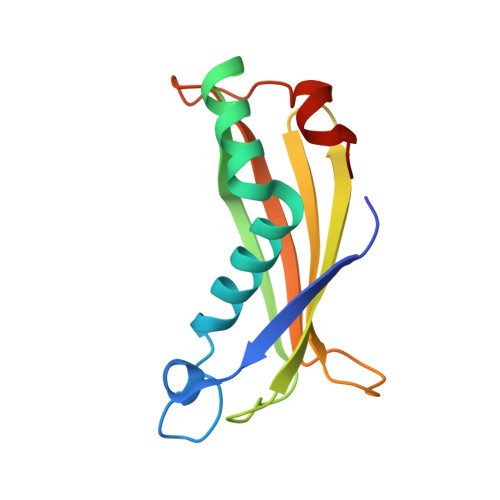
4I45 | pdb_00004i45

Crystal Structure of Orf6 protein from Photobacterium profundum, Mg2+-bound form


Experimental Data Snapshot

  • Method: X-RAY DIFFRACTION
  • Resolution: 1.40 Å
  • R-Value Free: 
    0.196 (Depositor), 0.196 (DCC) 
  • R-Value Work: 
    0.148 (Depositor), 0.153 (DCC) 
  • R-Value Observed: 
    0.151 (Depositor) 

Starting Model: experimental
View more details

wwPDB Validation 3D Report Full Report

Validation slider image for 4I45

This is version 1.2 of the entry. See complete history

Literature

Structure, Activity, and Substrate Selectivity of the Orf6 Thioesterase from Photobacterium profundum.

Rodriguez-Guilbe, M.Oyola-Robles, D.Schreiter, E.R.Baerga-Ortiz, A.

(2013) J Biological Chem 288: 10841-10848

  • DOI: https://doi.org/10.1074/jbc.M112.446765
  • Primary Citation Related Structures: 
    3R87, 4I45

  • PubMed Abstract: 

    Thioesterase activity is typically required for the release of products from polyketide synthase enzymes, but no such enzyme has been characterized in deep-sea bacteria associated with the production of polyunsaturated fatty acids. In this work, we have expressed and purified the Orf6 thioesterase from Photobacterium profundum. Enzyme assays revealed that Orf6 has a higher specific activity toward long-chain fatty acyl-CoA substrates (palmitoyl-CoA and eicosapentaenoyl-CoA) than toward short-chain or aromatic acyl-CoA substrates. We determined a high resolution (1.05 Å) structure of Orf6 that reveals a hotdog hydrolase fold arranged as a dimer of dimers. The putative active site of this structure is occupied by additional electron density not accounted for by the protein sequence, consistent with the presence of an elongated compound. A second crystal structure (1.40 Å) was obtained from a crystal that was grown in the presence of Mg(2+), which reveals the presence of a binding site for divalent cations at a crystal contact. The Mg(2+)-bound structure shows localized conformational changes (root mean square deviation of 1.63 Å), and its active site is unoccupied, suggesting a mechanism to open the active site for substrate entry or product release. These findings reveal a new thioesterase enzyme with a preference for long-chain CoA substrates in a deep-sea bacterium whose potential range of applications includes bioremediation and the production of biofuels.


  • Organizational Affiliation
    • Department of Biochemistry, University of Puerto Rico School of Medicine, San Juan, Puerto Rico.

Macromolecule Content 

  • Total Structure Weight: 15.59 kDa 
  • Atom Count: 1,262 
  • Modeled Residue Count: 129 
  • Deposited Residue Count: 135 
  • Unique protein chains: 1

Macromolecules

Find similar proteins by:|  3D Structure
Entity ID: 1
MoleculeChains  Sequence LengthOrganismDetailsImage
ORF6 thioesterase135Photobacterium profundumMutation(s): 0 
UniProt
Find proteins for Q93CG9 (Photobacterium profundum)
Explore Q93CG9 
Go to UniProtKB:  Q93CG9
Entity Groups
Sequence Clusters30% Identity50% Identity70% Identity90% Identity95% Identity100% Identity
UniProt GroupQ93CG9
Sequence Annotations
Expand
Reference Sequence

Small Molecules

Ligands 1 Unique
IDChains Name / Formula / InChI Key2D Diagram3D Interactions
MG

Query on MG


Download:Ideal Coordinates CCD File
B [auth A]MAGNESIUM ION
Mg
JLVVSXFLKOJNIY-UHFFFAOYSA-N

Experimental Data & Validation

Experimental Data

  • Method: X-RAY DIFFRACTION
  • Resolution: 1.40 Å
  • R-Value Free:  0.196 (Depositor), 0.196 (DCC) 
  • R-Value Work:  0.148 (Depositor), 0.153 (DCC) 
  • R-Value Observed: 0.151 (Depositor) 
Space Group: I 2 2 2
Unit Cell:
Length ( Å )Angle ( ˚ )
a = 51.292α = 90
b = 54.362β = 90
c = 88.363γ = 90
Software Package:
Software NamePurpose
ADSCdata collection
PHASERphasing
REFMACrefinement
d*TREKdata reduction
d*TREKdata scaling

Structure Validation

View Full Validation Report


Entry History 

Deposition Data

Revision History  (Full details and data files)

  • Version 1.0: 2013-02-27
    Type: Initial release
  • Version 1.1: 2013-05-01
    Changes: Database references
  • Version 1.2: 2023-09-20
    Changes: Data collection, Database references, Derived calculations, Refinement description