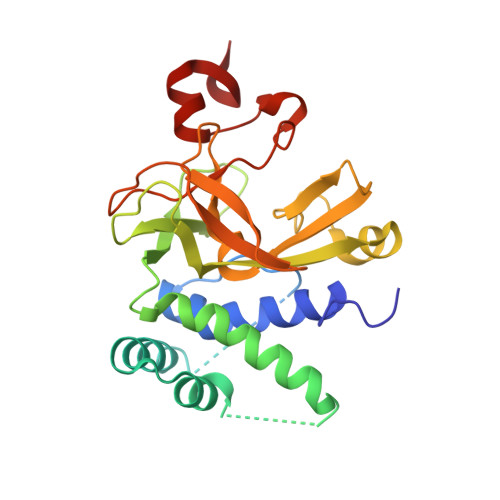
4BUP | pdb_00004bup

A novel route to product specificity in the Suv4-20 family of histone H4K20 methyltransferases


Experimental Data Snapshot

  • Method: X-RAY DIFFRACTION
  • Resolution: 2.17 Å
  • R-Value Free: 
    0.259 (Depositor), 0.258 (DCC) 
  • R-Value Work: 
    0.198 (Depositor), 0.199 (DCC) 
  • R-Value Observed: 
    0.201 (Depositor) 

Starting Model: experimental
View more details

wwPDB Validation 3D Report Full Report

Validation slider image for 4BUP

Ligand Structure Quality Assessment 


This is version 1.2 of the entry. See complete history

Literature

A Novel Route to Product Specificity in the Suv4-20 Family of Histone H4K20 Methyltransferases.

Southall, S.M.Cronin, N.B.Wilson, J.R.

(2014) Nucleic Acids Res 42: 661

  • DOI: https://doi.org/10.1093/nar/gkt776
  • Primary Citation Related Structures: 
    4AU7, 4BUP

  • PubMed Abstract: 

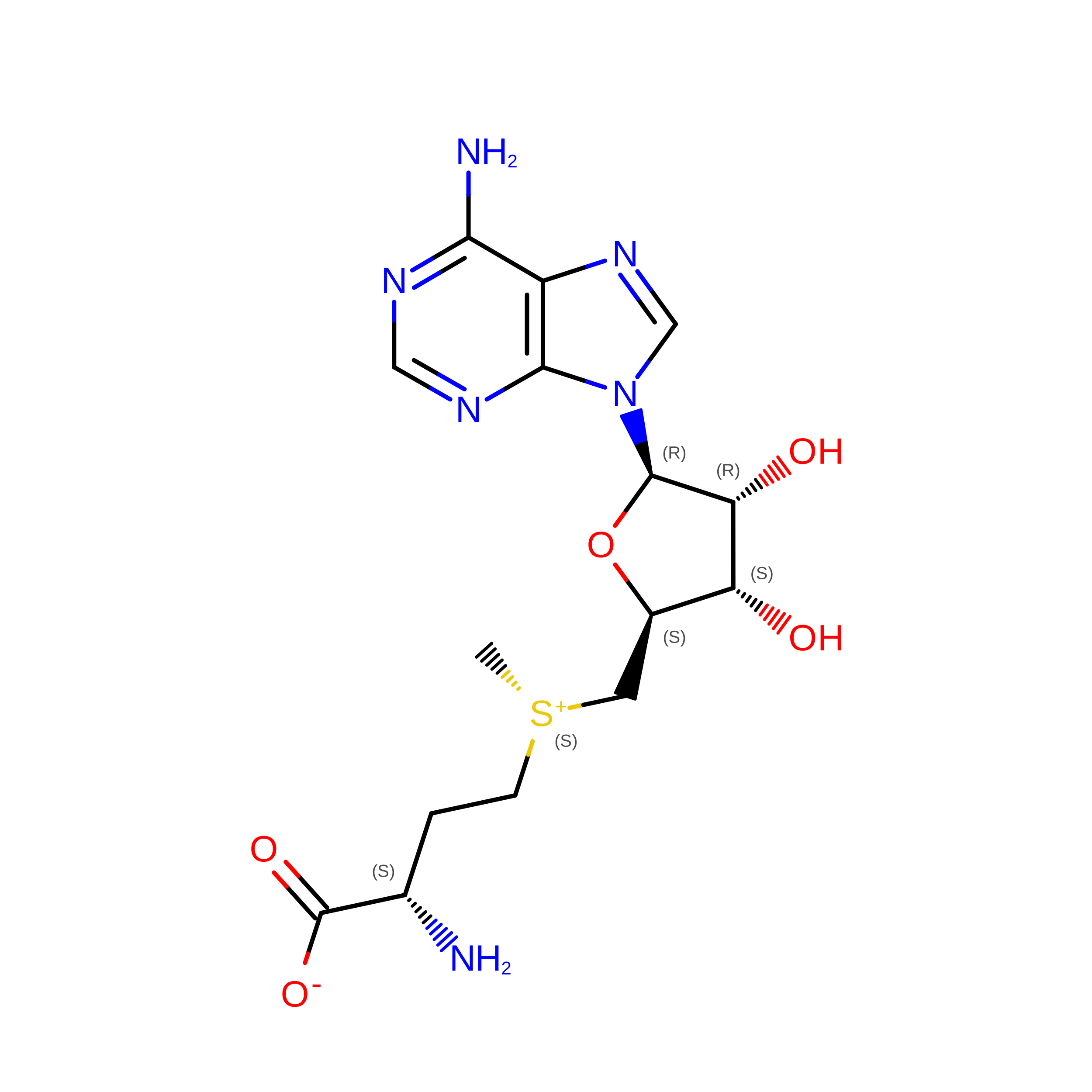
    The delivery of site-specific post-translational modifications to histones generates an epigenetic regulatory network that directs fundamental DNA-mediated processes and governs key stages in development. Methylation of histone H4 lysine-20 has been implicated in DNA repair, transcriptional silencing, genomic stability and regulation of replication. We present the structure of the histone H4K20 methyltransferase Suv4-20h2 in complex with its histone H4 peptide substrate and S-adenosyl methionine cofactor. Analysis of the structure reveals that the Suv4-20h2 active site diverges from the canonical SET domain configuration and generates a high degree of both substrate and product specificity. Together with supporting biochemical data comparing Suv4-20h1 and Suv4-20h2, we demonstrate that the Suv4-20 family enzymes take a previously mono-methylated H4K20 substrate and generate an exclusively di-methylated product. We therefore predict that other enzymes are responsible for the tri-methylation of histone H4K20 that marks silenced heterochromatin.


  • Organizational Affiliation
    • Division of Structural Biology, Institute of Cancer Research, Chester Beatty Laboratories, London, SW3 6JB, UK.

Macromolecule Content 

  • Total Structure Weight: 63.48 kDa 
  • Atom Count: 3,995 
  • Modeled Residue Count: 469 
  • Deposited Residue Count: 542 
  • Unique protein chains: 1

Macromolecules

Find similar proteins by:|  3D Structure
Entity ID: 1
MoleculeChains  Sequence LengthOrganismDetailsImage
HISTONE-LYSINE N-METHYLTRANSFERASE SUV420H1
A, B
271Mus musculusMutation(s): 0 
EC: 2.1.1.43 (PDB Primary Data), 2.1.1.362 (UniProt), 2.1.1.361 (UniProt)
UniProt & NIH Common Fund Data Resources
Find proteins for Q3U8K7 (Mus musculus)
Explore Q3U8K7 
Go to UniProtKB:  Q3U8K7
IMPC:  MGI:2444557
Entity Groups
Sequence Clusters30% Identity50% Identity70% Identity90% Identity95% Identity100% Identity
UniProt GroupQ3U8K7
Sequence Annotations
Expand
Reference Sequence

Experimental Data & Validation

Experimental Data

  • Method: X-RAY DIFFRACTION
  • Resolution: 2.17 Å
  • R-Value Free:  0.259 (Depositor), 0.258 (DCC) 
  • R-Value Work:  0.198 (Depositor), 0.199 (DCC) 
  • R-Value Observed: 0.201 (Depositor) 
Space Group: P 1 21 1
Unit Cell:
Length ( Å )Angle ( ˚ )
a = 46.31α = 90
b = 50.01β = 92.82
c = 129.4γ = 90
Software Package:
Software NamePurpose
PHENIXrefinement
MOSFLMdata reduction
SCALAdata scaling
PHASERphasing

Structure Validation

View Full Validation Report


Ligand Structure Quality Assessment 


Entry History 

Deposition Data

Revision History  (Full details and data files)

  • Version 1.0: 2013-10-02
    Type: Initial release
  • Version 1.1: 2014-01-15
    Changes: Database references
  • Version 1.2: 2023-12-20
    Changes: Data collection, Database references, Derived calculations, Other, Refinement description