4B9S | pdb_00004b9s

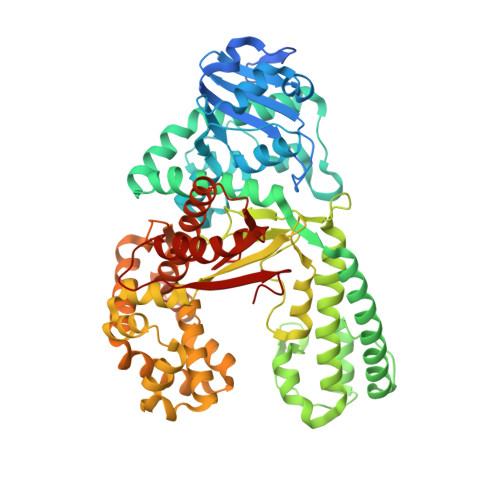
Structure of the high fidelity DNA polymerase I with an oxidative formamidopyrimidine-dG DNA lesion outside of the pre-insertion site.


Experimental Data Snapshot

  • Method: X-RAY DIFFRACTION
  • Resolution: 1.73 Å
  • R-Value Free: 
    0.206 (Depositor), 0.209 (DCC) 
  • R-Value Work: 
    0.181 (Depositor), 0.184 (DCC) 
  • R-Value Observed: 
    0.182 (Depositor) 

Starting Model: experimental
View more details

wwPDB Validation 3D Report Full Report

Validation slider image for 4B9S

This is version 2.1 of the entry. See complete history

Literature

Unexpected Non-Hoogsteen-Based Mutagenicity Mechanism of Fapy-DNA Lesions.

Gehrke, T.H.Lischke, U.Gasteiger, K.L.Schneider, S.Arnold, S.Muller, H.C.Stephenson, D.S.Zipse, H.Carell, T.

(2013) Nat Chem Biol 9: 455

  • DOI: https://doi.org/10.1038/nchembio.1254
  • Primary Citation Related Structures: 
    4B9L, 4B9M, 4B9N, 4B9S, 4B9T, 4B9U, 4B9V

  • PubMed Abstract: 

    8-Oxopurines (8-oxodG and 8-oxodA) and formamidopyrimidines (FaPydG and FaPydA) are major oxidative DNA lesions involved in cancer development and aging. Their mutagenicity is believed to result from a conformational shift of the N9-C1' glycosidic bonds from anti to syn, which allows the lesions to form noncanonical Hoogsteen-type base pairs with incoming triphosphates during DNA replication. Here we present biochemical data and what are to our knowledge the first crystal structures of carbocyclic FaPydA and FaPydG containing DNA in complex with a high-fidelity polymerase. Crystallographic snapshots show that the cFaPy lesions keep the anti geometry of the glycosidic bond during error-free and error-prone replication. The observed dG·dC→dT·dA transversion mutations are the result of base shifting and tautomerization.


  • Organizational Affiliation
    • Center for Integrated Protein Science at the Department of Chemistry, Ludwig Maximilians University, Munich, Germany.

Macromolecule Content 

  • Total Structure Weight: 78.94 kDa 
  • Atom Count: 5,474 
  • Modeled Residue Count: 601 
  • Deposited Residue Count: 644 
  • Unique protein chains: 1
  • Unique nucleic acid chains: 2

Macromolecules


Find similar proteins by:|  3D Structure
Entity ID: 1
MoleculeChains  Sequence LengthOrganismDetailsImage
DNA POLYMERASE619Geobacillus stearothermophilusMutation(s): 0 
EC: 2.7.7.7
UniProt
Find proteins for E1C9K5 (Geobacillus stearothermophilus)
Explore E1C9K5 
Go to UniProtKB:  E1C9K5
Entity Groups
Sequence Clusters30% Identity50% Identity70% Identity90% Identity95% Identity100% Identity
UniProt GroupE1C9K5
Sequence Annotations
Expand
Reference Sequence
Find similar nucleic acids by:  Sequence
Entity ID: 2
MoleculeChains LengthOrganismImage
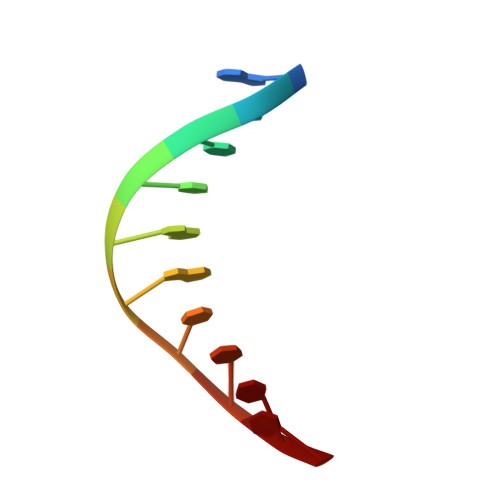
5'-D(*AP*CP*CP*TP*GP*AP*CP*TP*CP*TP)-3'10Geobacillus stearothermophilus
Sequence Annotations
Expand
Reference Sequence
Find similar nucleic acids by:  Sequence
Entity ID: 3
MoleculeChains LengthOrganismImage
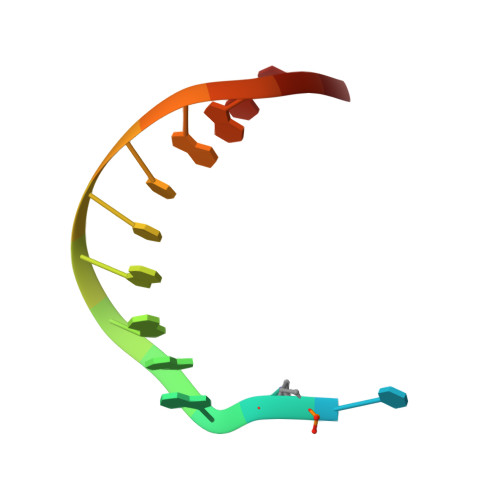
5'-D(*CP*AP*TP*FOXP*AP*GP*AP*GP*TP*CP*AP*GP*GP*TP*TP)-3'15Geobacillus stearothermophilus
Sequence Annotations
Expand
Reference Sequence

Oligosaccharides

Help  
Entity ID: 4
MoleculeChains Length2D Diagram GlycosylationD Interactions
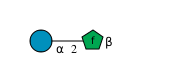
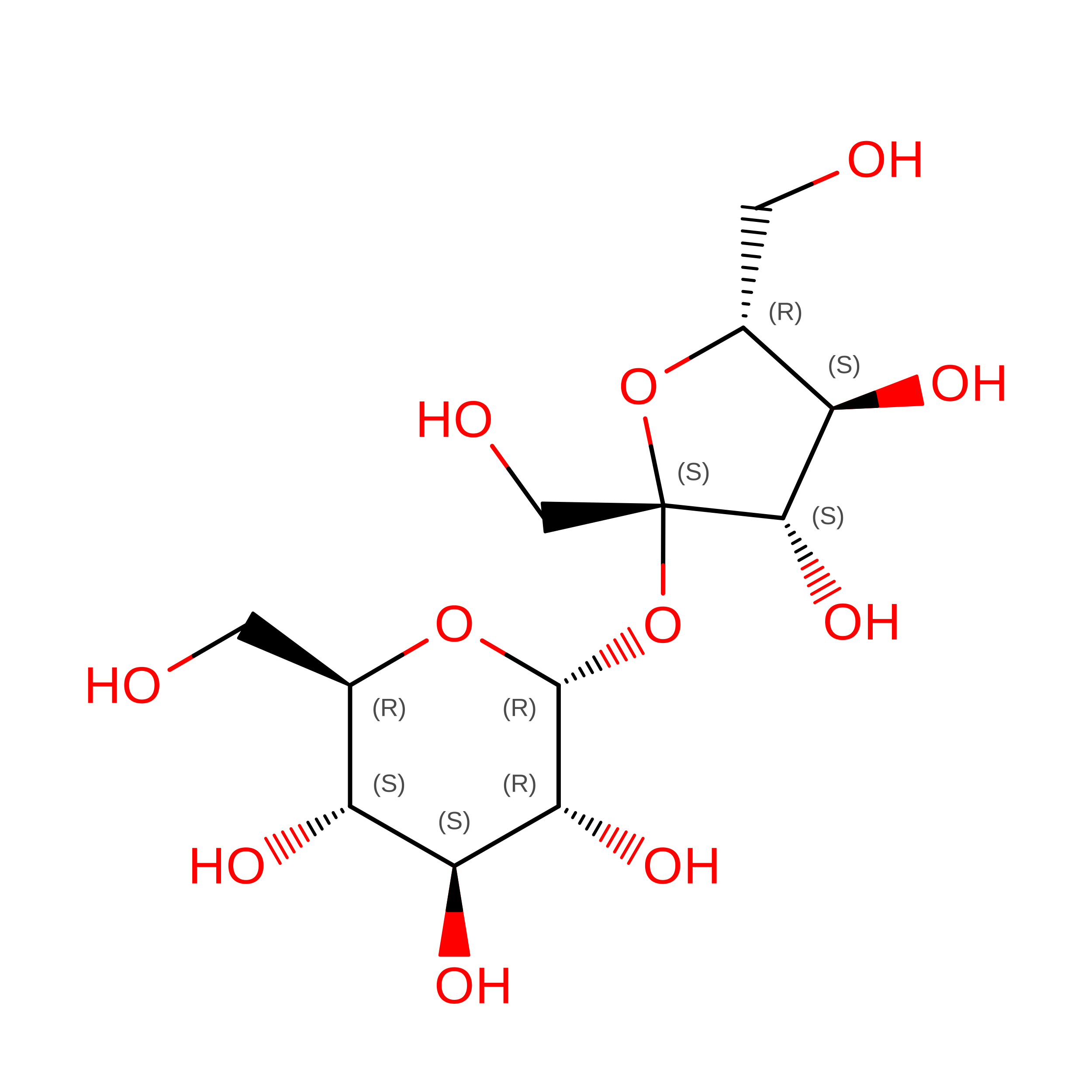
beta-D-fructofuranose-(2-1)-alpha-D-glucopyranose
D
2N/A
Glycosylation Resources
GlyTouCan: G05551OP
GlyCosmos: G05551OP

Biologically Interesting Molecules (External Reference) 

1 Unique

Experimental Data & Validation

Experimental Data

  • Method: X-RAY DIFFRACTION
  • Resolution: 1.73 Å
  • R-Value Free:  0.206 (Depositor), 0.209 (DCC) 
  • R-Value Work:  0.181 (Depositor), 0.184 (DCC) 
  • R-Value Observed: 0.182 (Depositor) 
Space Group: P 21 21 21
Unit Cell:
Length ( Å )Angle ( ˚ )
a = 88.066α = 90
b = 93.688β = 90
c = 105.604γ = 90
Software Package:
Software NamePurpose
REFMACrefinement
XDSdata reduction
SCALAdata scaling
PHASERphasing

Structure Validation

View Full Validation Report


Entry History 

Deposition Data

Revision History  (Full details and data files)

  • Version 1.0: 2013-04-17
    Type: Initial release
  • Version 1.1: 2013-05-22
    Changes: Database references, Structure summary
  • Version 1.2: 2013-05-29
    Changes: Database references
  • Version 1.3: 2013-07-03
    Changes: Database references
  • Version 2.0: 2020-07-29
    Type: Remediation
    Reason: Carbohydrate remediation
    Changes: Advisory, Atomic model, Data collection, Derived calculations, Non-polymer description, Other, Structure summary
  • Version 2.1: 2023-12-20
    Changes: Data collection, Database references, Refinement description, Structure summary