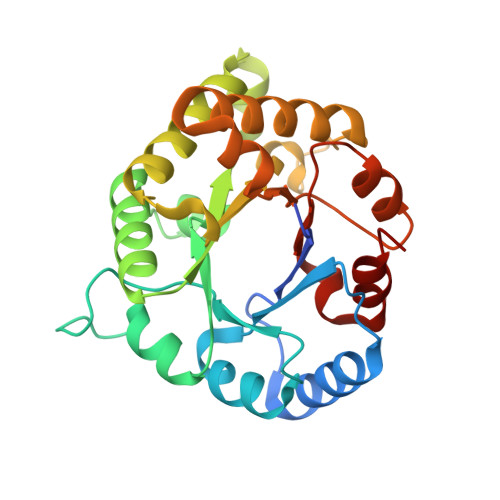
4ZVJ | pdb_00004zvj

Structure of human triose phosphate isomerase K13M


Experimental Data Snapshot

  • Method: X-RAY DIFFRACTION
  • Resolution: 1.70 Å
  • R-Value Free: 
    0.187 (Depositor), 0.194 (DCC) 
  • R-Value Work: 
    0.147 (Depositor), 0.158 (DCC) 
  • R-Value Observed: 
    0.149 (Depositor) 

Starting Model: experimental
View more details

wwPDB Validation 3D Report Full Report

Validation slider image for 4ZVJ

This is version 1.4 of the entry. See complete history

Literature

Triosephosphate isomerase I170V alters catalytic site, enhances stability and induces pathology in a Drosophila model of TPI deficiency.

Roland, B.P.Amrich, C.G.Kammerer, C.J.Stuchul, K.A.Larsen, S.B.Rode, S.Aslam, A.A.Heroux, A.Wetzel, R.VanDemark, A.P.Palladino, M.J.

(2015) Biochim Biophys Acta 1852: 61-69

  • DOI: https://doi.org/10.1016/j.bbadis.2014.10.010
  • Primary Citation Related Structures: 
    4POC, 4POD, 4ZVJ

  • PubMed Abstract: 

    Triosephosphate isomerase (TPI) is a glycolytic enzyme which homodimerizes for full catalytic activity. Mutations of the TPI gene elicit a disease known as TPI Deficiency, a glycolytic enzymopathy noted for its unique severity of neurological symptoms. Evidence suggests that TPI Deficiency pathogenesis may be due to conformational changes of the protein, likely affecting dimerization and protein stability. In this report, we genetically and physically characterize a human disease-associated TPI mutation caused by an I170V substitution. Human TPI(I170V) elicits behavioral abnormalities in Drosophila. An examination of hTPI(I170V) enzyme kinetics revealed this substitution reduced catalytic turnover, while assessments of thermal stability demonstrated an increase in enzyme stability. The crystal structure of the homodimeric I170V mutant reveals changes in the geometry of critical residues within the catalytic pocket. Collectively these data reveal new observations of the structural and kinetic determinants of TPI Deficiency pathology, providing new insights into disease pathogenesis.


  • Organizational Affiliation
    • Department of Pharmacology & Chemical Biology, University of Pittsburgh School of Medicine, Pittsburgh, PA 15261, USA; Pittsburgh Institute for Neurodegenerative Diseases (PIND), University of Pittsburgh School of Medicine, Pittsburgh, PA 15261, USA.

Macromolecule Content 

  • Total Structure Weight: 54.52 kDa 
  • Atom Count: 4,114 
  • Modeled Residue Count: 492 
  • Deposited Residue Count: 508 
  • Unique protein chains: 1

Macromolecules

Find similar proteins by:|  3D Structure
Entity ID: 1
MoleculeChains  Sequence LengthOrganismDetailsImage
Triosephosphate isomerase
A, B
254Homo sapiensMutation(s): 1 
Gene Names: TPI1TPI
EC: 5.3.1.1 (PDB Primary Data), 4.2.3.3 (UniProt)
UniProt & NIH Common Fund Data Resources
Find proteins for P60174 (Homo sapiens)
Explore P60174 
Go to UniProtKB:  P60174
PHAROS:  P60174
GTEx:  ENSG00000111669 
Entity Groups
Sequence Clusters30% Identity50% Identity70% Identity90% Identity95% Identity100% Identity
UniProt GroupP60174
Sequence Annotations
Expand
Reference Sequence

Experimental Data & Validation

Experimental Data

  • Method: X-RAY DIFFRACTION
  • Resolution: 1.70 Å
  • R-Value Free:  0.187 (Depositor), 0.194 (DCC) 
  • R-Value Work:  0.147 (Depositor), 0.158 (DCC) 
  • R-Value Observed: 0.149 (Depositor) 
Space Group: P 21 21 21
Unit Cell:
Length ( Å )Angle ( ˚ )
a = 65.066α = 90
b = 73.53β = 90
c = 92.816γ = 90
Software Package:
Software NamePurpose
HKL-2000data collection
SCALEPACKdata scaling
PHASERphasing
PHENIXrefinement
PDB_EXTRACTdata extraction
HKL-2000data reduction

Structure Validation

View Full Validation Report


Entry History 

& Funding Information

Deposition Data


Funding OrganizationLocationGrant Number
National Institutes of Health/National Institute of General Medical Sciences (NIH/NIGMS)United StatesGM103369

Revision History  (Full details and data files)

  • Version 1.0: 2016-03-09
    Type: Initial release
  • Version 1.1: 2017-01-18
    Changes: Database references
  • Version 1.2: 2017-09-06
    Changes: Author supporting evidence
  • Version 1.3: 2019-12-25
    Changes: Author supporting evidence
  • Version 1.4: 2023-09-27
    Changes: Data collection, Database references, Refinement description