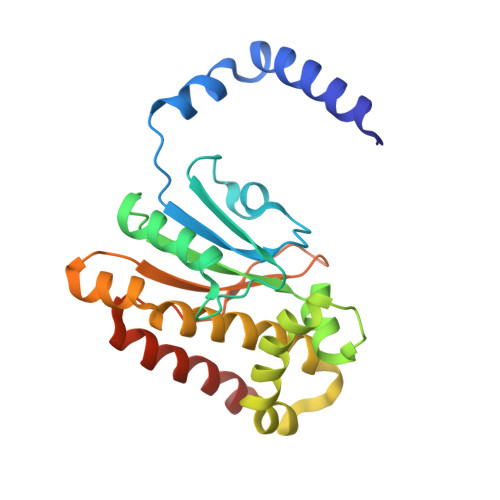
4ZNZ | pdb_00004znz

Crystal structure of Escherichia coli carbonic anhydrase (YadF) in complex with Zn - artifact of purification


Experimental Data Snapshot

  • Method: X-RAY DIFFRACTION
  • Resolution: 2.70 Å
  • R-Value Free: 
    0.258 (Depositor), 0.224 (DCC) 
  • R-Value Work: 
    0.149 (Depositor) 
  • R-Value Observed: 
    0.153 (Depositor) 

wwPDB Validation 3D Report Full Report

Validation slider image for 4ZNZ

This is version 1.5 of the entry. See complete history

Literature

Protein purification and crystallization artifacts: The tale usually not told.

Niedzialkowska, E.Gasiorowska, O.Handing, K.B.Majorek, K.A.Porebski, P.J.Shabalin, I.G.Zasadzinska, E.Cymborowski, M.Minor, W.

(2016) Protein Sci 25: 720-733

  • DOI: https://doi.org/10.1002/pro.2861
  • Primary Citation Related Structures: 
    4TNN, 4YYC, 4ZNZ

  • PubMed Abstract: 

    The misidentification of a protein sample, or contamination of a sample with the wrong protein, may be a potential reason for the non-reproducibility of experiments. This problem may occur in the process of heterologous overexpression and purification of recombinant proteins, as well as purification of proteins from natural sources. If the contaminated or misidentified sample is used for crystallization, in many cases the problem may not be detected until structures are determined. In the case of functional studies, the problem may not be detected for years. Here several procedures that can be successfully used for the identification of crystallized protein contaminants, including: (i) a lattice parameter search against known structures, (ii) sequence or fold identification from partially built models, and (iii) molecular replacement with common contaminants as search templates have been presented. A list of common contaminant structures to be used as alternative search models was provided. These methods were used to identify four cases of purification and crystallization artifacts. This report provides troubleshooting pointers for researchers facing difficulties in phasing or model building.


  • Organizational Affiliation
    • Department of Molecular Physiology and Biological Physics, University of Virginia School of Medicine, 1340 Jefferson Park Avenue, Jordan Hall, Room 4223, Charlottesville, Virginia, 22908.

Macromolecule Content 

  • Total Structure Weight: 25.2 kDa 
  • Atom Count: 1,701 
  • Modeled Residue Count: 215 
  • Deposited Residue Count: 220 
  • Unique protein chains: 1

Macromolecules

Find similar proteins by:|  3D Structure
Entity ID: 1
MoleculeChains  Sequence LengthOrganismDetailsImage
Carbonic anhydrase220Escherichia coli BL21(DE3)Mutation(s): 0 
EC: 4.2.1.1

Small Molecules

Ligands 1 Unique
IDChains Name / Formula / InChI Key2D Diagram3D Interactions
ZN

Query on ZN


Download:Ideal Coordinates CCD File
B [auth A]ZINC ION
Zn
PTFCDOFLOPIGGS-UHFFFAOYSA-N

Experimental Data & Validation

Experimental Data

  • Method: X-RAY DIFFRACTION
  • Resolution: 2.70 Å
  • R-Value Free:  0.258 (Depositor), 0.224 (DCC) 
  • R-Value Work:  0.149 (Depositor) 
  • R-Value Observed: 0.153 (Depositor) 
Space Group: P 42 21 2
Unit Cell:
Length ( Å )Angle ( ˚ )
a = 67.909α = 90
b = 67.909β = 90
c = 84.93γ = 90
Software Package:
Software NamePurpose
REFMACrefinement
HKL-3000phasing
MLPHAREphasing
SHELXphasing
HKL-3000data scaling
HKL-3000data reduction
BLU-MAXdata collection
PDB_EXTRACTdata extraction

Structure Validation

View Full Validation Report


Entry History 

& Funding Information

Deposition Data


Funding OrganizationLocationGrant Number
National Institutes of Health/National Institute of General Medical Sciences (NIH/NIGMS)United StatesU54-GM094662

Revision History  (Full details and data files)

  • Version 1.0: 2015-05-20
    Type: Initial release
  • Version 1.1: 2016-06-01
    Changes: Database references
  • Version 1.2: 2017-11-22
    Changes: Database references, Derived calculations, Refinement description
  • Version 1.3: 2019-12-04
    Changes: Author supporting evidence
  • Version 1.4: 2022-04-13
    Changes: Database references, Structure summary
  • Version 1.5: 2024-05-22
    Changes: Data collection