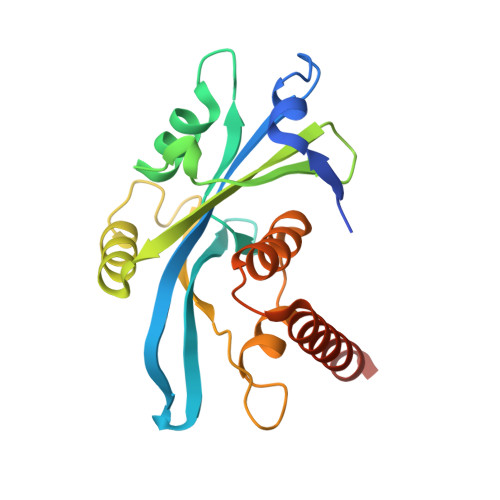
4ZG0 | pdb_00004zg0

Crystal structure of Mouse Syndesmos protein


Experimental Data Snapshot

  • Method: X-RAY DIFFRACTION
  • Resolution: 2.01 Å
  • R-Value Free: 
    0.225 (Depositor), 0.225 (DCC) 
  • R-Value Work: 
    0.178 (Depositor), 0.181 (DCC) 
  • R-Value Observed: 
    0.181 (Depositor) 

Starting Model: experimental
View more details

wwPDB Validation 3D Report Full Report

Validation slider image for 4ZG0

This is version 1.2 of the entry. See complete history

Literature

Crystal structure of syndesmos and its interaction with Syndecan-4 proteoglycan

Kim, H.Yoo, J.Lee, I.Kang, Y.J.Cho, H.S.Lee, W.

(2015) Biochem Biophys Res Commun 463: 762-767

  • DOI: https://doi.org/10.1016/j.bbrc.2015.06.010
  • Primary Citation Related Structures: 
    4ZG0

  • PubMed Abstract: 

    Syndesmos, nucleoside diphosphate linked moiety X (nudix)-type motif 16-like 1 (Nudt16l1), is evolutionarily divergent from the Nudt16 family. Syndesmos, which is co-localized with syndecan-4 cytoplasmic domain (Syn4(cyto)) in focal contacts, interacts with various cell adhesion adaptor proteins to control cell signaling. We determined the X-ray crystal structure of syndesmos; it is composed of seven α-helices and seven β-strands. Although syndesmos has a molecular topology similar to that of nudix hydrolase proteins, the structure of the nudix motif differs from that of X29. The dimeric interface of syndesmos is composed of α-helix 4, 7 and β-strand 2, 7, which primarily form hydrophobic interactions. The binding interaction between syndesmos and syn4(cyto) was characterized as a low-affinity interaction (Kd = 62 μM) by surface plasmon resonance (SPR) and nuclear magnetic resonance (NMR). The NMR resonances of Lys (177, 178, 179), Gly182, and Ser183 in the C1 region and Lys193 and Lys194 in the V region of syndecan-4 are perturbed upon syndesmos binding. Our results provide structural insight into the molecular function of syndesmos in the regulation of cell signaling via binding to syndecan-4.


  • Organizational Affiliation
    • Department of Biochemistry, College of Life Science and Biotechnology, Yonsei University, Seoul, 120-749, South Korea.

Macromolecule Content 

  • Total Structure Weight: 47 kDa 
  • Atom Count: 3,306 
  • Modeled Residue Count: 386 
  • Deposited Residue Count: 424 
  • Unique protein chains: 1

Macromolecules

Find similar proteins by:|  3D Structure
Entity ID: 1
MoleculeChains  Sequence LengthOrganismDetailsImage
Protein syndesmos
A, B
212Mus musculusMutation(s): 0 
Gene Names: Nudt16l1Sdos
UniProt & NIH Common Fund Data Resources
Find proteins for Q8VHN8 (Mus musculus)
Explore Q8VHN8 
Go to UniProtKB:  Q8VHN8
IMPC:  MGI:1914161
Entity Groups
Sequence Clusters30% Identity50% Identity70% Identity90% Identity95% Identity100% Identity
UniProt GroupQ8VHN8
Sequence Annotations
Expand
Reference Sequence

Experimental Data & Validation

Experimental Data

  • Method: X-RAY DIFFRACTION
  • Resolution: 2.01 Å
  • R-Value Free:  0.225 (Depositor), 0.225 (DCC) 
  • R-Value Work:  0.178 (Depositor), 0.181 (DCC) 
  • R-Value Observed: 0.181 (Depositor) 
Space Group: P 1 21 1
Unit Cell:
Length ( Å )Angle ( ˚ )
a = 45.318α = 90
b = 68.701β = 103.93
c = 66.191γ = 90
Software Package:
Software NamePurpose
PHENIXrefinement
PDB_EXTRACTdata extraction
HKL-2000data processing
Cootmodel building
MOLREPphasing
HKL-2000data reduction
HKL-2000data scaling

Structure Validation

View Full Validation Report


Entry History 

Deposition Data

Revision History  (Full details and data files)

  • Version 1.0: 2016-04-20
    Type: Initial release
  • Version 1.1: 2016-06-01
    Changes: Database references
  • Version 1.2: 2023-11-08
    Changes: Data collection, Database references, Derived calculations, Refinement description