4ZA1 | pdb_00004za1

Crystal Structure of NosA Involved in Nosiheptide Biosynthesis


Experimental Data Snapshot

  • Method: X-RAY DIFFRACTION
  • Resolution: 2.50 Å
  • R-Value Free: 
    0.215 (Depositor), 0.223 (DCC) 
  • R-Value Work: 
    0.179 (Depositor), 0.225 (DCC) 
  • R-Value Observed: 
    0.263 (Depositor) 

wwPDB Validation 3D Report Full Report

Validation slider image for 4ZA1

This is version 1.2 of the entry. See complete history

Literature

Structure-based Mechanistic Insights into Terminal Amide Synthase in Nosiheptide-Represented Thiopeptides Biosynthesis

Liu, S.Guo, H.Zhang, T.Han, L.Yao, P.Zhang, Y.Rong, N.Yu, Y.Lan, W.Wang, C.Ding, J.Wang, R.Liu, W.Cao, C.

(2015) Sci Rep 5: 12744-12744

  • DOI: https://doi.org/10.1038/srep12744
  • Primary Citation Related Structures: 
    4ZA1

  • PubMed Abstract: 

    Nosiheptide is a parent compound of thiopeptide family that exhibit potent activities against various bacterial pathogens. Its C-terminal amide formation is catalyzed by NosA, which is an unusual strategy for maturating certain thiopeptides by processing their precursor peptides featuring a serine extension. We here report the crystal structure of truncated NosA1-111 variant, revealing three key elements, including basic lysine 49 (K49), acidic glutamic acid 101 (E101) and flexible C-terminal loop NosA112-151, are crucial to the catalytic terminal amide formation in nosiheptide biosynthesis. The side-chain of residue K49 and the C-terminal loop fasten the substrate through hydrogen bonds and hydrophobic interactions. The side-chain of residue E101 enhances nucleophilic attack of H2O to the methyl imine intermediate, leading to Cα-N bond cleavage and nosiheptide maturation. The sequence alignment of NosA and its homologs NocA, PbtH, TpdK and BerI, and the enzymatic assay suggest that the mechanistic studies on NosA present an intriguing paradigm about how NosA family members function during thiopeptide biosynthesis.


  • Organizational Affiliation
    • State Key Laboratory of Bio-Organic and Natural Product Chemistry and Collaborative Innovation Center of Chemistry for Life Sciences, Shanghai Institute of Organic Chemistry, Chinese Academy of Sciences, 345 Lingling Road, Shanghai, 200032, China.

Macromolecule Content 

  • Total Structure Weight: 49.06 kDa 
  • Atom Count: 2,343 
  • Modeled Residue Count: 281 
  • Deposited Residue Count: 453 
  • Unique protein chains: 1

Macromolecules

Find similar proteins by:|  3D Structure
Entity ID: 1
MoleculeChains  Sequence LengthOrganismDetailsImage
NosA
A, B, C
151Streptomyces actuosusMutation(s): 0 
Gene Names: nosA
UniProt
Find proteins for C6FX40 (Streptomyces actuosus)
Explore C6FX40 
Go to UniProtKB:  C6FX40
Entity Groups
Sequence Clusters30% Identity50% Identity70% Identity90% Identity95% Identity100% Identity
UniProt GroupC6FX40
Sequence Annotations
Expand
Reference Sequence

Small Molecules

Ligands 1 Unique
IDChains Name / Formula / InChI Key2D Diagram3D Interactions
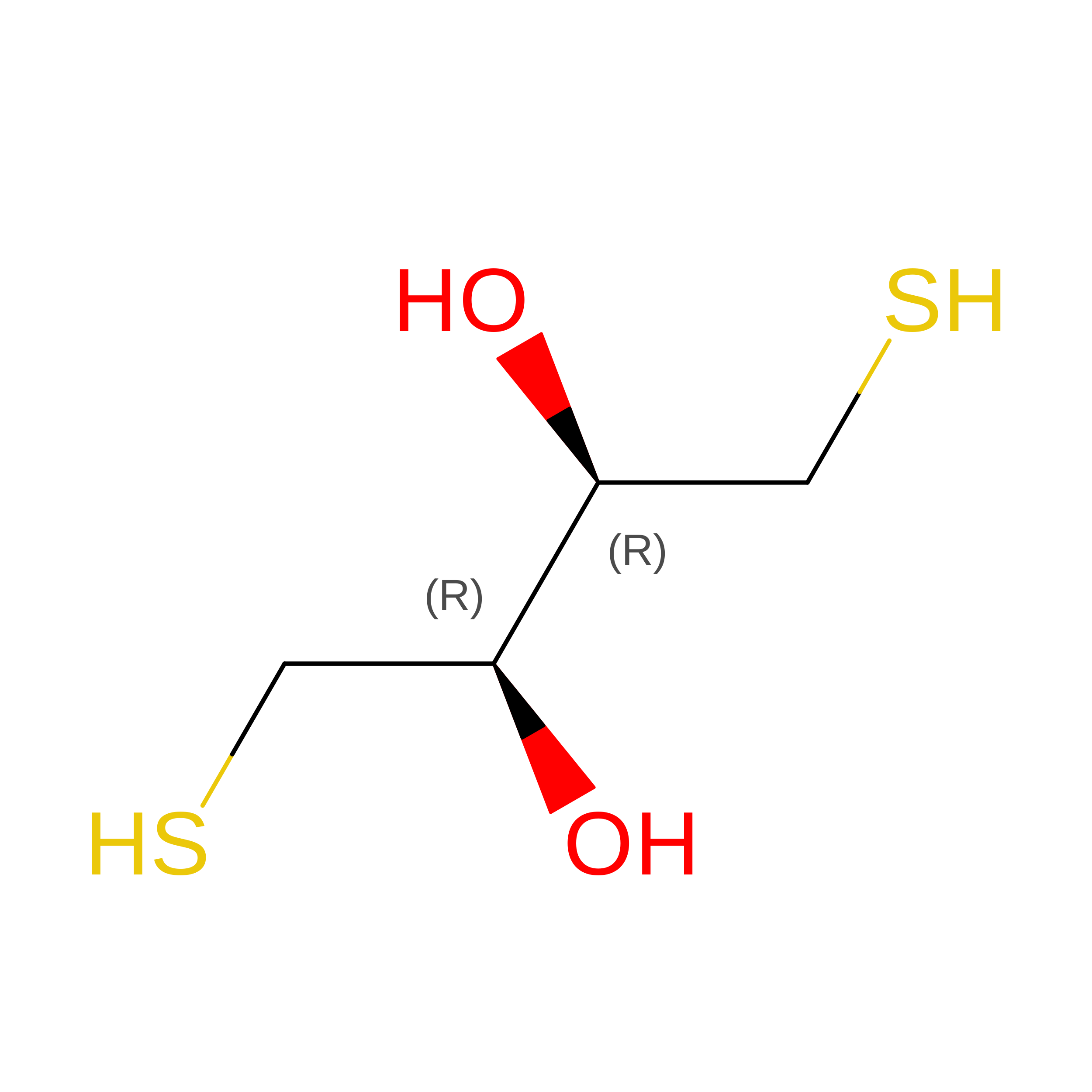
DTT

Query on DTT


Download:Ideal Coordinates CCD File
D [auth A]2,3-DIHYDROXY-1,4-DITHIOBUTANE
C4 H10 O2 S2
VHJLVAABSRFDPM-IMJSIDKUSA-N

Experimental Data & Validation

Experimental Data

  • Method: X-RAY DIFFRACTION
  • Resolution: 2.50 Å
  • R-Value Free:  0.215 (Depositor), 0.223 (DCC) 
  • R-Value Work:  0.179 (Depositor), 0.225 (DCC) 
  • R-Value Observed: 0.263 (Depositor) 
Space Group: P 41 3 2
Unit Cell:
Length ( Å )Angle ( ˚ )
a = 143.371α = 90
b = 143.371β = 90
c = 143.371γ = 90
Software Package:
Software NamePurpose
HKL-2000data scaling
REFMACrefinement
PDB_EXTRACTdata extraction
HKL-2000data reduction
PHENIXphasing

Structure Validation

View Full Validation Report


Entry History 

Deposition Data

Revision History  (Full details and data files)

  • Version 1.0: 2015-08-19
    Type: Initial release
  • Version 1.1: 2015-09-02
    Changes: Other
  • Version 1.2: 2024-03-20
    Changes: Data collection, Database references, Derived calculations