4Z3H | pdb_00004z3h

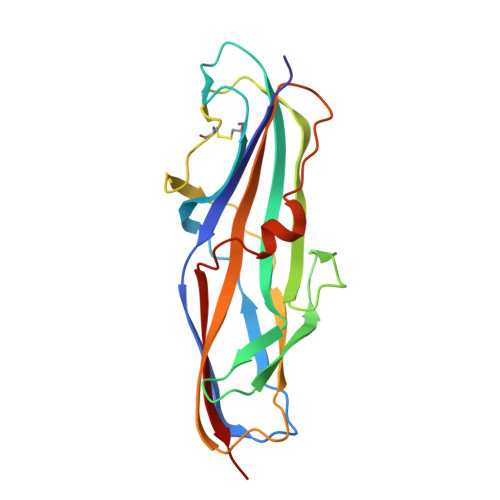
Crystal structure of the lectin domain of PapG from E. coli BI47 in complex with 4-methoxyphenyl beta-D-galabiose in space group P21


Experimental Data Snapshot

  • Method: X-RAY DIFFRACTION
  • Resolution: 1.50 Å
  • R-Value Free: 
    0.178 (Depositor), 0.176 (DCC) 
  • R-Value Work: 
    0.150 (Depositor), 0.149 (DCC) 
  • R-Value Observed: 
    0.151 (Depositor) 

Starting Model: experimental
View more details

wwPDB Validation 3D Report Full Report

Validation slider image for 4Z3H

This is version 2.3 of the entry. See complete history

Literature

Carbohydrate-Lectin Interactions: An Unexpected Contribution to Affinity.

Navarra, G.Zihlmann, P.Jakob, R.P.Stangier, K.Preston, R.C.Rabbani, S.Smiesko, M.Wagner, B.Maier, T.Ernst, B.

(2017) Chembiochem 18: 539-544

  • DOI: https://doi.org/10.1002/cbic.201600615
  • Primary Citation Related Structures: 
    4Z3E, 4Z3F, 4Z3G, 4Z3H, 4Z3I, 4Z3J

  • PubMed Abstract: 

    Uropathogenic E. coli exploit PapG-II adhesin for infecting host cells of the kidney; the expression of PapG-II at the tip of bacterial pili correlates with the onset of pyelonephritis in humans, a potentially life-threatening condition. It was envisaged that blocking PapG-II (and thus bacterial adhesion) would provide a viable therapeutic alternative to conventional antibiotic treatment. In our search for potent PapG-II antagonists, we observed an increase in affinity when tetrasaccharide 1, the natural ligand of PapG-II in human kidneys, was elongated to hexasaccharide 2, even though the additional Siaα(2-3)Gal extension is not in direct contact with the lectin. ITC studies suggest that the increased affinity results from partial desolvation of nonbinding regions of the hexasaccharide; this is ultimately responsible for perturbation of the outer hydration layers. Our results are in agreement with previous observations and suggest a general mechanism for modulating carbohydrate-protein interactions based on nonbinding regions of the ligand.


  • Organizational Affiliation
    • Institute of Molecular Pharmacy, Pharmacenter, University of Basel, Klingelbergstrasse 50, 4056, Basel, Switzerland.

Macromolecule Content 

  • Total Structure Weight: 23.22 kDa 
  • Atom Count: 1,974 
  • Modeled Residue Count: 197 
  • Deposited Residue Count: 198 
  • Unique protein chains: 1

Macromolecules

Find similar proteins by:|  3D Structure
Entity ID: 1
MoleculeChains  Sequence LengthOrganismDetailsImage
PapG, lectin domain198Escherichia coliMutation(s): 0 
UniProt
Find proteins for A0A182DW20 (Escherichia coli)
Explore A0A182DW20 
Go to UniProtKB:  A0A182DW20
Entity Groups
Sequence Clusters30% Identity50% Identity70% Identity90% Identity95% Identity100% Identity
UniProt GroupA0A182DW20
Sequence Annotations
Expand
Reference Sequence

Oligosaccharides

Help  
Entity ID: 2
MoleculeChains Length2D Diagram GlycosylationD Interactions
alpha-D-galactopyranose-(1-4)-beta-D-galactopyranose
B
2N/A
Glycosylation Resources
GlyTouCan: G67988RO
GlyCosmos: G67988RO
GlyGen: G67988RO

Small Molecules

Ligands 1 Unique
IDChains Name / Formula / InChI Key2D Diagram3D Interactions
4KS

Query on 4KS


Download:Ideal Coordinates CCD File
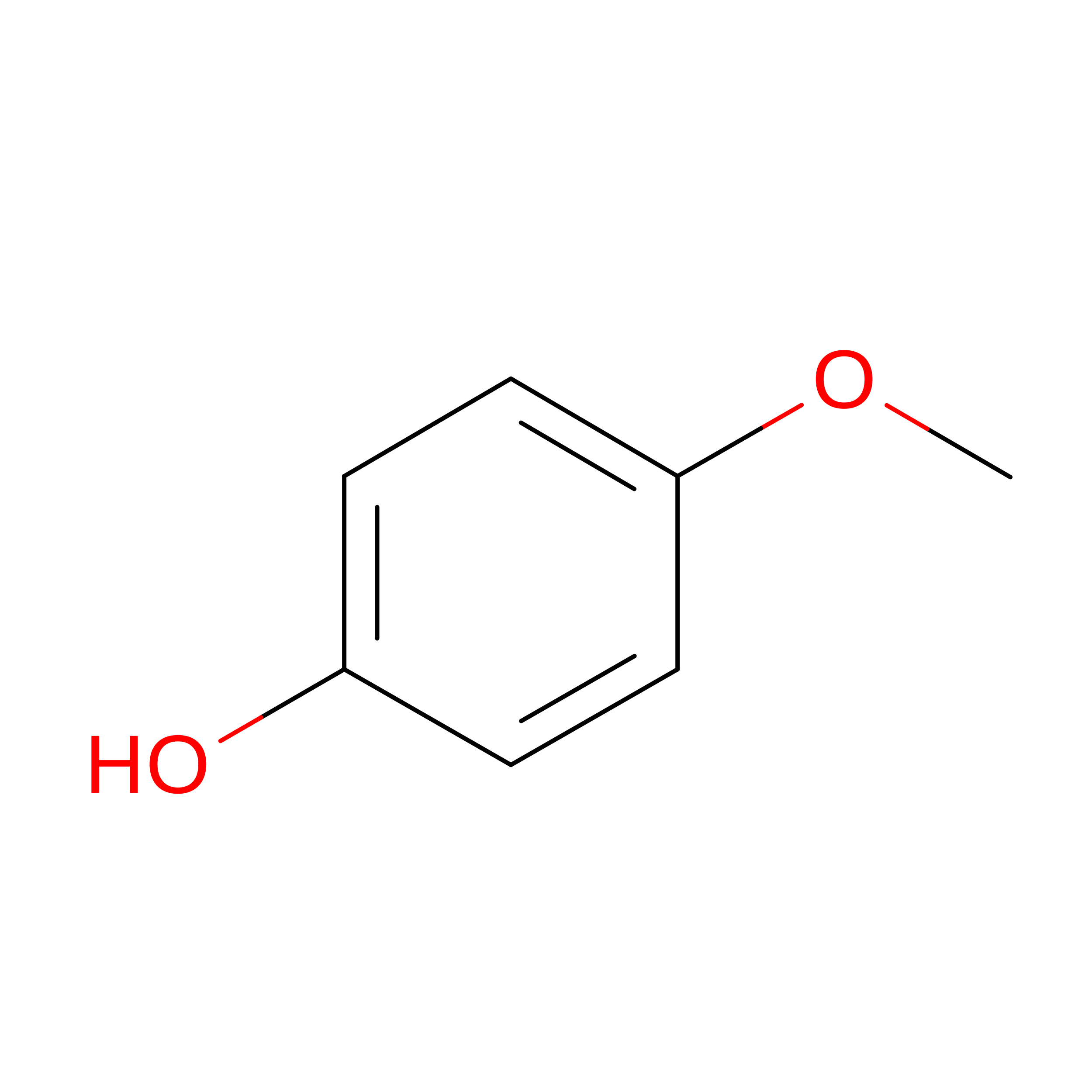
C [auth A]4-methoxyphenol
C7 H8 O2
NWVVVBRKAWDGAB-UHFFFAOYSA-N

Experimental Data & Validation

Experimental Data

  • Method: X-RAY DIFFRACTION
  • Resolution: 1.50 Å
  • R-Value Free:  0.178 (Depositor), 0.176 (DCC) 
  • R-Value Work:  0.150 (Depositor), 0.149 (DCC) 
  • R-Value Observed: 0.151 (Depositor) 
Space Group: P 1 21 1
Unit Cell:
Length ( Å )Angle ( ˚ )
a = 47.35α = 90
b = 53.77β = 117.58
c = 48.32γ = 90
Software Package:
Software NamePurpose
BUSTERrefinement
XDSdata reduction
XSCALEdata scaling
PHASERphasing

Structure Validation

View Full Validation Report


Entry History 

Deposition Data

Revision History  (Full details and data files)

  • Version 1.0: 2016-04-13
    Type: Initial release
  • Version 2.0: 2020-07-29
    Type: Remediation
    Reason: Carbohydrate remediation
    Changes: Atomic model, Data collection, Derived calculations, Structure summary
  • Version 2.1: 2024-01-10
    Changes: Data collection, Database references, Derived calculations, Refinement description, Structure summary
  • Version 2.2: 2024-07-17
    Changes: Database references
  • Version 2.3: 2024-10-09
    Changes: Structure summary