4YG6 | pdb_00004yg6

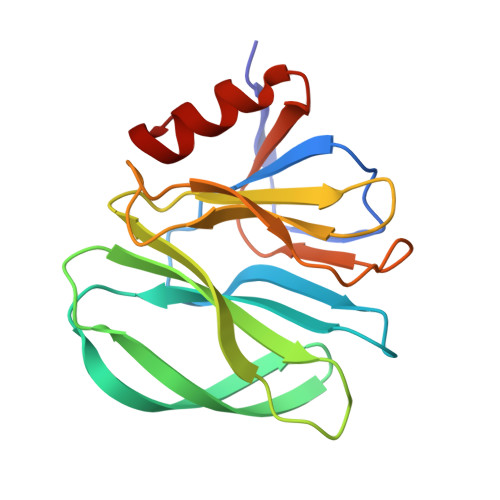
Structural basis of glycan recognition in neonate-specific rotaviruses


Experimental Data Snapshot

  • Method: X-RAY DIFFRACTION
  • Resolution: 1.46 Å
  • R-Value Free: 
    0.197 (Depositor), 0.209 (DCC) 
  • R-Value Work: 
    0.176 (Depositor), 0.187 (DCC) 
  • R-Value Observed: 
    0.177 (Depositor) 

Starting Model: experimental
View more details

wwPDB Validation 3D Report Full Report

Validation slider image for 4YG6

This is version 2.1 of the entry. See complete history

Literature

Structural basis of glycan specificity in neonate-specific bovine-human reassortant rotavirus.

Hu, L.Ramani, S.Czako, R.Sankaran, B.Yu, Y.Smith, D.F.Cummings, R.D.Estes, M.K.Venkataram Prasad, B.V.

(2015) Nat Commun 6: 8346-8346

  • DOI: https://doi.org/10.1038/ncomms9346
  • Primary Citation Related Structures: 
    4YFW, 4YFZ, 4YG0, 4YG3, 4YG6

  • PubMed Abstract: 

    Strain-dependent variation of glycan recognition during initial cell attachment of viruses is a critical determinant of host specificity, tissue-tropism and zoonosis. Rotaviruses (RVs), which cause life-threatening gastroenteritis in infants and children, display significant genotype-dependent variations in glycan recognition resulting from sequence alterations in the VP8* domain of the spike protein VP4. The structural basis of this genotype-dependent glycan specificity, particularly in human RVs, remains poorly understood. Here, from crystallographic studies, we show how genotypic variations configure a novel binding site in the VP8* of a neonate-specific bovine-human reassortant to uniquely recognize either type I or type II precursor glycans, and to restrict type II glycan binding in the bovine counterpart. Such a distinct glycan-binding site that allows differential recognition of the precursor glycans, which are developmentally regulated in the neonate gut and abundant in bovine and human milk provides a basis for age-restricted tropism and zoonotic transmission of G10P[11] rotaviruses.


  • Organizational Affiliation
    • Verna and Marrs McLean Department of Biochemistry and Molecular Biology, Baylor College of Medicine, One Baylor Plaza, Houston, Texas 77030, USA.

Macromolecule Content 

  • Total Structure Weight: 75.14 kDa 
  • Atom Count: 6,759 
  • Modeled Residue Count: 651 
  • Deposited Residue Count: 652 
  • Unique protein chains: 1

Macromolecules

Find similar proteins by:|  3D Structure
Entity ID: 1
MoleculeChains  Sequence LengthOrganismDetailsImage
Outer capsid protein VP8*
A, B, C, D
163Rotavirus A RVA/Cow-tc/USA/B223/1983/G10P[11]Mutation(s): 0 
UniProt
Find proteins for A2T3T2 (Rotavirus A (isolate RVA/Monkey/South Africa/SA11-H96/1958/G3P5B[2]))
Explore A2T3T2 
Go to UniProtKB:  A2T3T2
Entity Groups
Sequence Clusters30% Identity50% Identity70% Identity90% Identity95% Identity100% Identity
UniProt GroupA2T3T2
Sequence Annotations
Expand
Reference Sequence

Oligosaccharides

Help  
Entity ID: 2
MoleculeChains Length2D Diagram GlycosylationD Interactions
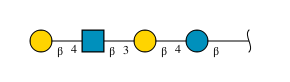
beta-D-galactopyranose-(1-4)-2-acetamido-2-deoxy-beta-D-glucopyranose-(1-3)-beta-D-galactopyranose-(1-4)-beta-D-glucopyranose
E, F, G
4N/A
Glycosylation Resources
GlyTouCan: G58896AZ
GlyCosmos: G58896AZ
GlyGen: G58896AZ
Entity ID: 3
MoleculeChains Length2D Diagram GlycosylationD Interactions
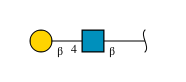
beta-D-galactopyranose-(1-4)-2-acetamido-2-deoxy-beta-D-glucopyranose
H
2N/A
Glycosylation Resources
GlyTouCan: G00055MO
GlyCosmos: G00055MO
GlyGen: G00055MO

Experimental Data & Validation

Experimental Data

  • Method: X-RAY DIFFRACTION
  • Resolution: 1.46 Å
  • R-Value Free:  0.197 (Depositor), 0.209 (DCC) 
  • R-Value Work:  0.176 (Depositor), 0.187 (DCC) 
  • R-Value Observed: 0.177 (Depositor) 
Space Group: P 1 21 1
Unit Cell:
Length ( Å )Angle ( ˚ )
a = 36.2α = 90
b = 140.28β = 90.78
c = 54.6γ = 90
Software Package:
Software NamePurpose
PHENIXrefinement
iMOSFLMdata reduction
SCALAdata scaling
PHASERphasing

Structure Validation

View Full Validation Report


Entry History 

& Funding Information

Deposition Data


Funding OrganizationLocationGrant Number
National Institutes of Health/National Institute Of Allergy and Infectious Diseases (NIH/NIAID)United StatesAI36040

Revision History  (Full details and data files)

  • Version 1.0: 2015-09-30
    Type: Initial release
  • Version 1.1: 2015-10-14
    Changes: Database references
  • Version 1.2: 2017-09-13
    Changes: Advisory, Author supporting evidence, Derived calculations
  • Version 1.3: 2019-12-11
    Changes: Author supporting evidence, Data collection
  • Version 2.0: 2020-07-29
    Type: Remediation
    Reason: Carbohydrate remediation
    Changes: Advisory, Atomic model, Data collection, Derived calculations, Structure summary
  • Version 2.1: 2023-09-27
    Changes: Advisory, Data collection, Database references, Derived calculations, Refinement description, Structure summary