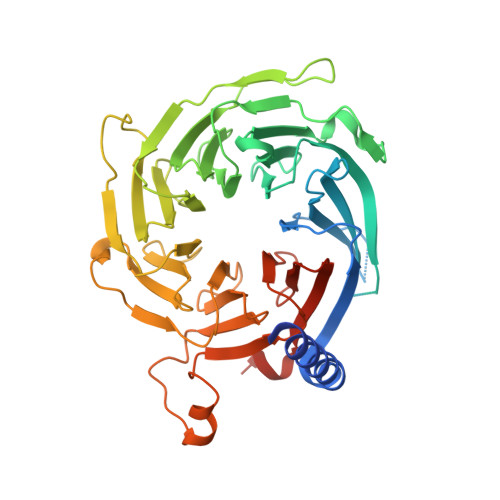
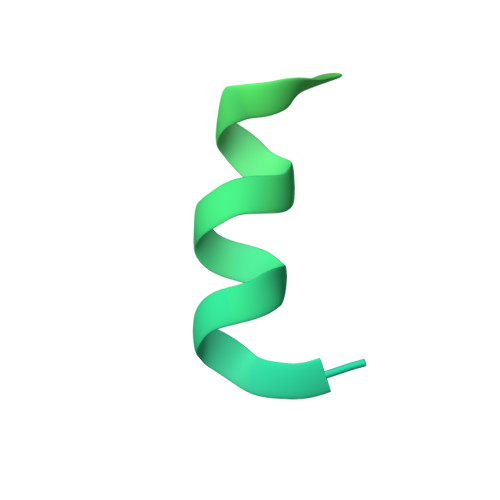
4XYI | pdb_00004xyi

Mis16 with H4 peptide


Experimental Data Snapshot

  • Method: X-RAY DIFFRACTION
  • Resolution: 3.00 Å
  • R-Value Free: 
    0.230 (Depositor), 0.231 (DCC) 
  • R-Value Work: 
    0.200 (Depositor), 0.203 (DCC) 
  • R-Value Observed: 
    0.203 (Depositor) 

Starting Model: experimental
View more details

wwPDB Validation 3D Report Full Report

Validation slider image for 4XYI

This is version 1.3 of the entry. See complete history

Literature

Mis16 Independently Recognizes Histone H4 and the CENP-ACnp1-Specific Chaperone Scm3sp.

An, S.Kim, H.Cho, U.S.

(2015) J Mol Biology 427: 3230-3240

  • DOI: https://doi.org/10.1016/j.jmb.2015.08.022
  • Primary Citation Related Structures: 
    4XYH, 4XYI

  • PubMed Abstract: 

    CENP-A is a centromere-specific histone H3 variant that is required for kinetochore assembly and accurate chromosome segregation. For it to function properly, CENP-A must be specifically localized to centromeres. In fission yeast, Scm3sp and the Mis18 complex, composed of Mis16, Eic1, and Mis18, function as a CENP-A(Cnp1)-specific chaperone and a recruiting factor, respectively, and together ensure accurate delivery of CENP-A(Cnp1) to centromeres. Although how Scm3sp specifically recognizes CENP-A(Cnp1) has been revealed recently, the recruiting mechanism of CENP-A(Cnp1) via the Mis18 complex remains unknown. In this study, we have determined crystal structures of Schizosaccharomyces japonicus Mis16 alone and in complex with the helix 1 of histone H4 (H4α1). Crystal structures followed by mutant analysis and affinity pull-downs have revealed that Mis16 recognizes both H4α1 and Scm3sp independently within the CENP-A(Cnp1)/H4:Scm3sp complex. This observation suggests that Mis16 gains CENP-A(Cnp1) specificity by recognizing both Scm3sp and histone H4. Our studies provide insights into the molecular mechanisms underlying specific recruitment of CENP-A(Cnp1)/H4:Scm3sp into centromeres.


  • Organizational Affiliation
    • Department of Biological Chemistry, University of Michigan Medical School, 1150 West Medical Center Drive, SPC 5606, Ann Arbor, MI 48109, USA.

Macromolecule Content 

  • Total Structure Weight: 59.88 kDa 
  • Atom Count: 3,079 
  • Modeled Residue Count: 388 
  • Deposited Residue Count: 533 
  • Unique protein chains: 2

Macromolecules

Find similar proteins by:|  3D Structure
Entity ID: 1
MoleculeChains  Sequence LengthOrganismDetailsImage
Kinetochore protein Mis16430Schizosaccharomyces japonicus yFS275Mutation(s): 0 
Gene Names: SJAG_03867
UniProt
Find proteins for B6K598 (Schizosaccharomyces japonicus (strain yFS275 / FY16936))
Explore B6K598 
Go to UniProtKB:  B6K598
Entity Groups
Sequence Clusters30% Identity50% Identity70% Identity90% Identity95% Identity100% Identity
UniProt GroupB6K598
Sequence Annotations
Expand
Reference Sequence
Find similar proteins by:|  3D Structure
Entity ID: 2
MoleculeChains  Sequence LengthOrganismDetailsImage
Histone H4103Schizosaccharomyces japonicus yFS275Mutation(s): 0 
UniProt
Find proteins for B6JV96 (Schizosaccharomyces japonicus (strain yFS275 / FY16936))
Explore B6JV96 
Go to UniProtKB:  B6JV96
Entity Groups
Sequence Clusters30% Identity50% Identity70% Identity90% Identity95% Identity100% Identity
UniProt GroupB6JV96
Sequence Annotations
Expand
Reference Sequence

Experimental Data & Validation

Experimental Data

  • Method: X-RAY DIFFRACTION
  • Resolution: 3.00 Å
  • R-Value Free:  0.230 (Depositor), 0.231 (DCC) 
  • R-Value Work:  0.200 (Depositor), 0.203 (DCC) 
  • R-Value Observed: 0.203 (Depositor) 
Space Group: P 65
Unit Cell:
Length ( Å )Angle ( ˚ )
a = 136.226α = 90
b = 136.226β = 90
c = 65.536γ = 120
Software Package:
Software NamePurpose
PHENIXrefinement
HKL-2000data reduction
HKL-2000data scaling
PHASERphasing

Structure Validation

View Full Validation Report


Entry History 

Deposition Data

Revision History  (Full details and data files)

  • Version 1.0: 2016-02-03
    Type: Initial release
  • Version 1.1: 2016-02-17
    Changes: Database references
  • Version 1.2: 2018-06-13
    Changes: Data collection, Database references, Derived calculations
  • Version 1.3: 2023-09-27
    Changes: Data collection, Database references, Refinement description