4XRT | pdb_00004xrt

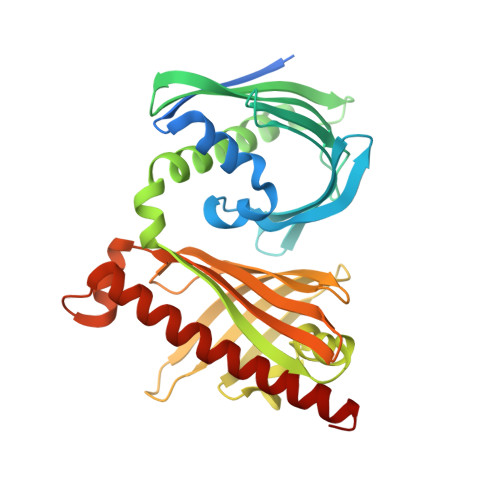
Crystal structure of the di-domain ARO/CYC StfQ from the steffimycin biosynthetic pathway


Experimental Data Snapshot

  • Method: X-RAY DIFFRACTION
  • Resolution: 1.95 Å
  • R-Value Free: 
    0.209 (Depositor), 0.211 (DCC) 
  • R-Value Work: 
    0.178 (Depositor), 0.183 (DCC) 
  • R-Value Observed: 
    0.179 (Depositor) 

wwPDB Validation 3D Report Full Report

Validation slider image for 4XRT

This is version 1.5 of the entry. See complete history

Literature

Structural and functional analysis of two di-domain aromatase/cyclases from type II polyketide synthases.

Caldara-Festin, G.Jackson, D.R.Barajas, J.F.Valentic, T.R.Patel, A.B.Aguilar, S.Nguyen, M.Vo, M.Khanna, A.Sasaki, E.Liu, H.W.Tsai, S.C.

(2015) Proc Natl Acad Sci U S A 112: E6844-E6851

  • DOI: https://doi.org/10.1073/pnas.1512976112
  • Primary Citation Related Structures: 
    4XRT, 4XRW

  • PubMed Abstract: 

    Aromatic polyketides make up a large class of natural products with diverse bioactivity. During biosynthesis, linear poly-β-ketone intermediates are regiospecifically cyclized, yielding molecules with defined cyclization patterns that are crucial for polyketide bioactivity. The aromatase/cyclases (ARO/CYCs) are responsible for regiospecific cyclization of bacterial polyketides. The two most common cyclization patterns are C7-C12 and C9-C14 cyclizations. We have previously characterized three monodomain ARO/CYCs: ZhuI, TcmN, and WhiE. The last remaining uncharacterized class of ARO/CYCs is the di-domain ARO/CYCs, which catalyze C7-C12 cyclization and/or aromatization. Di-domain ARO/CYCs can further be separated into two subclasses: "nonreducing" ARO/CYCs, which act on nonreduced poly-β-ketones, and "reducing" ARO/CYCs, which act on cyclized C9 reduced poly-β-ketones. For years, the functional role of each domain in cyclization and aromatization for di-domain ARO/CYCs has remained a mystery. Here we present what is to our knowledge the first structural and functional analysis, along with an in-depth comparison, of the nonreducing (StfQ) and reducing (BexL) di-domain ARO/CYCs. This work completes the structural and functional characterization of mono- and di-domain ARO/CYCs in bacterial type II polyketide synthases and lays the groundwork for engineered biosynthesis of new bioactive polyketides.


  • Organizational Affiliation
    • Department of Molecular Biology and Biochemistry, University of California, Irvine, CA 92697; Department of Chemistry, University of California, Irvine, CA 92697; Department of Pharmaceutical Sciences, University of California, Irvine, CA 92697;

Macromolecule Content 

  • Total Structure Weight: 74.32 kDa 
  • Atom Count: 5,452 
  • Modeled Residue Count: 601 
  • Deposited Residue Count: 658 
  • Unique protein chains: 1

Macromolecules

Find similar proteins by:|  3D Structure
Entity ID: 1
MoleculeChains  Sequence LengthOrganismDetailsImage
StfQ Aromatase/Cyclase
A, B
329Streptomyces steffisburgensisMutation(s): 0 
Gene Names: stfQ
UniProt
Find proteins for Q2PA00 (Streptomyces steffisburgensis)
Explore Q2PA00 
Go to UniProtKB:  Q2PA00
Entity Groups
Sequence Clusters30% Identity50% Identity70% Identity90% Identity95% Identity100% Identity
UniProt GroupQ2PA00
Sequence Annotations
Expand
Reference Sequence

Experimental Data & Validation

Experimental Data

  • Method: X-RAY DIFFRACTION
  • Resolution: 1.95 Å
  • R-Value Free:  0.209 (Depositor), 0.211 (DCC) 
  • R-Value Work:  0.178 (Depositor), 0.183 (DCC) 
  • R-Value Observed: 0.179 (Depositor) 
Space Group: P 21 21 21
Unit Cell:
Length ( Å )Angle ( ˚ )
a = 59.976α = 90
b = 92.433β = 90
c = 138.529γ = 90
Software Package:
Software NamePurpose
PHENIXrefinement
HKL-2000data reduction
HKL-2000data scaling
PHENIXphasing

Structure Validation

View Full Validation Report


Entry History 

& Funding Information

Deposition Data


Funding OrganizationLocationGrant Number
National Institutes of Health/National Institute of General Medical Sciences (NIH/NIGMS)United States3R01GM076330-04S1

Revision History  (Full details and data files)

  • Version 1.0: 2015-12-02
    Type: Initial release
  • Version 1.1: 2015-12-16
    Changes: Database references
  • Version 1.2: 2015-12-30
    Changes: Database references
  • Version 1.3: 2017-09-06
    Changes: Author supporting evidence, Database references, Derived calculations
  • Version 1.4: 2019-12-25
    Changes: Author supporting evidence
  • Version 1.5: 2024-02-28
    Changes: Data collection, Database references