4XLO | pdb_00004xlo

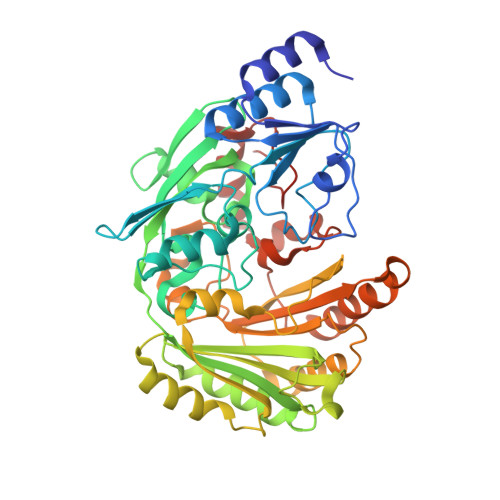
Crystal Structure of EncM (crystallized with 4 mM NADPH)


Experimental Data Snapshot

  • Method: X-RAY DIFFRACTION
  • Resolution: 1.67 Å
  • R-Value Free: 
    0.230 (Depositor), 0.227 (DCC) 
  • R-Value Work: 
    0.185 (Depositor), 0.182 (DCC) 
  • R-Value Observed: 
    0.187 (Depositor) 

Starting Model: experimental
View more details

wwPDB Validation 3D Report Full Report

Validation slider image for 4XLO

Ligand Structure Quality Assessment 


This is version 1.5 of the entry. See complete history

Literature

Flavin-mediated dual oxidation controls an enzymatic Favorskii-type rearrangement.

Teufel, R.Miyanaga, A.Michaudel, Q.Stull, F.Louie, G.Noel, J.P.Baran, P.S.Palfey, B.Moore, B.S.

(2013) Nature 503: 552-556

  • DOI: https://doi.org/10.1038/nature12643
  • Primary Citation Related Structures: 
    3W8W, 3W8X, 3W8Z, 4XLO

  • PubMed Abstract: 

    Flavoproteins catalyse a diversity of fundamental redox reactions and are one of the most studied enzyme families. As monooxygenases, they are universally thought to control oxygenation by means of a peroxyflavin species that transfers a single atom of molecular oxygen to an organic substrate. Here we report that the bacterial flavoenzyme EncM catalyses the peroxyflavin-independent oxygenation-dehydrogenation dual oxidation of a highly reactive poly(β-carbonyl). The crystal structure of EncM with bound substrate mimics and isotope labelling studies reveal previously unknown flavin redox biochemistry. We show that EncM maintains an unexpected stable flavin-oxygenating species, proposed to be a flavin-N5-oxide, to promote substrate oxidation and trigger a rare Favorskii-type rearrangement that is central to the biosynthesis of the antibiotic enterocin. This work provides new insight into the fine-tuning of the flavin cofactor in offsetting the innate reactivity of a polyketide substrate to direct its efficient electrocyclization.


  • Organizational Affiliation
    • Center for Marine Biotechnology and Biomedicine, Scripps Institution of Oceanography, University of California San Diego, La Jolla, California, 92093, USA.

Macromolecule Content 

  • Total Structure Weight: 203.44 kDa 
  • Atom Count: 16,464 
  • Modeled Residue Count: 1,841 
  • Deposited Residue Count: 1,856 
  • Unique protein chains: 1

Macromolecules

Find similar proteins by:|  3D Structure
Entity ID: 1
MoleculeChains  Sequence LengthOrganismDetailsImage
FAD-dependent oxygenase EncM
A, B, C, D
464Streptomyces maritimusMutation(s): 0 
Gene Names: encM
UniProt
Find proteins for Q9KHK2 (Streptomyces maritimus)
Explore Q9KHK2 
Go to UniProtKB:  Q9KHK2
Entity Groups
Sequence Clusters30% Identity50% Identity70% Identity90% Identity95% Identity100% Identity
UniProt GroupQ9KHK2
Sequence Annotations
Expand
Reference Sequence

Experimental Data & Validation

Experimental Data

  • Method: X-RAY DIFFRACTION
  • Resolution: 1.67 Å
  • R-Value Free:  0.230 (Depositor), 0.227 (DCC) 
  • R-Value Work:  0.185 (Depositor), 0.182 (DCC) 
  • R-Value Observed: 0.187 (Depositor) 
Space Group: C 2 2 2
Unit Cell:
Length ( Å )Angle ( ˚ )
a = 166.06α = 90
b = 175.02β = 90
c = 132.29γ = 90
Software Package:
Software NamePurpose
REFMACrefinement
iMOSFLMdata reduction
MOSFLMdata reduction
MOLREPphasing

Structure Validation

View Full Validation Report


Ligand Structure Quality Assessment 


Entry History 

& Funding Information

Deposition Data

  • Released Date: 2015-01-28 
  • Deposition Author(s): Teufel, R.

Funding OrganizationLocationGrant Number
National Institutes of Health/National Institute Of Allergy and Infectious Diseases (NIH/NIAID)United StatesR01AI47818

Revision History  (Full details and data files)

  • Version 1.0: 2015-01-28
    Type: Initial release
  • Version 1.1: 2017-09-06
    Changes: Author supporting evidence, Derived calculations, Source and taxonomy
  • Version 1.2: 2017-11-22
    Changes: Refinement description
  • Version 1.3: 2019-12-11
    Changes: Author supporting evidence
  • Version 1.4: 2023-09-27
    Changes: Data collection, Database references, Refinement description
  • Version 1.5: 2024-10-23
    Changes: Structure summary