Download Mendeley
Structural Insights into the Substrate Specificity of a Glycoside Hydrolase Family 5 Lichenase from Caldicellulosiruptor sp. F32
Meng, D.D., Liu, X., Dong, S., Wang, Y.F., Ma, X.Q., Zhou, H., Wang, X., Yao, L.S., Feng, Y., Li, F.L.(2017) Biochem J
- PubMed: 28838949 Search on PubMed
- DOI: https://doi.org/10.1042/BCJ20170328
- Primary Citation Related Structures:
4X0V, 5H4R - PubMed Abstract:
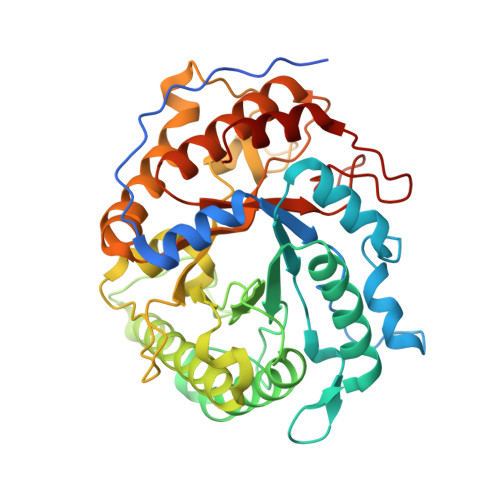
Glycoside hydrolase (GH) family 5 is one of the largest GH families with various GH activities including lichenase, but the structural basis of the GH5 lichenase activity is still unknown. A novel thermostable lichenase F32EG5 belonging to GH5 was identified from an extremely thermophilic bacterium Caldicellulosiruptor sp. F32. F32EG5 is a bi-functional cellulose and a lichenan-degrading enzyme, and exhibited a high activity on β-1,3-1,4-glucan but side activity on cellulose. Thin-layer chromatography and NMR analyses indicated that F32EG5 cleaved the β-1,4 linkage or the β-1,3 linkage while a 4- O -substitued glucose residue linked to a glucose residue through a β-1,3 linkage, which is completely different from extensively studied GH16 lichenase that catalyses strict endo-hydrolysis of the β-1,4-glycosidic linkage adjacent to a 3- O -substitued glucose residue in the mixed-linked β-glucans. The crystal structure of F32EG5 was determined to 2.8 Å resolution, and the crystal structure of the complex of F32EG5 E193Q mutant and cellotetraose was determined to 1.7 Å resolution, which revealed that the exit subsites of substrate-binding sites contribute to both thermostability and substrate specificity of F32EG5. The sugar chain showed a sharp bend in the complex structure, suggesting that a substrate cleft fitting to the bent sugar chains in lichenan is a common feature of GH5 lichenases. The mechanism of thermostability and substrate selectivity of F32EG5 was further demonstrated by molecular dynamics simulation and site-directed mutagenesis. These results provide biochemical and structural insights into thermostability and substrate selectivity of GH5 lichenases, which have potential in industrial processes.
- Key Laboratory of Biofuels, Qingdao Institute of Bioenergy and Bioprocess Technology, Chinese Academy of Sciences, Qingdao 266101, China.
Organizational Affiliation: