4X09 | pdb_00004x09

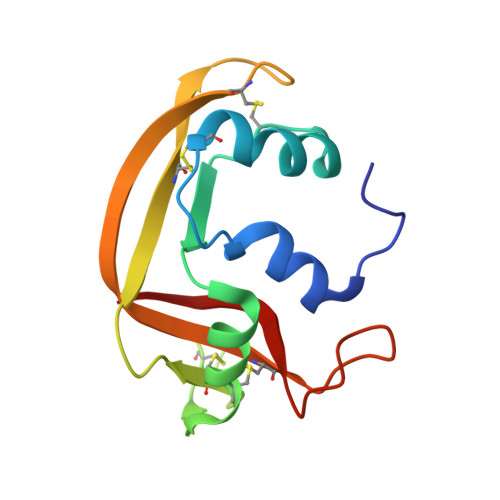
Structure of human RNase 6 in complex with sulphate anions


Experimental Data Snapshot

  • Method: X-RAY DIFFRACTION
  • Resolution: 1.72 Å
  • R-Value Free: 
    0.227 (Depositor), 0.231 (DCC) 
  • R-Value Work: 
    0.193 (Depositor), 0.200 (DCC) 
  • R-Value Observed: 
    0.194 (Depositor) 

Starting Model: experimental
View more details

wwPDB Validation 3D Report Full Report

Validation slider image for 4X09

This is version 1.4 of the entry. See complete history

Literature

The first crystal structure of human RNase 6 reveals a novel substrate-binding and cleavage site arrangement.

Prats-Ejarque, G.Arranz-Trullen, J.Blanco, J.A.Pulido, D.Nogues, M.V.Moussaoui, M.Boix, E.

(2016) Biochem J 473: 1523-1536

  • DOI: https://doi.org/10.1042/BCJ20160245
  • Primary Citation Related Structures: 
    4X09

  • PubMed Abstract: 

    Human RNase 6 is a cationic secreted protein that belongs to the RNase A superfamily. Its expression is induced in neutrophils and monocytes upon bacterial infection, suggesting a role in host defence. We present here the crystal structure of RNase 6 obtained at 1.72 Å (1 Å=0.1 nm) resolution, which is the first report for the protein 3D structure and thereby setting the basis for functional studies. The structure shows an overall kidney-shaped globular fold shared with the other known family members. Three sulfate anions bound to RNase 6 were found, interacting with residues at the main active site (His(15), His(122) and Gln(14)) and cationic surface-exposed residues (His(36), His(39), Arg(66) and His(67)). Kinetic characterization, together with prediction of protein-nucleotide complexes by molecular dynamics, was applied to analyse the RNase 6 substrate nitrogenous base and phosphate selectivity. Our results reveal that, although RNase 6 is a moderate catalyst in comparison with the pancreatic RNase type, its structure includes lineage-specific features that facilitate its activity towards polymeric nucleotide substrates. In particular, enzyme interactions at the substrate 5' end can provide an endonuclease-type cleavage pattern. Interestingly, the RNase 6 crystal structure revealed a novel secondary active site conformed by the His(36)-His(39) dyad that facilitates the polynucleotide substrate catalysis.


  • Organizational Affiliation
    • Department of Biochemistry and Molecular Biology, Faculty of Biosciences, Universitat Autònoma de Barcelona, E-08193 Cerdanyola del Vallès, Spain.

Macromolecule Content 

  • Total Structure Weight: 15.28 kDa 
  • Atom Count: 1,225 
  • Modeled Residue Count: 128 
  • Deposited Residue Count: 128 
  • Unique protein chains: 1

Macromolecules

Find similar proteins by:|  3D Structure
Entity ID: 1
MoleculeChains  Sequence LengthOrganismDetailsImage
Ribonuclease K6128Homo sapiensMutation(s): 0 
Gene Names: RNASE6RNS6
EC: 3.1.27.5 (PDB Primary Data), 3.1.27 (UniProt)
UniProt & NIH Common Fund Data Resources
Find proteins for Q93091 (Homo sapiens)
Explore Q93091 
Go to UniProtKB:  Q93091
PHAROS:  Q93091
GTEx:  ENSG00000169413 
Entity Groups
Sequence Clusters30% Identity50% Identity70% Identity90% Identity95% Identity100% Identity
UniProt GroupQ93091
Sequence Annotations
Expand
Reference Sequence

Experimental Data & Validation

Experimental Data

  • Method: X-RAY DIFFRACTION
  • Resolution: 1.72 Å
  • R-Value Free:  0.227 (Depositor), 0.231 (DCC) 
  • R-Value Work:  0.193 (Depositor), 0.200 (DCC) 
  • R-Value Observed: 0.194 (Depositor) 
Space Group: P 21 21 21
Unit Cell:
Length ( Å )Angle ( ˚ )
a = 27.733α = 90
b = 38.86β = 90
c = 97.965γ = 90
Software Package:
Software NamePurpose
PHENIXrefinement
Cootmodel building
PHENIXphasing
Aimlessdata scaling
XDSdata reduction

Structure Validation

View Full Validation Report


Entry History 

& Funding Information

Deposition Data


Funding OrganizationLocationGrant Number
Spanish Ministry of Economy and CompetitivenessSpainBFU2012-38965
Generalitat de CatalunyaSpain2009 SGR 795

Revision History  (Full details and data files)

  • Version 1.0: 2016-04-06
    Type: Initial release
  • Version 1.1: 2016-06-08
    Changes: Database references
  • Version 1.2: 2017-09-13
    Changes: Author supporting evidence
  • Version 1.3: 2024-01-10
    Changes: Data collection, Database references, Refinement description
  • Version 1.4: 2024-10-23
    Changes: Structure summary