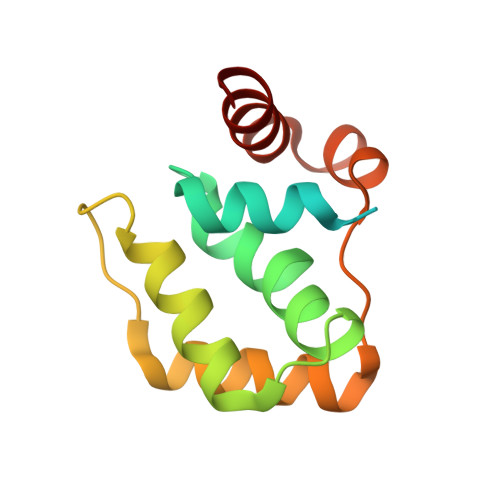
4WYH | pdb_00004wyh

Crystal structure of PriX from the hyperthermophilic archaeon Sulfolobus solfataricus


Experimental Data Snapshot

  • Method: X-RAY DIFFRACTION
  • Resolution: 1.95 Å
  • R-Value Free: 
    0.180 (Depositor), 0.182 (DCC) 
  • R-Value Work: 
    0.158 (Depositor), 0.159 (DCC) 
  • R-Value Observed: 
    0.160 (Depositor) 

wwPDB Validation 3D Report Full Report

Validation slider image for 4WYH

This is version 1.2 of the entry. See complete history

Literature

A primase subunit essential for efficient primer synthesis by an archaeal eukaryotic-type primase.

Liu, B.Ouyang, S.Makarova, K.S.Xia, Q.Zhu, Y.Li, Z.Guo, L.Koonin, E.V.Liu, Z.J.Huang, L.

(2015) Nat Commun 6: 7300-7300

  • DOI: https://doi.org/10.1038/ncomms8300
  • Primary Citation Related Structures: 
    4WYH

  • PubMed Abstract: 

    Archaea encode a eukaryotic-type primase comprising a catalytic subunit (PriS) and a noncatalytic subunit (PriL). Here we report the identification of a primase noncatalytic subunit, denoted PriX, from the hyperthermophilic archaeon Sulfolobus solfataricus. Like PriL, PriX is essential for the survival of the organism. The crystallographic analysis complemented by sensitive sequence comparisons shows that PriX is a diverged homologue of the C-terminal domain of PriL but lacks the iron-sulfur cluster. Phylogenomic analysis provides clues on the origin and evolution of PriX. PriX, PriL and PriS form a stable heterotrimer (PriSLX). Both PriSX and PriSLX show far greater affinity for nucleotide substrates and are substantially more active in primer synthesis than the PriSL heterodimer. In addition, PriL, but not PriX, facilitates primer extension by PriS. We propose that the catalytic activity of PriS is modulated through concerted interactions with the two noncatalytic subunits in primer synthesis.


  • Organizational Affiliation
    • State Key Laboratory of Microbial Resources, Institute of Microbiology, Chinese Academy of Sciences, No. 1 West Beichen Road, Chaoyang District, Beijing 100101, China.

Macromolecule Content 

  • Total Structure Weight: 15.76 kDa 
  • Atom Count: 927 
  • Modeled Residue Count: 99 
  • Deposited Residue Count: 129 
  • Unique protein chains: 1

Macromolecules

Find similar proteins by:|  3D Structure
Entity ID: 1
MoleculeChains  Sequence LengthOrganismDetailsImage
Uncharacterized protein129Saccharolobus solfataricus P2Mutation(s): 0 
Gene Names: SSO0502
UniProt
Find proteins for Q97ZS7 (Saccharolobus solfataricus (strain ATCC 35092 / DSM 1617 / JCM 11322 / P2))
Explore Q97ZS7 
Go to UniProtKB:  Q97ZS7
Entity Groups
Sequence Clusters30% Identity50% Identity70% Identity90% Identity95% Identity100% Identity
UniProt GroupQ97ZS7
Sequence Annotations
Expand
Reference Sequence

Experimental Data & Validation

Experimental Data

  • Method: X-RAY DIFFRACTION
  • Resolution: 1.95 Å
  • R-Value Free:  0.180 (Depositor), 0.182 (DCC) 
  • R-Value Work:  0.158 (Depositor), 0.159 (DCC) 
  • R-Value Observed: 0.160 (Depositor) 
Space Group: P 21 21 21
Unit Cell:
Length ( Å )Angle ( ˚ )
a = 28.258α = 90
b = 36.232β = 90
c = 83.758γ = 90
Software Package:
Software NamePurpose
PHENIXrefinement
HKL-2000data reduction
HKL-2000data scaling
HKL-2000phasing

Structure Validation

View Full Validation Report


Entry History 

Deposition Data

  • Released Date: 2015-06-24 
  • Deposition Author(s): Ouyang, S.

Revision History  (Full details and data files)

  • Version 1.0: 2015-06-24
    Type: Initial release
  • Version 1.1: 2015-07-01
    Changes: Database references
  • Version 1.2: 2024-03-20
    Changes: Data collection, Database references, Derived calculations, Source and taxonomy