4WVB | pdb_00004wvb

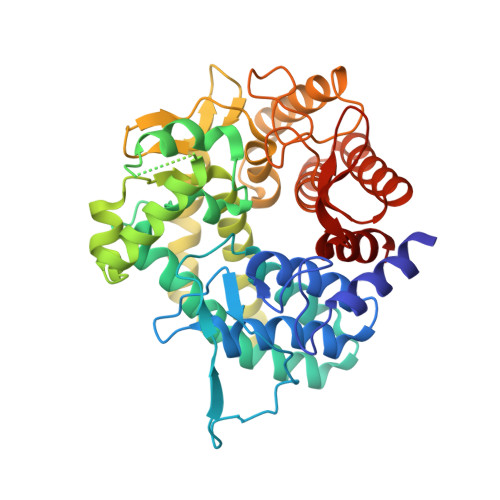
Crystal structure of GH63 mannosylglycerate hydrolase from Thermus thermophilus HB8 in complex with glucose


Experimental Data Snapshot

  • Method: X-RAY DIFFRACTION
  • Resolution: 1.77 Å
  • R-Value Free: 
    0.187 (Depositor), 0.200 (DCC) 
  • R-Value Work: 
    0.158 (Depositor), 0.172 (DCC) 
  • R-Value Observed: 
    0.160 (Depositor) 

Starting Model: experimental
View more details

wwPDB Validation 3D Report Full Report

Validation slider image for 4WVB

Ligand Structure Quality Assessment 


This is version 1.4 of the entry. See complete history

Literature

Crystal structure and substrate-binding mode of GH63 mannosylglycerate hydrolase from Thermus thermophilus HB8.

Miyazaki, T.Ichikawa, M.Iino, H.Nishikawa, A.Tonozuka, T.

(2015) J Struct Biol 190: 21-30

  • DOI: https://doi.org/10.1016/j.jsb.2015.02.006
  • Primary Citation Related Structures: 
    4WVA, 4WVB, 4WVC

  • PubMed Abstract: 

    Glycoside hydrolase family 63 (GH63) proteins are found in eukaryotes such as processing α-glucosidase I and also many bacteria and archaea. Recent studies have identified two bacterial and one plant GH63 mannosylglycerate hydrolases that act on both glucosylglycerate and mannosylglycerate, which are compatible solutes found in many thermophilic prokaryotes and some plants. Here we report the 1.67-Å crystal structure of one of these GH63 mannosylglycerate hydrolases, Tt8MGH from Thermus thermophilus HB8, which is 99% homologous to mannosylglycerate hydrolase from T. thermophilus HB27. Tt8MGH consists of a single (α/α)6-barrel catalytic domain with two additional helices and two long loops which form a homotrimer. The structures of this protein in complexes with glucose or glycerate were also determined at 1.77- or 2.10-Å resolution, respectively. A comparison of these structures revealed that the conformations of three flexible loops were largely different from each other. The conformational changes may be induced by ligand binding and serve to form finger-like structures for holding substrates. These findings represent the first-ever proposed substrate recognition mechanism for GH63 mannosylglycerate hydrolase.


  • Organizational Affiliation
    • Department of Applied Biological Science, Tokyo University of Agriculture and Technology, 3-5-8 Saiwai-cho, Fuchu, Tokyo 183-8509, Japan.

Macromolecule Content 

  • Total Structure Weight: 98.4 kDa 
  • Atom Count: 7,302 
  • Modeled Residue Count: 811 
  • Deposited Residue Count: 840 
  • Unique protein chains: 1

Macromolecules

Find similar proteins by:|  3D Structure
Entity ID: 1
MoleculeChains  Sequence LengthOrganismDetailsImage
Uncharacterized protein
A, B
420Thermus thermophilus HB8Mutation(s): 0 
Gene Names: TTHA0978
UniProt
Find proteins for Q5SJN0 (Thermus thermophilus (strain ATCC 27634 / DSM 579 / HB8))
Explore Q5SJN0 
Go to UniProtKB:  Q5SJN0
Entity Groups
Sequence Clusters30% Identity50% Identity70% Identity90% Identity95% Identity100% Identity
UniProt GroupQ5SJN0
Sequence Annotations
Expand
Reference Sequence

Small Molecules

Ligands 3 Unique
IDChains Name / Formula / InChI Key2D Diagram3D Interactions
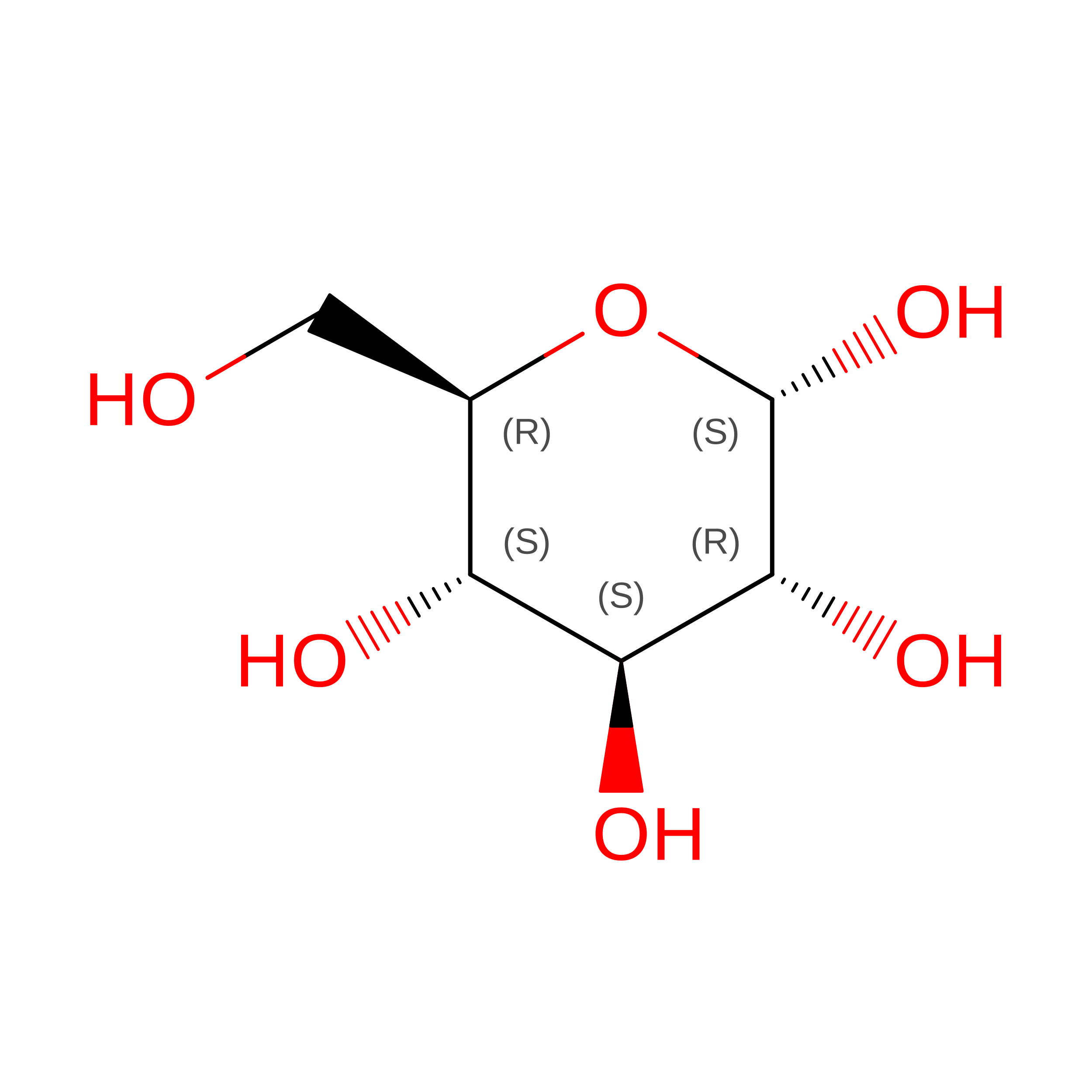
GLC

Query on GLC


Download:Ideal Coordinates CCD File
F [auth A]alpha-D-glucopyranose
C6 H12 O6
WQZGKKKJIJFFOK-DVKNGEFBSA-N
MPD

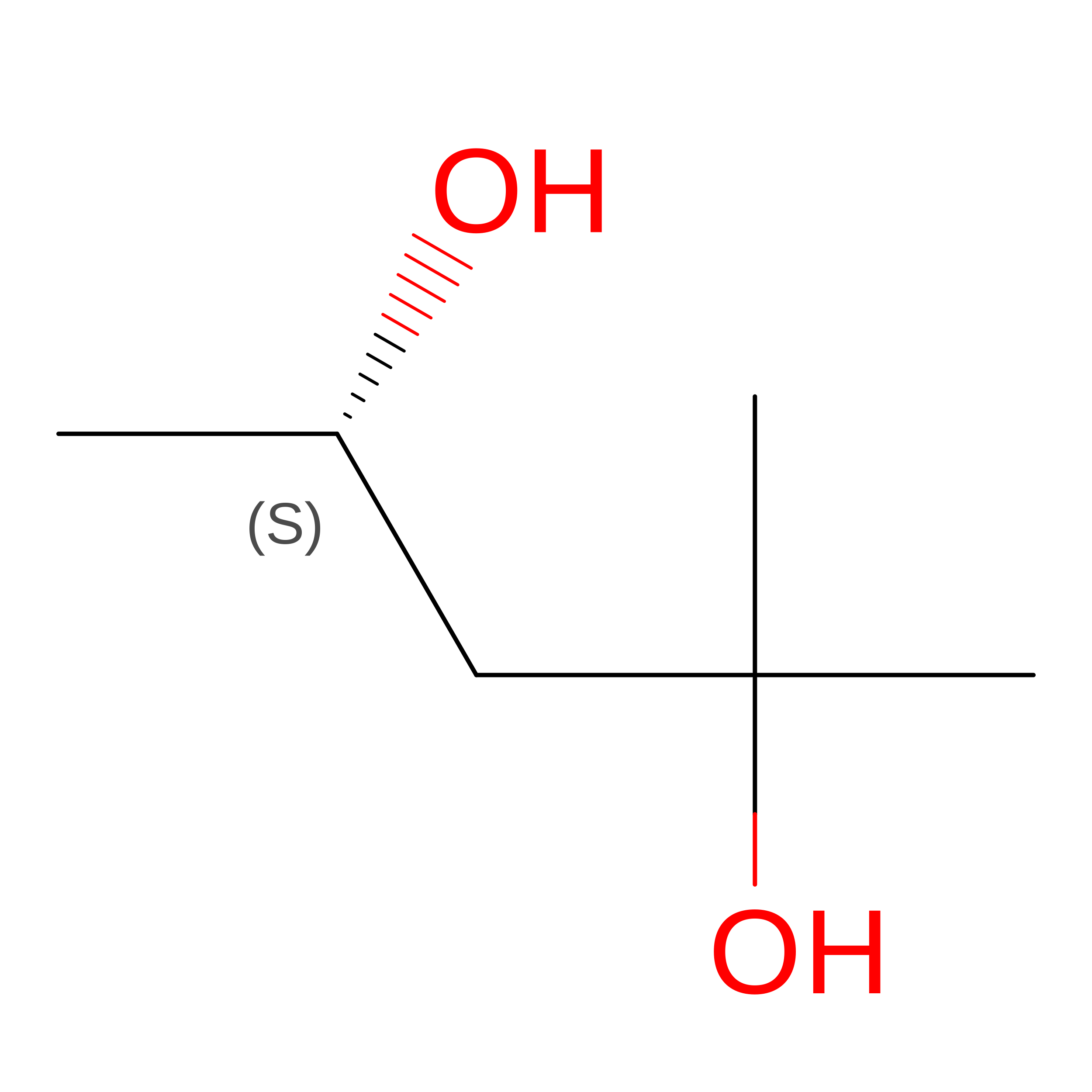
Query on MPD


Download:Ideal Coordinates CCD File
D [auth A],
E [auth A],
H [auth B],
I [auth B]
(4S)-2-METHYL-2,4-PENTANEDIOL
C6 H14 O2
SVTBMSDMJJWYQN-YFKPBYRVSA-N
CL

Query on CL


Download:Ideal Coordinates CCD File
C [auth A],
G [auth B]
CHLORIDE ION
Cl
VEXZGXHMUGYJMC-UHFFFAOYSA-M

Experimental Data & Validation

Experimental Data

  • Method: X-RAY DIFFRACTION
  • Resolution: 1.77 Å
  • R-Value Free:  0.187 (Depositor), 0.200 (DCC) 
  • R-Value Work:  0.158 (Depositor), 0.172 (DCC) 
  • R-Value Observed: 0.160 (Depositor) 
Space Group: H 3
Unit Cell:
Length ( Å )Angle ( ˚ )
a = 93.445α = 90
b = 93.445β = 90
c = 254.141γ = 120
Software Package:
Software NamePurpose
REFMACrefinement
HKL-2000data processing
HKL-2000data scaling
MOLREPphasing
Cootmodel building

Structure Validation

View Full Validation Report


Ligand Structure Quality Assessment 


Entry History 

Deposition Data

Revision History  (Full details and data files)

  • Version 1.0: 2015-03-11
    Type: Initial release
  • Version 1.1: 2015-04-22
    Changes: Database references
  • Version 1.2: 2020-02-05
    Changes: Data collection, Database references, Derived calculations, Source and taxonomy
  • Version 1.3: 2020-07-29
    Type: Remediation
    Reason: Carbohydrate remediation
    Changes: Data collection, Derived calculations, Structure summary
  • Version 1.4: 2023-11-08
    Changes: Data collection, Database references, Refinement description, Structure summary