4WO7 | pdb_00004wo7

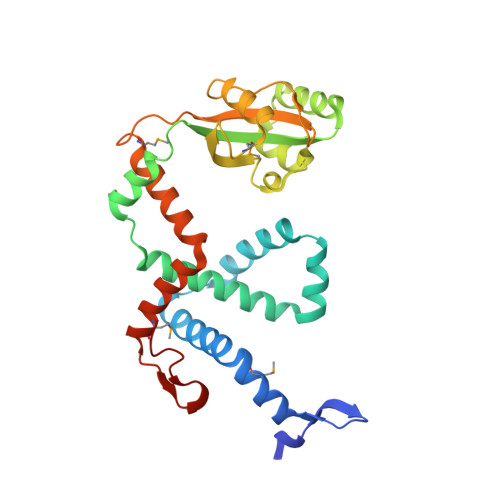
Crystal Structure of PrsA from Bacillus subtilis


Experimental Data Snapshot

  • Method: X-RAY DIFFRACTION
  • Resolution: 2.63 Å
  • R-Value Free: 
    0.251 (Depositor), 0.246 (DCC) 
  • R-Value Work: 
    0.226 (Depositor), 0.240 (DCC) 
  • R-Value Observed: 
    0.228 (Depositor) 

wwPDB Validation 3D Report Full Report

Validation slider image for 4WO7

This is version 2.1 of the entry. See complete history

Literature

Dimeric Structure of the Bacterial Extracellular Foldase PrsA.

Jakob, R.P.Koch, J.R.Burmann, B.M.Schmidpeter, P.A.Hunkeler, M.Hiller, S.Schmid, F.X.Maier, T.

(2015) J Biological Chem 290: 3278-3292

  • DOI: https://doi.org/10.1074/jbc.M114.622910
  • Primary Citation Related Structures: 
    4WO7

  • PubMed Abstract: 

    Secretion of proteins into the membrane-cell wall space is essential for cell wall biosynthesis and pathogenicity in Gram-positive bacteria. Folding and maturation of many secreted proteins depend on a single extracellular foldase, the PrsA protein. PrsA is a 30-kDa protein, lipid anchored to the outer leaflet of the cell membrane. The crystal structure of Bacillus subtilis PrsA reveals a central catalytic parvulin-type prolyl isomerase domain, which is inserted into a larger composite NC domain formed by the N- and C-terminal regions. This domain architecture resembles, despite a lack of sequence conservation, both trigger factor, a ribosome-binding bacterial chaperone, and SurA, a periplasmic chaperone in Gram-negative bacteria. Two main structural differences are observed in that the N-terminal arm of PrsA is substantially shortened relative to the trigger factor and SurA and in that PrsA is found to dimerize in a unique fashion via its NC domain. Dimerization leads to a large, bowl-shaped crevice, which might be involved in vivo in protecting substrate proteins from aggregation. NMR experiments reveal a direct, dynamic interaction of both the parvulin and the NC domain with secretion propeptides, which have been implicated in substrate targeting to PrsA.


  • Organizational Affiliation
    • From the Biozentrum, Universität Basel, Klingelbergstrasse 50/70, 4056 Basel, Switzerland and roman.jakob@unibas.ch.

Macromolecule Content 

  • Total Structure Weight: 59.95 kDa 
  • Atom Count: 4,122 
  • Modeled Residue Count: 513 
  • Deposited Residue Count: 526 
  • Unique protein chains: 1

Macromolecules

Find similar proteins by:|  3D Structure
Entity ID: 1
MoleculeChains  Sequence LengthOrganismDetailsImage
Foldase protein PrsA
A, B
263Bacillus subtilis subsp. subtilis str. 168Mutation(s): 0 
Gene Names: prsABSU09950
EC: 5.2.1.8
UniProt
Find proteins for P24327 (Bacillus subtilis (strain 168))
Explore P24327 
Go to UniProtKB:  P24327
Entity Groups
Sequence Clusters30% Identity50% Identity70% Identity90% Identity95% Identity100% Identity
UniProt GroupP24327
Sequence Annotations
Expand
Reference Sequence

Small Molecules

Modified Residues  1 Unique
IDChains TypeFormula2D DiagramParent
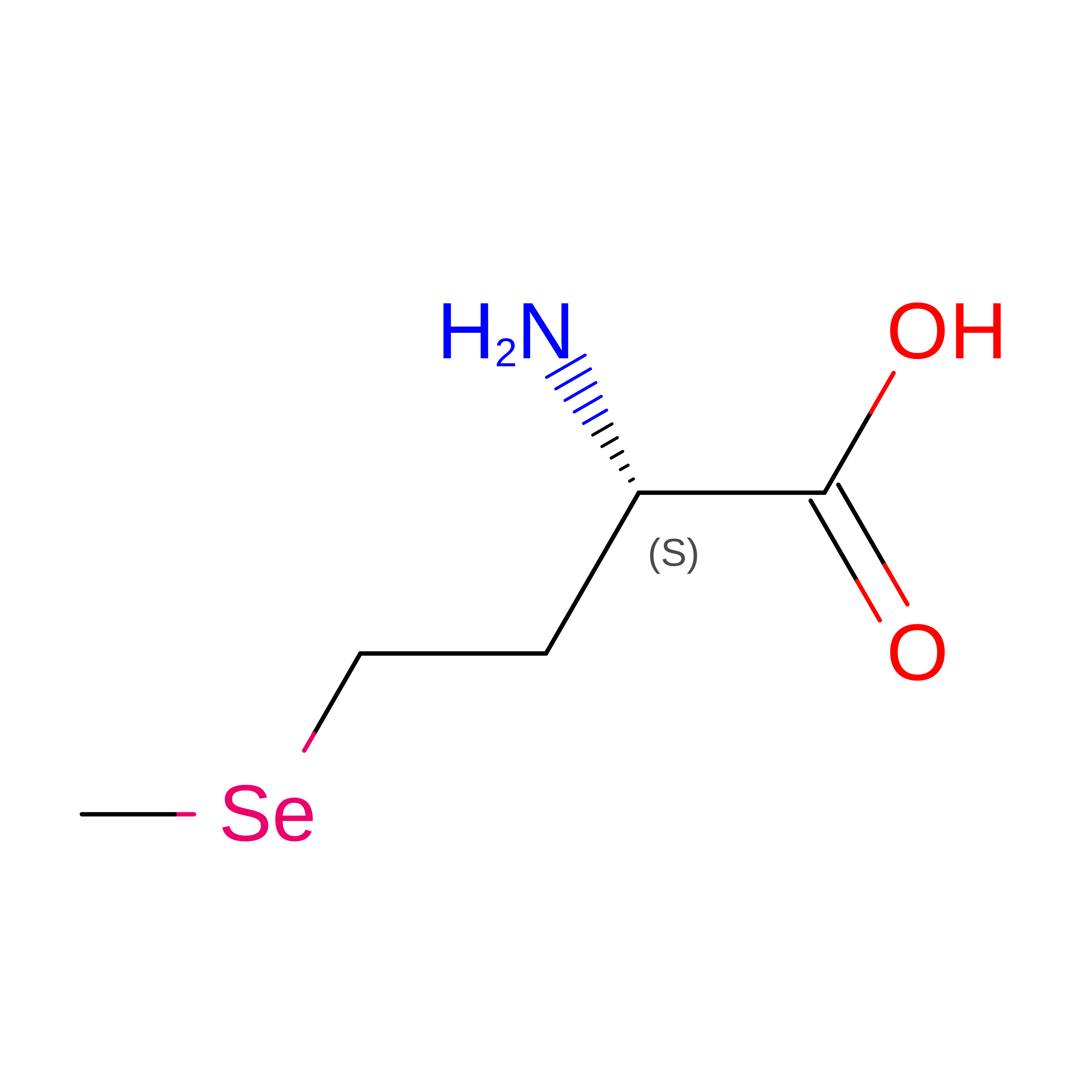
MSE
Query on MSE
A, B
L-PEPTIDE LINKINGC5 H11 N O2 SeMET

Experimental Data & Validation

Experimental Data

  • Method: X-RAY DIFFRACTION
  • Resolution: 2.63 Å
  • R-Value Free:  0.251 (Depositor), 0.246 (DCC) 
  • R-Value Work:  0.226 (Depositor), 0.240 (DCC) 
  • R-Value Observed: 0.228 (Depositor) 
Space Group: C 2 2 21
Unit Cell:
Length ( Å )Angle ( ˚ )
a = 69.29α = 90
b = 87.68β = 90
c = 234.1γ = 90
Software Package:
Software NamePurpose
PHENIXrefinement
XSCALEdata scaling
XDSdata reduction
PHENIXphasing

Structure Validation

View Full Validation Report


Entry History 

& Funding Information

Deposition Data


Funding OrganizationLocationGrant Number
Swiss National Science FoundationSwitzerlandPP00P3_152989
Swiss National Science FoundationSwitzerlandCRSII3_147646

Revision History  (Full details and data files)

  • Version 1.0: 2014-12-24
    Type: Initial release
  • Version 1.1: 2014-12-31
    Changes: Database references
  • Version 1.2: 2015-02-18
    Changes: Database references
  • Version 2.0: 2017-09-13
    Changes: Advisory, Atomic model, Author supporting evidence
  • Version 2.1: 2024-11-20
    Changes: Data collection, Database references, Structure summary