4UW2 | pdb_00004uw2

Crystal structure of Csm1 in T.onnurineus


Experimental Data Snapshot

  • Method: X-RAY DIFFRACTION
  • Resolution: 2.63 Å
  • R-Value Free: 
    0.261 (Depositor), 0.263 (DCC) 
  • R-Value Work: 
    0.203 (Depositor), 0.208 (DCC) 
  • R-Value Observed: 
    0.206 (Depositor) 

wwPDB Validation 3D Report Full Report

Validation slider image for 4UW2

This is version 1.3 of the entry. See complete history

Literature

Crystal Structure of the Csm1 Subunit of the Csm Complex and its Single-Stranded DNA-Specific Nuclease Activity.

Jung, T.An, Y.Park, K.Lee, M.Oh, B.Woo, E.

(2015) Structure 23: 782

  • DOI: https://doi.org/10.1016/j.str.2015.01.021
  • Primary Citation Related Structures: 
    4UW2

  • PubMed Abstract: 

    The CRISPR-Cas system is the RNA-guided immune defense mechanism in bacteria and archaea. Csm1 belongs to the Cas10 family, which is the common signature protein of the type III system. Csm1 is the largest subunit of the Csm interference complex in the type III-A subtype, which targets foreign DNA or RNA. Here, we report crystallographic and biochemical analyses of Thermococcus onnurineus Csm1, revealing a five-domain organization and single-stranded DNA (ssDNA)-specific nuclease activity associated with the N-terminal HD domain. This domain folds into permuted secondary structures in comparison with the HD domain of Cas3 and contains all the catalytically important residues. It exhibited both endo- and exonuclease activities in an Ni(2+) or Mn(2+)-dependent manner. The narrow width of the active-site cleft appears to restrict the substrate specificity to ssDNA and thus to prevent Csm1 from cleaving double-stranded chromosomal DNA. These data suggest that Csm1 may function in DNA interference by the Csm effector complex.


  • Organizational Affiliation
    • Department of Biological Sciences, KAIST Institute for the Biocentury, Korea Advanced Institute of Science and Technology, Daejeon 305-701, Korea; Functional Genomic Research Center, Korea Research Institute of Bioscience and Biotechnology, Daejeon 305-333, Korea.

Macromolecule Content 

  • Total Structure Weight: 356.15 kDa 
  • Atom Count: 14,308 
  • Modeled Residue Count: 1,702 
  • Deposited Residue Count: 3,116 
  • Unique protein chains: 1

Macromolecules

Find similar proteins by:|  3D Structure
Entity ID: 1
MoleculeChains  Sequence LengthOrganismDetailsImage
CSM1
A, B, C, D
779Thermococcus onnurineus NA1Mutation(s): 0 
EC: 3.1 (UniProt), 2.7.7 (UniProt)
UniProt
Find proteins for B6YWB8 (Thermococcus onnurineus (strain NA1))
Explore B6YWB8 
Go to UniProtKB:  B6YWB8
Entity Groups
Sequence Clusters30% Identity50% Identity70% Identity90% Identity95% Identity100% Identity
UniProt GroupB6YWB8
Sequence Annotations
Expand
Reference Sequence

Small Molecules

Modified Residues  1 Unique
IDChains TypeFormula2D DiagramParent
MSE
Query on MSE
A, B, C, D
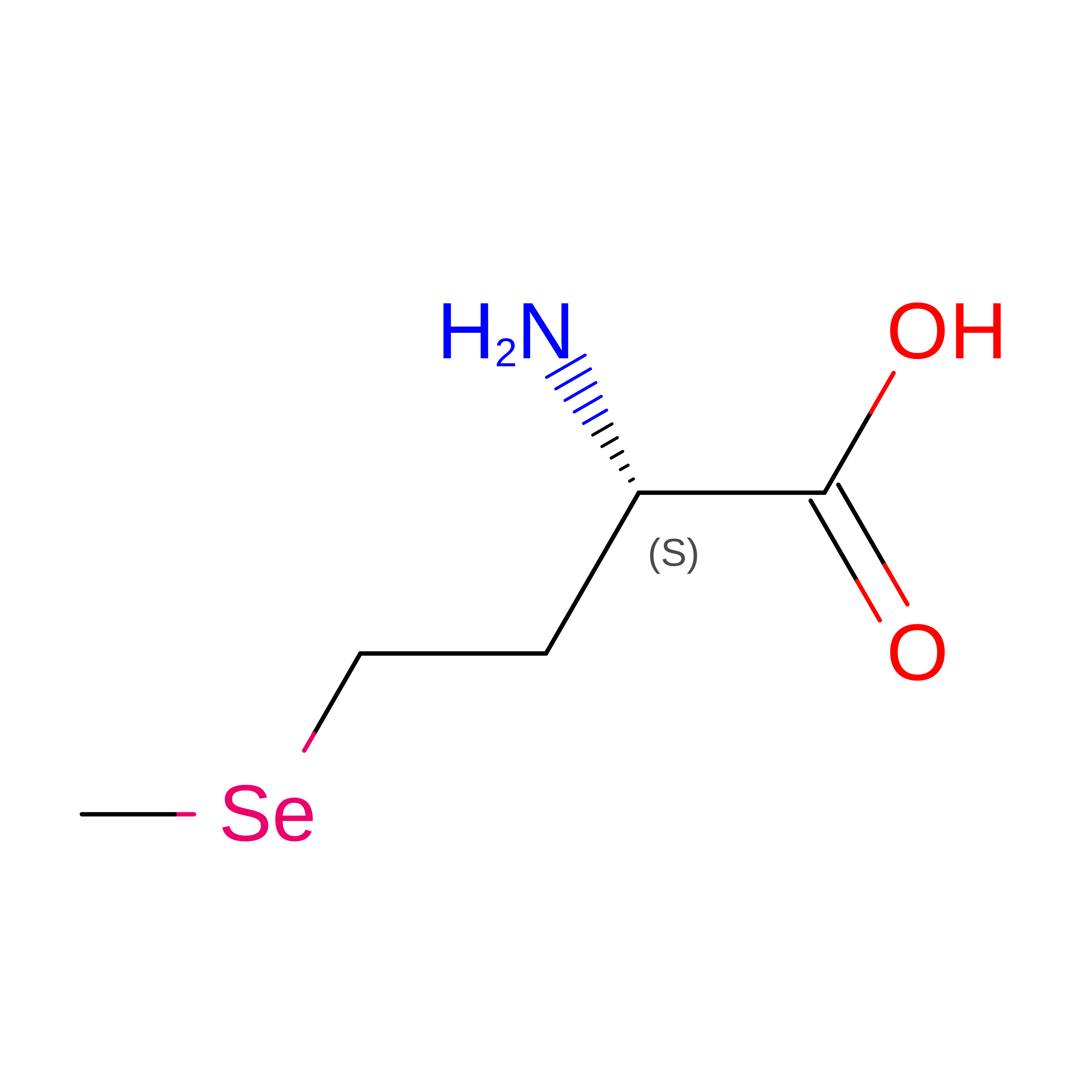
L-PEPTIDE LINKINGC5 H11 N O2 SeMET

Experimental Data & Validation

Experimental Data

  • Method: X-RAY DIFFRACTION
  • Resolution: 2.63 Å
  • R-Value Free:  0.261 (Depositor), 0.263 (DCC) 
  • R-Value Work:  0.203 (Depositor), 0.208 (DCC) 
  • R-Value Observed: 0.206 (Depositor) 
Space Group: C 1 2 1
Unit Cell:
Length ( Å )Angle ( ˚ )
a = 57.894α = 90
b = 158.292β = 89.97
c = 299.275γ = 90
Software Package:
Software NamePurpose
PHENIXrefinement
HKL-2000data reduction
HKL-2000data scaling
PHENIXphasing

Structure Validation

View Full Validation Report


Entry History 

Deposition Data

Revision History  (Full details and data files)

  • Version 1.0: 2015-03-25
    Type: Initial release
  • Version 1.1: 2015-04-22
    Changes: Database references
  • Version 1.2: 2015-09-23
    Changes: Data collection
  • Version 1.3: 2024-11-13
    Changes: Data collection, Database references, Derived calculations, Other, Structure summary