4UHB | pdb_00004uhb

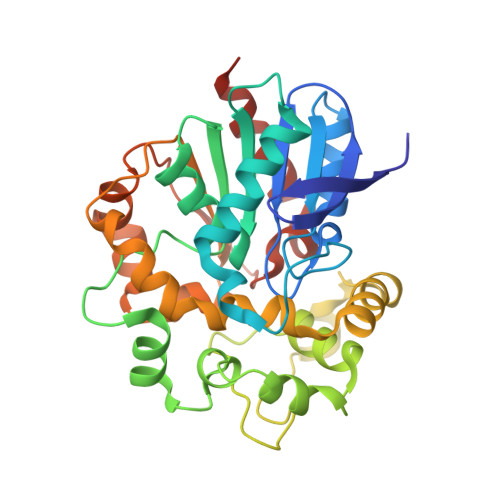
Laboratory evolved variant R-C1 of potato epoxide hydrolase StEH1


Experimental Data Snapshot

  • Method: X-RAY DIFFRACTION
  • Resolution: 1.80 Å
  • R-Value Free: 
    0.211 (Depositor), 0.220 (DCC) 
  • R-Value Work: 
    0.199 (Depositor), 0.210 (DCC) 
  • R-Value Observed: 
    0.199 (Depositor) 

Starting Model: experimental
View more details

wwPDB Validation 3D Report Full Report

Validation slider image for 4UHB

This is version 1.3 of the entry. See complete history

Literature

Laboratory Evolved Enzymes Provide Snapshots of the Development of Enantioconvergence in Enzyme-Catalyzed Epoxide Hydrolysis.

Janfalk Carlsson, A.Bauer, P.Dobritzsch, D.Nilsson, M.Kamerlin, S.C.Widersten, M.

(2016) Chembiochem 17: 1693

  • DOI: https://doi.org/10.1002/cbic.201600330
  • Primary Citation Related Structures: 
    4UFO, 4UFP, 4UHB

  • PubMed Abstract: 

    Engineered enzyme variants of potato epoxide hydrolase (StEH1) display varying degrees of enrichment of (2R)-3-phenylpropane-1,2-diol from racemic benzyloxirane. Curiously, the observed increase in the enantiomeric excess of the (R)-diol is not only a consequence of changes in enantioselectivity for the preferred epoxide enantiomer, but also to changes in the regioselectivity of the epoxide ring opening of (S)-benzyloxirane. In order to probe the structural origin of these differences in substrate selectivity and catalytic regiopreference, we solved the crystal structures for the evolved StEH1 variants. We used these structures as a starting point for molecular docking studies of the epoxide enantiomers into the respective active sites. Interestingly, despite the simplicity of our docking analysis, the apparent preferred binding modes appear to rationalize the experimentally determined regioselectivities. The analysis also identifies an active site residue (F33) as a potentially important interaction partner, a role that could explain the high conservation of this residue during evolution. Overall, our experimental, structural, and computational studies provide snapshots into the evolution of enantioconvergence in StEH1-catalyzed epoxide hydrolysis.


  • Organizational Affiliation
    • Department of Chemistry, BMC, Uppsala University, Box 576, 751 23, Uppsala, Sweden.

Macromolecule Content 

  • Total Structure Weight: 75.3 kDa 
  • Atom Count: 5,780 
  • Modeled Residue Count: 640 
  • Deposited Residue Count: 656 
  • Unique protein chains: 1

Macromolecules

Find similar proteins by:|  3D Structure
Entity ID: 1
MoleculeChains  Sequence LengthOrganismDetailsImage
EPOXIDE HYDROLASE
A, B
328Solanum tuberosumMutation(s): 2 
EC: 3.3.2.3 (PDB Primary Data), 3.3.2.10 (UniProt)
UniProt
Find proteins for Q41415 (Solanum tuberosum)
Explore Q41415 
Go to UniProtKB:  Q41415
Entity Groups
Sequence Clusters30% Identity50% Identity70% Identity90% Identity95% Identity100% Identity
UniProt GroupQ41415
Sequence Annotations
Expand
Reference Sequence

Small Molecules

Ligands 2 Unique
IDChains Name / Formula / InChI Key2D Diagram3D Interactions
GOL

Query on GOL


Download:Ideal Coordinates CCD File
C [auth A]
D [auth A]
E [auth A]
F [auth A]
H [auth B]
C [auth A],
D [auth A],
E [auth A],
F [auth A],
H [auth B],
I [auth B],
J [auth B],
K [auth B],
L [auth B]
GLYCEROL
C3 H8 O3
PEDCQBHIVMGVHV-UHFFFAOYSA-N
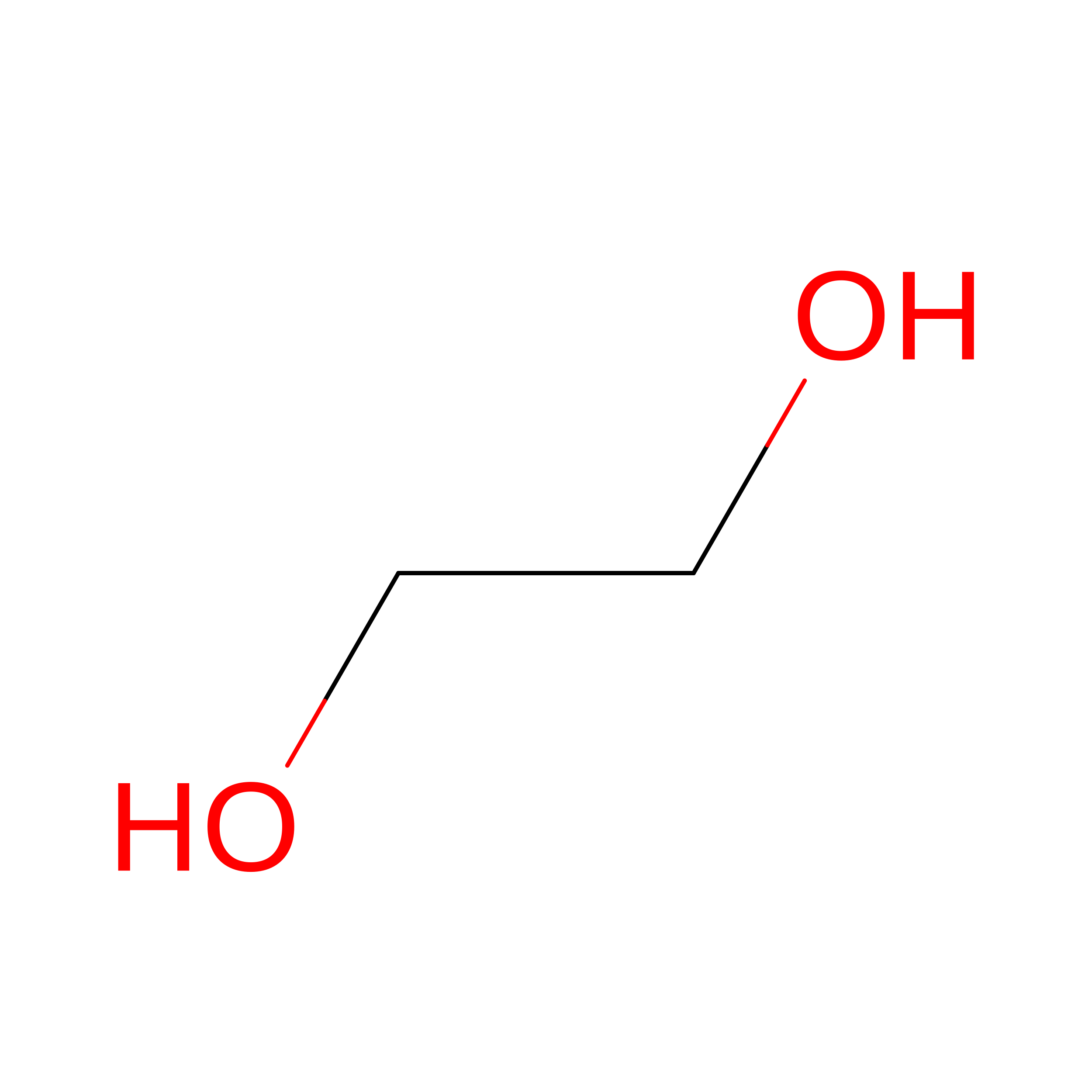
EDO

Query on EDO


Download:Ideal Coordinates CCD File
G [auth A],
M [auth B]
1,2-ETHANEDIOL
C2 H6 O2
LYCAIKOWRPUZTN-UHFFFAOYSA-N

Experimental Data & Validation

Experimental Data

  • Method: X-RAY DIFFRACTION
  • Resolution: 1.80 Å
  • R-Value Free:  0.211 (Depositor), 0.220 (DCC) 
  • R-Value Work:  0.199 (Depositor), 0.210 (DCC) 
  • R-Value Observed: 0.199 (Depositor) 
Space Group: P 21 21 21
Unit Cell:
Length ( Å )Angle ( ˚ )
a = 55.8α = 90
b = 96.33β = 90
c = 121.78γ = 90
Software Package:
Software NamePurpose
REFMACrefinement
XDSdata reduction
SCALAdata scaling
REFMACphasing

Structure Validation

View Full Validation Report


Entry History 

Deposition Data

Revision History  (Full details and data files)

  • Version 1.0: 2016-04-13
    Type: Initial release
  • Version 1.1: 2016-07-20
    Changes: Database references
  • Version 1.2: 2016-10-05
    Changes: Database references
  • Version 1.3: 2024-01-10
    Changes: Data collection, Database references, Derived calculations, Other, Refinement description