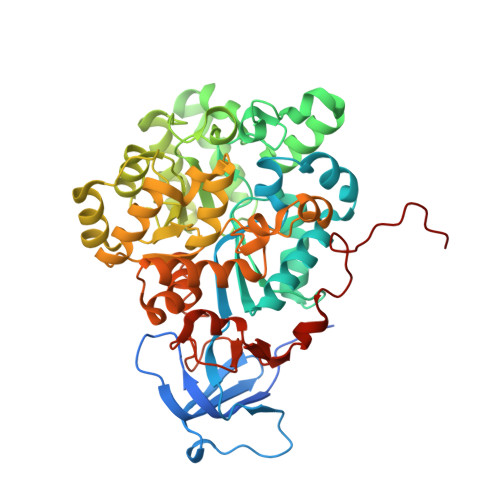
4UB9 | pdb_00004ub9

Structural and catalytic characterization of molinate hydrolase


Experimental Data Snapshot

  • Method: X-RAY DIFFRACTION
  • Resolution: 2.27 Å
  • R-Value Free: 
    0.229 (Depositor), 0.233 (DCC) 
  • R-Value Work: 
    0.201 (Depositor), 0.207 (DCC) 
  • R-Value Observed: 
    0.202 (Depositor) 

Starting Model: experimental
View more details

wwPDB Validation 3D Report Full Report

Validation slider image for 4UB9

This is version 1.2 of the entry. See complete history

Literature

Structure-guided engineering of molinate hydrolase for the degradation of thiocarbamate pesticides.

Leite, J.P.Duarte, M.Paiva, A.M.Ferreira-da-Silva, F.Matias, P.M.Nunes, O.C.Gales, L.

(2015) PLoS One 10: e0123430-e0123430

  • DOI: https://doi.org/10.1371/journal.pone.0123430
  • Primary Citation Related Structures: 
    4UB9

  • PubMed Abstract: 

    Molinate is a recalcitrant thiocarbamate used to control grass weeds in rice fields. The recently described molinate hydrolase, from Gulosibacter molinativorax ON4T, plays a key role in the only known molinate degradation pathway ending in the formation of innocuous compounds. Here we report the crystal structure of recombinant molinate hydrolase at 2.27 Å. The structure reveals a homotetramer with a single mononuclear metal-dependent active site per monomer. The active site architecture shows similarities with other amidohydrolases and enables us to propose a general acid-base catalysis mechanism for molinate hydrolysis. Molinate hydrolase is unable to degrade bulkier thiocarbamate pesticides such as thiobencarb which is used mostly in rice crops. Using a structural-based approach, we were able to generate a mutant (Arg187Ala) that efficiently degrades thiobencarb. The engineered enzyme is suitable for the development of a broader thiocarbamate bioremediation system.


  • Organizational Affiliation
    • Instituto de Investigação e Inovação em Saúde, Universidade do Porto, Porto, Portugal; IBMC-Instituto de Biologia Molecular e Celular, Universidade do Porto, Porto, Portugal.

Macromolecule Content 

  • Total Structure Weight: 437.96 kDa 
  • Atom Count: 29,391 
  • Modeled Residue Count: 3,736 
  • Deposited Residue Count: 3,968 
  • Unique protein chains: 1

Macromolecules

Find similar proteins by:|  3D Structure
Entity ID: 1
MoleculeChains  Sequence LengthOrganismDetailsImage
Molinate hydrolase
A, B, C, D, E
A, B, C, D, E, F, G, H
496Gulosibacter molinativoraxMutation(s): 0 
Gene Names: molA
UniProt
Find proteins for G2XLB0 (Gulosibacter molinativorax)
Explore G2XLB0 
Go to UniProtKB:  G2XLB0
Entity Groups
Sequence Clusters30% Identity50% Identity70% Identity90% Identity95% Identity100% Identity
UniProt GroupG2XLB0
Sequence Annotations
Expand
Reference Sequence

Experimental Data & Validation

Experimental Data

  • Method: X-RAY DIFFRACTION
  • Resolution: 2.27 Å
  • R-Value Free:  0.229 (Depositor), 0.233 (DCC) 
  • R-Value Work:  0.201 (Depositor), 0.207 (DCC) 
  • R-Value Observed: 0.202 (Depositor) 
Space Group: C 1 2 1
Unit Cell:
Length ( Å )Angle ( ˚ )
a = 367.696α = 90
b = 99.079β = 109.61
c = 131.337γ = 90
Software Package:
Software NamePurpose
REFMACrefinement
XDSdata reduction
SHARPphasing
XSCALEdata scaling

Structure Validation

View Full Validation Report


Entry History 

& Funding Information

Deposition Data


Funding OrganizationLocationGrant Number
FCTPortugalFCOMP-01-0124-FEDER-027883 (PTDC/AAGTEC/3909/2012FCOMP)

Revision History  (Full details and data files)

  • Version 1.0: 2015-06-24
    Type: Initial release
  • Version 1.1: 2019-02-20
    Changes: Advisory, Data collection, Derived calculations
  • Version 1.2: 2024-05-01
    Changes: Data collection, Database references, Derived calculations, Refinement description