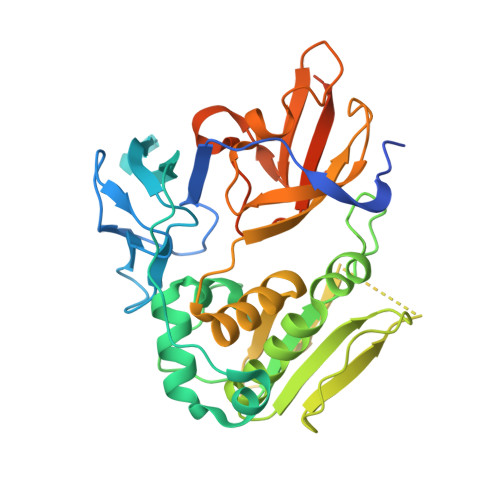
4U9Q | pdb_00004u9q

Crystal structure of NqrA in spacegroup P21


Experimental Data Snapshot

  • Method: X-RAY DIFFRACTION
  • Resolution: 2.10 Å
  • R-Value Free: 
    0.235 (Depositor), 0.237 (DCC) 
  • R-Value Work: 
    0.201 (Depositor), 0.207 (DCC) 
  • R-Value Observed: 
    0.203 (Depositor) 

Starting Model: experimental
View more details

wwPDB Validation 3D Report Full Report

Validation slider image for 4U9Q

This is version 2.0 of the entry. See complete history

Literature

Structure of the V. cholerae Na+-pumping NADH:quinone oxidoreductase.

Steuber, J.Vohl, G.Casutt, M.S.Vorburger, T.Diederichs, K.Fritz, G.

(2014) Nature 516: 62-67

  • DOI: https://doi.org/10.1038/nature14003
  • Primary Citation Related Structures: 
    4U9O, 4U9Q, 4U9S, 4U9U, 4UAJ

  • PubMed Abstract: 

    NADH oxidation in the respiratory chain is coupled to ion translocation across the membrane to build up an electrochemical gradient. The sodium-translocating NADH:quinone oxidoreductase (Na(+)-NQR), a membrane protein complex widespread among pathogenic bacteria, consists of six subunits, NqrA, B, C, D, E and F. To our knowledge, no structural information on the Na(+)-NQR complex has been available until now. Here we present the crystal structure of the Na(+)-NQR complex at 3.5 Å resolution. The arrangement of cofactors both at the cytoplasmic and the periplasmic side of the complex, together with a hitherto unknown iron centre in the midst of the membrane-embedded part, reveals an electron transfer pathway from the NADH-oxidizing cytoplasmic NqrF subunit across the membrane to the periplasmic NqrC, and back to the quinone reduction site on NqrA located in the cytoplasm. A sodium channel was localized in subunit NqrB, which represents the largest membrane subunit of the Na(+)-NQR and is structurally related to urea and ammonia transporters. On the basis of the structure we propose a mechanism of redox-driven Na(+) translocation where the change in redox state of the flavin mononucleotide cofactor in NqrB triggers the transport of Na(+) through the observed channel.


  • Organizational Affiliation
    • Department of Microbiology, Garbenstrasse 30, University of Hohenheim, 70599 Stuttgart, Germany.

Macromolecule Content 

  • Total Structure Weight: 78.24 kDa 
  • Atom Count: 4,916 
  • Modeled Residue Count: 607 
  • Deposited Residue Count: 720 
  • Unique protein chains: 1

Macromolecules

Find similar proteins by:|  3D Structure
Entity ID: 1
MoleculeChains  Sequence LengthOrganismDetailsImage
Na(+)-translocating NADH-quinone reductase subunit A
A, B
360Vibrio choleraeMutation(s): 0 
Gene Names: nqrAVC_2295
EC: 1.6.5 (PDB Primary Data), 7.2.1.1 (UniProt)
UniProt
Find proteins for Q9KPS1 (Vibrio cholerae serotype O1 (strain ATCC 39315 / El Tor Inaba N16961))
Explore Q9KPS1 
Go to UniProtKB:  Q9KPS1
Entity Groups
Sequence Clusters30% Identity50% Identity70% Identity90% Identity95% Identity100% Identity
UniProt GroupQ9KPS1
Sequence Annotations
Expand
Reference Sequence

Experimental Data & Validation

Experimental Data

  • Method: X-RAY DIFFRACTION
  • Resolution: 2.10 Å
  • R-Value Free:  0.235 (Depositor), 0.237 (DCC) 
  • R-Value Work:  0.201 (Depositor), 0.207 (DCC) 
  • R-Value Observed: 0.203 (Depositor) 
Space Group: P 1 21 1
Unit Cell:
Length ( Å )Angle ( ˚ )
a = 56.183α = 90
b = 81.703β = 92.71
c = 85.065γ = 90
Software Package:
Software NamePurpose
PHENIXrefinement
XDSdata reduction
PHASERphasing
PDB_EXTRACTdata extraction
Cootmodel building
XSCALEdata scaling
XSCALEdata reduction

Structure Validation

View Full Validation Report


Entry History 

& Funding Information

Deposition Data

  • Released Date: 2014-12-03 
  • Deposition Author(s): Fritz, G.

Funding OrganizationLocationGrant Number
German Research FoundationGermanyFR 1488/3-2

Revision History  (Full details and data files)

  • Version 1.0: 2014-12-03
    Type: Initial release
  • Version 1.1: 2014-12-17
    Changes: Database references
  • Version 2.0: 2023-12-20
    Changes: Advisory, Atomic model, Author supporting evidence, Data collection, Database references, Refinement description