4U5R | pdb_00004u5r

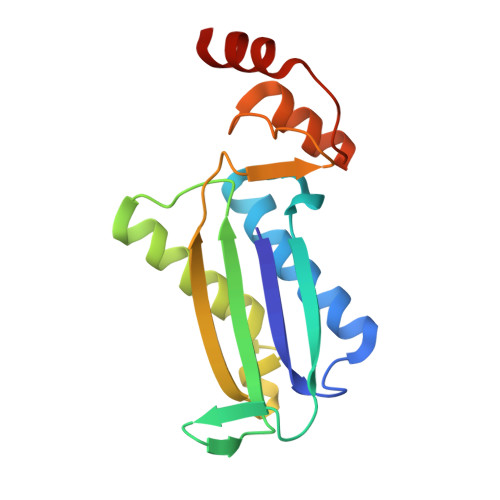
Crystal structure of D106A mutant of RhCC (YP_702633.1) from Rhodococcus jostii RHA1 at 1.55 Angstrom


Experimental Data Snapshot

  • Method: X-RAY DIFFRACTION
  • Resolution: 1.55 Å
  • R-Value Free: 
    0.175 (Depositor), 0.181 (DCC) 
  • R-Value Work: 
    0.160 (Depositor) 
  • R-Value Observed: 
    0.161 (Depositor) 

Starting Model: experimental
View more details

wwPDB Validation 3D Report Full Report

Validation slider image for 4U5R

This is version 2.0 of the entry. See complete history

Literature

Functional and structural characterization of an unusual cofactor-independent oxygenase.

Baas, B.J.Poddar, H.Geertsema, E.M.Rozeboom, H.J.de Vries, M.P.Permentier, H.P.Thunnissen, A.M.Poelarends, G.J.

(2015) Biochemistry 54: 1219-1232

  • DOI: https://doi.org/10.1021/bi501200j
  • Primary Citation Related Structures: 
    4U5P, 4U5R

  • PubMed Abstract: 

    The vast majority of characterized oxygenases use bound cofactors to activate molecular oxygen to carry out oxidation chemistry. Here, we show that an enzyme of unknown activity, RhCC from Rhodococcus jostii RHA1, functions as an oxygenase, using 4-hydroxyphenylenolpyruvate as a substrate. This unique and complex reaction yields 3-hydroxy-3-(4-hydroxyphenyl)-pyruvate, 4-hydroxybenzaldehyde, and oxalic acid as major products. Incubations with H2(18)O, (18)O2, and a substrate analogue suggest that this enzymatic oxygenation reaction likely involves a peroxide anion intermediate. Analysis of sequence similarity and the crystal structure of RhCC (solved at 1.78 Å resolution) reveal that this enzyme belongs to the tautomerase superfamily. Members of this superfamily typically catalyze tautomerization, dehalogenation, or decarboxylation reactions rather than oxygenation reactions. The structure shows the absence of cofactors, establishing RhCC as a rare example of a redox-metal- and coenzyme-free oxygenase. This sets the stage to study the mechanistic details of cofactor-independent oxygen activation in the unusual context of the tautomerase superfamily.


  • Organizational Affiliation
    • Department of Pharmaceutical Biology, Groningen Research Institute of Pharmacy and ‡Analytical Biochemistry and Mass Spectrometry Core Facility, Department of Pharmacy, University of Groningen , Antonius Deusinglaan 1, 9713 AV Groningen, The Netherlands.

Macromolecule Content 

  • Total Structure Weight: 53.05 kDa 
  • Atom Count: 4,207 
  • Modeled Residue Count: 454 
  • Deposited Residue Count: 456 
  • Unique protein chains: 1

Macromolecules

Find similar proteins by:|  3D Structure
Entity ID: 1
MoleculeChains  Sequence LengthOrganismDetailsImage
RhCC
A, B, C
152Rhodococcus jostii RHA1Mutation(s): 1 
Gene Names: RHA1_ro02670
UniProt
Find proteins for Q0SDB1 (Rhodococcus jostii (strain RHA1))
Explore Q0SDB1 
Go to UniProtKB:  Q0SDB1
Entity Groups
Sequence Clusters30% Identity50% Identity70% Identity90% Identity95% Identity100% Identity
UniProt GroupQ0SDB1
Sequence Annotations
Expand
Reference Sequence

Small Molecules

Ligands 1 Unique
IDChains Name / Formula / InChI Key2D Diagram3D Interactions
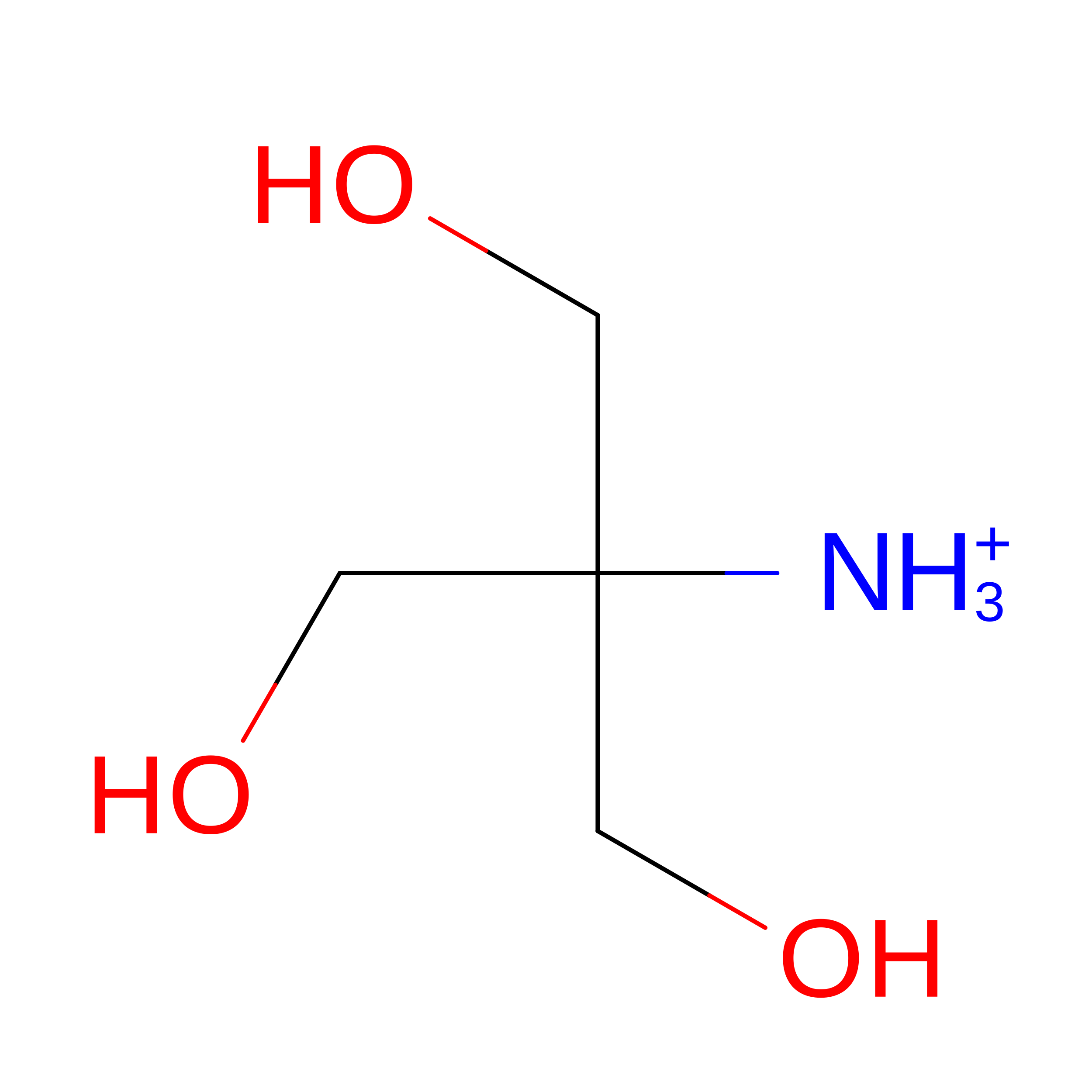
TRS

Query on TRS


Download:Ideal Coordinates CCD File
D [auth A]2-AMINO-2-HYDROXYMETHYL-PROPANE-1,3-DIOL
C4 H12 N O3
LENZDBCJOHFCAS-UHFFFAOYSA-O

Experimental Data & Validation

Experimental Data

  • Method: X-RAY DIFFRACTION
  • Resolution: 1.55 Å
  • R-Value Free:  0.175 (Depositor), 0.181 (DCC) 
  • R-Value Work:  0.160 (Depositor) 
  • R-Value Observed: 0.161 (Depositor) 
Space Group: C 1 2 1
Unit Cell:
Length ( Å )Angle ( ˚ )
a = 99.795α = 90
b = 57.784β = 90.41
c = 92.026γ = 90
Software Package:
Software NamePurpose
SCALAdata scaling
PDB_EXTRACTdata extraction
PHENIXrefinement
PHASERphasing

Structure Validation

View Full Validation Report


Entry History 

& Funding Information

Deposition Data


Funding OrganizationLocationGrant Number
Netherlands Organisation for Scientific ResearchNetherlandsVIDI grant 700.56.421
European Research Coucil242293

Revision History  (Full details and data files)

  • Version 1.0: 2015-02-25
    Type: Initial release
  • Version 2.0: 2023-12-20
    Changes: Atomic model, Data collection, Database references, Refinement description