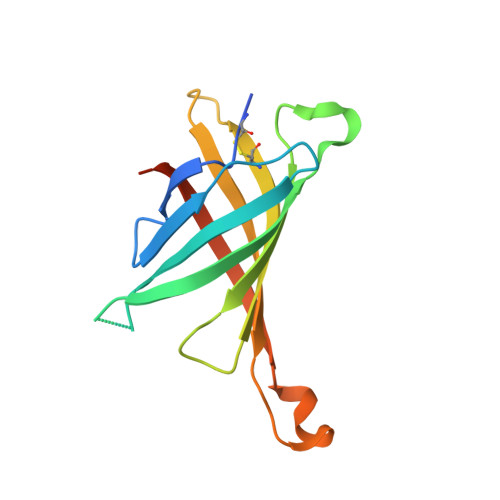
4U46 | pdb_00004u46

Crystal structure of an avidin mutant


Experimental Data Snapshot

  • Method: X-RAY DIFFRACTION
  • Resolution: 1.95 Å
  • R-Value Free: 
    0.214 (Depositor), 0.221 (DCC) 
  • R-Value Work: 
    0.182 (Depositor), 0.188 (DCC) 
  • R-Value Observed: 
    0.184 (Depositor) 

Starting Model: experimental
View more details

wwPDB Validation 3D Report Full Report

Validation slider image for 4U46

This is version 1.3 of the entry. See complete history. 

Literature

Artificial Avidin-Based Receptors for a Panel of Small Molecules.

Lehtonen, S.I., Tullila, A., Agrawal, N., Kukkurainen, S., Kahkonen, N., Koskinen, M., Nevanen, T.K., Johnson, M.S., Airenne, T.T., Kulomaa, M.S., Riihimaki, T.A., Hytonen, V.P.

(2016) ACS Chem Biol 11: 211-221

  • DOI: https://doi.org/10.1021/acschembio.5b00906
  • Primary Citation Related Structures: 
    4U46

  • PubMed Abstract: 

    Proteins with high specificity, affinity, and stability are needed for biomolecular recognition in a plethora of applications. Antibodies are powerful affinity tools, but they may also suffer from limitations such as low stability and high production costs. Avidin and streptavidin provide a promising scaffold for protein engineering, and due to their ultratight binding to D-biotin they are widely used in various biotechnological and biomedical applications. In this study, we demonstrate that the avidin scaffold is suitable for use as a novel receptor for several biologically active small molecules: Artificial, chicken avidin-based proteins, antidins, were generated using a directed evolution method for progesterone, hydrocortisone, testosterone, cholic acid, ketoprofen, and folic acid, all with micromolar to nanomolar affinity and significantly reduced biotin-binding affinity. We also describe the crystal structure of an antidin, sbAvd-2(I117Y), a steroid-binding avidin, which proves that the avidin scaffold can tolerate significant modifications without losing its characteristic tetrameric beta-barrel structure, helping us to further design avidin-based small molecule receptors.


  • Organizational Affiliation: 
    • BioMediTech, University of Tampere , Biokatu 6, FI-33014 Tampere, Finland.

Macromolecule Content 

  • Total Structure Weight: 32.15 kDa 
  • Atom Count: 1,957 
  • Modeled Residue Count: 232 
  • Deposited Residue Count: 276 
  • Unique protein chains: 1

Macromolecules

Find similar proteins by:|  3D Structure
Entity ID: 1
MoleculeChains  Sequence LengthOrganismDetailsImage
Avidin
A, B
138Gallus gallusMutation(s): 0 
Gene Names: AVD
UniProt
Find proteins for P02701 (Gallus gallus)
Explore P02701 
Go to UniProtKB:  P02701
Entity Groups
Sequence Clusters30% Identity50% Identity70% Identity90% Identity95% Identity100% Identity
UniProt GroupP02701
Sequence Annotations
Expand
Reference Sequence

Small Molecules

Ligands 1 Unique
IDChains Name / Formula / InChI Key2D Diagram3D Interactions
CL

Query on CL


Download:Ideal Coordinates CCD File
C [auth A]
D [auth A]
E [auth A]
F [auth A]
G [auth A]
C [auth A],
D [auth A],
E [auth A],
F [auth A],
G [auth A],
H [auth A],
I [auth B],
J [auth B],
K [auth B],
L [auth B],
M [auth B],
N [auth B]
CHLORIDE ION
Cl
VEXZGXHMUGYJMC-UHFFFAOYSA-M

Experimental Data & Validation

Experimental Data

  • Method: X-RAY DIFFRACTION
  • Resolution: 1.95 Å
  • R-Value Free:  0.214 (Depositor), 0.221 (DCC) 
  • R-Value Work:  0.182 (Depositor), 0.188 (DCC) 
  • R-Value Observed: 0.184 (Depositor) 
Space Group: P 21 21 2
Unit Cell:
Length ( Å )Angle ( ˚ )
a = 74.48α = 90
b = 79.8β = 90
c = 43.07γ = 90
Software Package:
Software NamePurpose
XDSdata reduction
REFMACrefinement
XSCALEdata scaling
PHASERphasing

Structure Validation

View Full Validation Report


Entry History 

Deposition Data

Revision History  (Full details and data files)

  • Version 1.0: 2015-08-05
    Type: Initial release
  • Version 1.1: 2016-09-28
    Changes: Database references
  • Version 1.2: 2023-12-20
    Changes: Data collection, Database references, Refinement description
  • Version 1.3: 2024-11-06
    Changes: Structure summary