4TQG | pdb_00004tqg

Crystal structure of Megavirus UDP-GlcNAc 4,6-dehydratase, 5-epimerase Mg534


Experimental Data Snapshot

  • Method: X-RAY DIFFRACTION
  • Resolution: 2.20 Å
  • R-Value Free: 
    0.232 (Depositor), 0.233 (DCC) 
  • R-Value Work: 
    0.193 (Depositor), 0.194 (DCC) 
  • R-Value Observed: 
    0.195 (Depositor) 

Starting Model: experimental
View more details

wwPDB Validation 3D Report Full Report

Validation slider image for 4TQG

Ligand Structure Quality Assessment 


This is version 2.2 of the entry. See complete history

Literature

Giant Virus Megavirus chilensis Encodes the Biosynthetic Pathway for Uncommon Acetamido Sugars.

Piacente, F.De Castro, C.Jeudy, S.Molinaro, A.Salis, A.Damonte, G.Bernardi, C.Abergel, C.Tonetti, M.G.

(2014) J Biological Chem 289: 24428-24439

  • DOI: https://doi.org/10.1074/jbc.M114.588947
  • Primary Citation Related Structures: 
    4TQG

  • PubMed Abstract: 

    Giant viruses mimicking microbes, by the sizes of their particles and the heavily glycosylated fibrils surrounding their capsids, infect Acanthamoeba sp., which are ubiquitous unicellular eukaryotes. The glycans on fibrils are produced by virally encoded enzymes, organized in gene clusters. Like Mimivirus, Megavirus glycans are mainly composed of virally synthesized N-acetylglucosamine (GlcNAc). They also contain N-acetylrhamnosamine (RhaNAc), a rare sugar; the enzymes involved in its synthesis are encoded by a gene cluster specific to Megavirus close relatives. We combined activity assays on two enzymes of the pathway with mass spectrometry and NMR studies to characterize their specificities. Mg534 is a 4,6-dehydratase 5-epimerase; its three-dimensional structure suggests that it belongs to a third subfamily of inverting dehydratases. Mg535, next in the pathway, is a bifunctional 3-epimerase 4-reductase. The sequential activity of the two enzymes leads to the formation of UDP-l-RhaNAc. This study is another example of giant viruses performing their glycan synthesis using enzymes different from their cellular counterparts, raising again the question of the origin of these pathways.


  • Organizational Affiliation
    • From the Department of Experimental Medicine and Center of Excellence for Biomedical Research, University of Genova, Viale Benedetto XV,1 16132 Genova, Italy.

Macromolecule Content 

  • Total Structure Weight: 37.68 kDa 
  • Atom Count: 2,523 
  • Modeled Residue Count: 297 
  • Deposited Residue Count: 323 
  • Unique protein chains: 1

Macromolecules

Find similar proteins by:|  3D Structure
Entity ID: 1
MoleculeChains  Sequence LengthOrganismDetailsImage
Putative dTDP-d-glucose 4 6-dehydratase323Megavirus chiliensisMutation(s): 0 
Gene Names: mg534
UniProt
Find proteins for G5CSR9 (Megavirus chiliensis)
Explore G5CSR9 
Go to UniProtKB:  G5CSR9
Entity Groups
Sequence Clusters30% Identity50% Identity70% Identity90% Identity95% Identity100% Identity
UniProt GroupG5CSR9
Sequence Annotations
Expand
Reference Sequence

Small Molecules

Ligands 1 Unique
IDChains Name / Formula / InChI Key2D Diagram3D Interactions
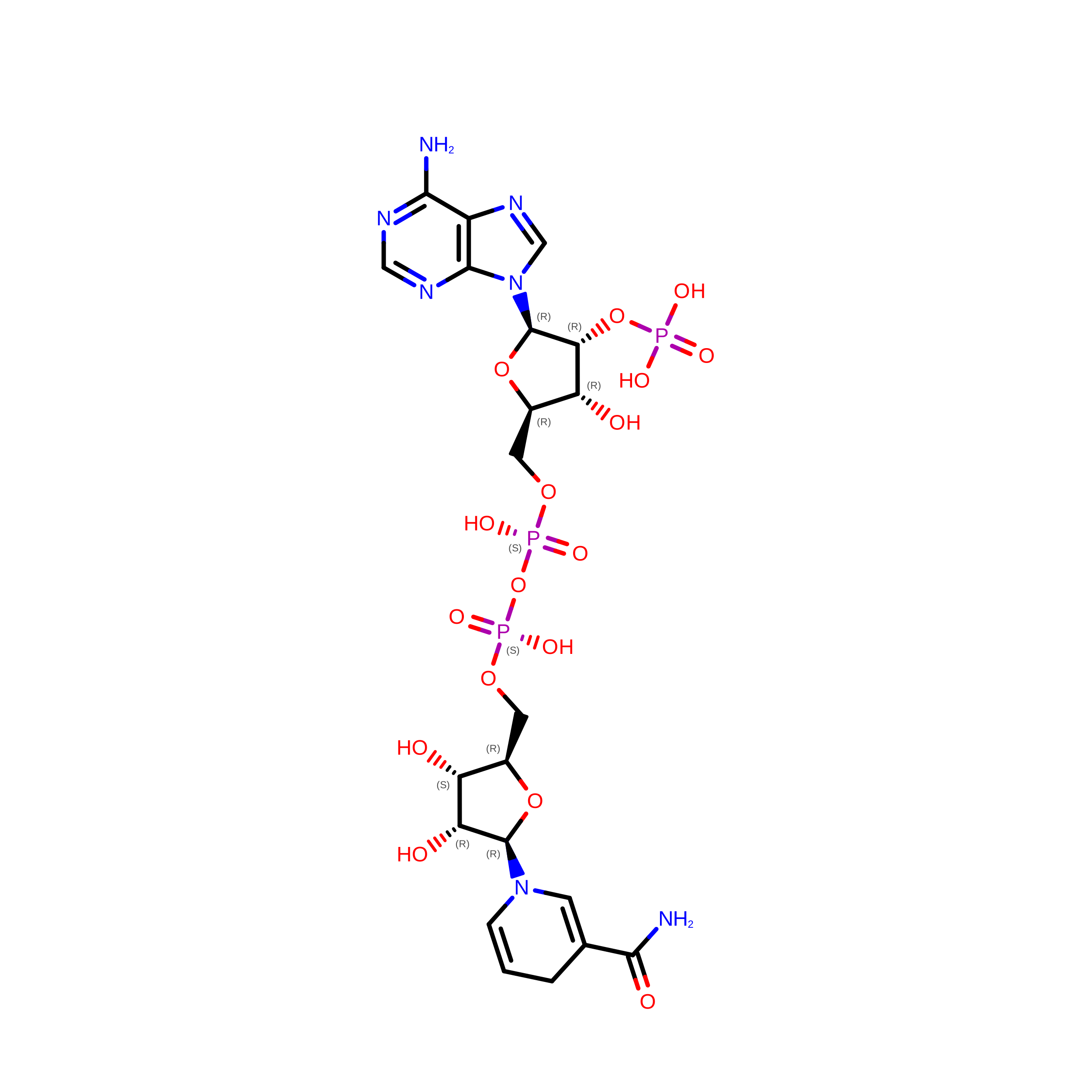
NDP

Query on NDP


Download:Ideal Coordinates CCD File
B [auth A]NADPH DIHYDRO-NICOTINAMIDE-ADENINE-DINUCLEOTIDE PHOSPHATE
C21 H30 N7 O17 P3
ACFIXJIJDZMPPO-NNYOXOHSSA-N

Experimental Data & Validation

Experimental Data

  • Method: X-RAY DIFFRACTION
  • Resolution: 2.20 Å
  • R-Value Free:  0.232 (Depositor), 0.233 (DCC) 
  • R-Value Work:  0.193 (Depositor), 0.194 (DCC) 
  • R-Value Observed: 0.195 (Depositor) 
Space Group: P 63 2 2
Unit Cell:
Length ( Å )Angle ( ˚ )
a = 153.509α = 90
b = 153.509β = 90
c = 60.68γ = 120
Software Package:
Software NamePurpose
MOSFLMdata reduction
SCALAdata scaling
PDB_EXTRACTdata extraction
PHASERphasing
PHENIXrefinement

Structure Validation

View Full Validation Report


Ligand Structure Quality Assessment 


Entry History 

Deposition Data

Revision History  (Full details and data files)

  • Version 1.0: 2014-06-25
    Type: Initial release
  • Version 1.1: 2014-07-30
    Changes: Database references
  • Version 1.2: 2014-09-10
    Changes: Database references
  • Version 2.0: 2020-03-11
    Changes: Atomic model, Data collection, Derived calculations
  • Version 2.1: 2023-12-20
    Changes: Data collection, Database references, Refinement description
  • Version 2.2: 2024-11-20
    Changes: Structure summary