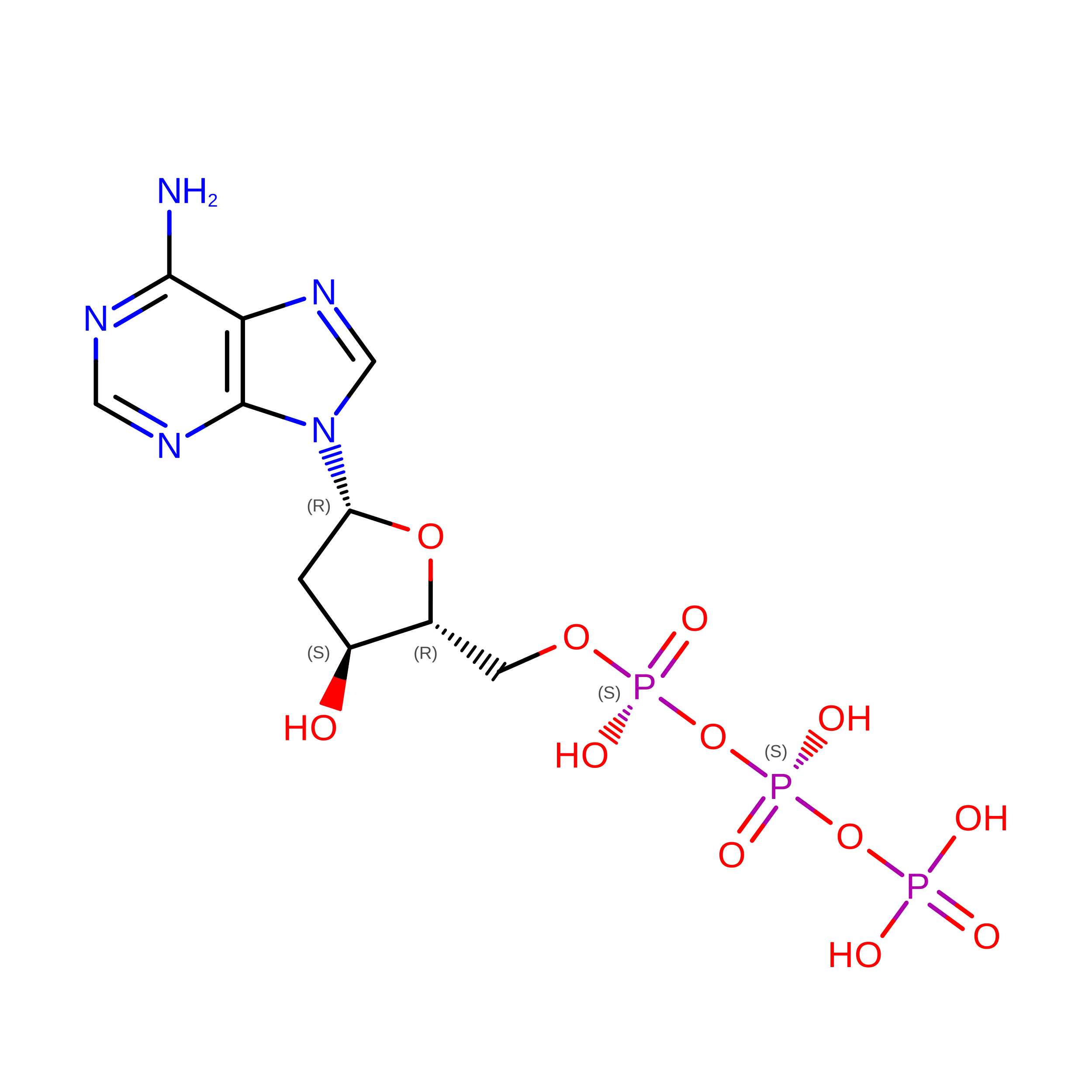
4RUA | pdb_00004rua

Crystal structure of Y-family DNA polymerase Dpo4 bypassing a MeFapy-dG adduct


Experimental Data Snapshot

  • Method: X-RAY DIFFRACTION
  • Resolution: 3.07 Å
  • R-Value Free: 
    0.258 (Depositor), 0.253 (DCC) 
  • R-Value Work: 
    0.163 (Depositor), 0.167 (DCC) 
  • R-Value Observed: 
    0.168 (Depositor) 

Starting Model: experimental
View more details

wwPDB Validation 3D Report Full Report

Validation slider image for 4RUA

Ligand Structure Quality Assessment 


This is version 1.1 of the entry. See complete history

Literature

Structural Basis for Error-Free Bypass of the 5-N-Methylformamidopyrimidine-dG Lesion by Human DNA Polymerase eta and Sulfolobus solfataricus P2 Polymerase IV.

Patra, A.Banerjee, S.Johnson Salyard, T.L.Malik, C.K.Christov, P.P.Rizzo, C.J.Stone, M.P.Egli, M.

(2015) J Am Chem Soc 137: 7011-7014

  • DOI: https://doi.org/10.1021/jacs.5b02701
  • Primary Citation Related Structures: 
    4RU9, 4RUA, 4RUC

  • PubMed Abstract: 

    N(6)-(2-Deoxy-D-erythro-pentofuranosyl)-2,6-diamino-3,4-dihydro-4-oxo-5-N-methylformamidopyrimidine (MeFapy-dG) arises from N7-methylation of deoxyguanosine followed by imidazole ring opening. The lesion has been reported to persist in animal tissues. Previous in vitro replication bypass investigations of the MeFapy-dG adduct revealed predominant insertion of C opposite the lesion, dependent on the identity of the DNA polymerase (Pol) and the local sequence context. Here we report crystal structures of ternary Pol·DNA·dNTP complexes between MeFapy-dG-adducted DNA template:primer duplexes and the Y-family polymerases human Pol η and P2 Pol IV (Dpo4) from Sulfolobus solfataricus. The structures of the hPol η and Dpo4 complexes at the insertion and extension stages, respectively, are representative of error-free replication, with MeFapy-dG in the anti conformation and forming Watson-Crick pairs with dCTP or dC.


  • Organizational Affiliation
    • †Department of Biochemistry, Center in Molecular Toxicology, Vanderbilt-Ingram Cancer Center, Vanderbilt Institute of Chemical Biology, Center for Structural Biology, Vanderbilt University School of Medicine, Nashville, Tennessee 37232, United States.

Macromolecule Content 

  • Total Structure Weight: 49.15 kDa 
  • Atom Count: 3,424 
  • Modeled Residue Count: 371 
  • Deposited Residue Count: 372 
  • Unique protein chains: 1
  • Unique nucleic acid chains: 2

Macromolecules


Find similar proteins by:|  3D Structure
Entity ID: 1
MoleculeChains  Sequence LengthOrganismDetailsImage
DNA polymerase IV341Saccharolobus solfataricus P2Mutation(s): 0 
Gene Names: dbhdpo4SSO2448
EC: 2.7.7.7
UniProt
Find proteins for Q97W02 (Saccharolobus solfataricus (strain ATCC 35092 / DSM 1617 / JCM 11322 / P2))
Explore Q97W02 
Go to UniProtKB:  Q97W02
Entity Groups
Sequence Clusters30% Identity50% Identity70% Identity90% Identity95% Identity100% Identity
UniProt GroupQ97W02
Sequence Annotations
Expand
Reference Sequence
Find similar nucleic acids by:  Sequence
Entity ID: 2
MoleculeChains LengthOrganismImage
Nucleic acids Template: TCAT(MF7)GAATCCTTCCCCCB [auth T]18synthetic construct
Sequence Annotations
Expand
Reference Sequence
Find similar nucleic acids by:  Sequence
Entity ID: 3
MoleculeChains LengthOrganismImage
Nucleic acids Primar: GGGGGAAGGATTCC [auth P]13synthetic construct
Sequence Annotations
Expand
Reference Sequence

Experimental Data & Validation

Experimental Data

  • Method: X-RAY DIFFRACTION
  • Resolution: 3.07 Å
  • R-Value Free:  0.258 (Depositor), 0.253 (DCC) 
  • R-Value Work:  0.163 (Depositor), 0.167 (DCC) 
  • R-Value Observed: 0.168 (Depositor) 
Space Group: P 21 21 2
Unit Cell:
Length ( Å )Angle ( ˚ )
a = 95.451α = 90
b = 102.716β = 90
c = 53.432γ = 90
Software Package:
Software NamePurpose
MD2data collection
PHASERphasing
REFMACrefinement
HKL-2000data reduction
HKL-2000data scaling

Structure Validation

View Full Validation Report


Ligand Structure Quality Assessment 


Entry History 

Deposition Data

Revision History  (Full details and data files)

  • Version 1.0: 2015-08-05
    Type: Initial release
  • Version 1.1: 2023-09-20
    Changes: Advisory, Data collection, Database references, Derived calculations, Refinement description