4RSW | pdb_00004rsw

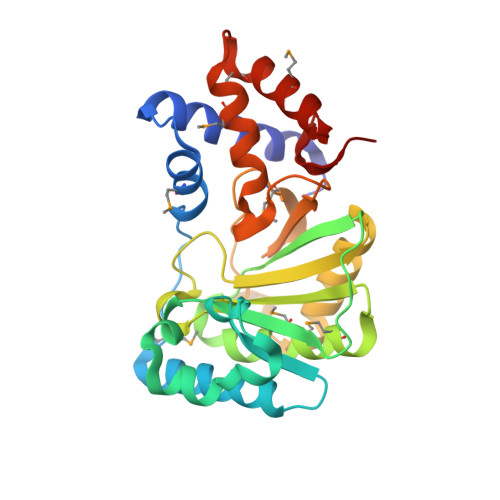
The structure of the effector protein from Pseudomonas syringae pv. syringae strain 61


Experimental Data Snapshot

  • Method: X-RAY DIFFRACTION
  • Resolution: 1.90 Å
  • R-Value Free: 
    0.226 (Depositor), 0.231 (DCC) 
  • R-Value Work: 
    0.195 (Depositor), 0.203 (DCC) 
  • R-Value Observed: 
    0.196 (Depositor) 

wwPDB Validation 3D Report Full Report

Validation slider image for 4RSW

This is version 1.2 of the entry. See complete history

Literature

Crystal structure of the effector protein HopA1 from Pseudomonas syringae

Park, Y.Shin, I.Rhee, S.

(2015) J Struct Biol 189: 276-280

  • DOI: https://doi.org/10.1016/j.jsb.2015.02.002
  • Primary Citation Related Structures: 
    4RSW, 4RSX

  • PubMed Abstract: 

    Plants have evolved to protect themselves against pathogen attack; in these competitions, many Gram-negative bacteria translocate pathogen-originated proteins known as effectors directly into plant cells to interfere with cellular processes. Effector-triggered immunity (ETI) is a plant defense mechanism in which plant resistance proteins recognize the presence of effectors and initiate immune responses. Enhanced disease susceptibility 1 (EDS1) in Arabidopsis thaliana serves as a central node protein for basal immune resistance and ETI by interacting dynamically with other immune regulatory or resistance proteins. Recently, the effector HopA1 from Pseudomonas syringae was shown to affect these EDS1 complexes by binding EDS1 directly and activating the immune response signaling pathway. Here, we report the crystal structure of the effector HopA1 from P. syringae pv. syringae strain 61 and tomato strain DC3000. HopA1, a sequence-unrelated protein to EDS1, has an α+β fold in which the central antiparallel β-sheet is flanked by helices. A similar structural domain, an α/β fold, is one of the two domains in both EDS1 and the EDS1-interacting protein SAG101, and plays a crucial role in forming the EDS1 complex. Further analyses suggest structural similarity and differences between HopA1 and the α/β fold of SAG101, as well as between two HopA1s from different pathovars. Our structural analysis provides a foundation for understanding the molecular basis of the effect of HopA1 on plant immunity.


  • Organizational Affiliation
    • Department of Agricultural Biotechnology, Seoul National University, Seoul, Republic of Korea.

Macromolecule Content 

  • Total Structure Weight: 57.6 kDa 
  • Atom Count: 4,336 
  • Modeled Residue Count: 510 
  • Deposited Residue Count: 510 
  • Unique protein chains: 1

Macromolecules

Find similar proteins by:|  3D Structure
Entity ID: 1
MoleculeChains  Sequence LengthOrganismDetailsImage
HopA1
A, B
255Pseudomonas syringae pv. syringaeMutation(s): 0 
Gene Names: hopA1
UniProt
Find proteins for Q83YM3 (Pseudomonas syringae pv. syringae)
Explore Q83YM3 
Go to UniProtKB:  Q83YM3
Entity Groups
Sequence Clusters30% Identity50% Identity70% Identity90% Identity95% Identity100% Identity
UniProt GroupQ83YM3
Sequence Annotations
Expand
Reference Sequence

Small Molecules

Modified Residues  1 Unique
IDChains TypeFormula2D DiagramParent
MSE
Query on MSE
A, B
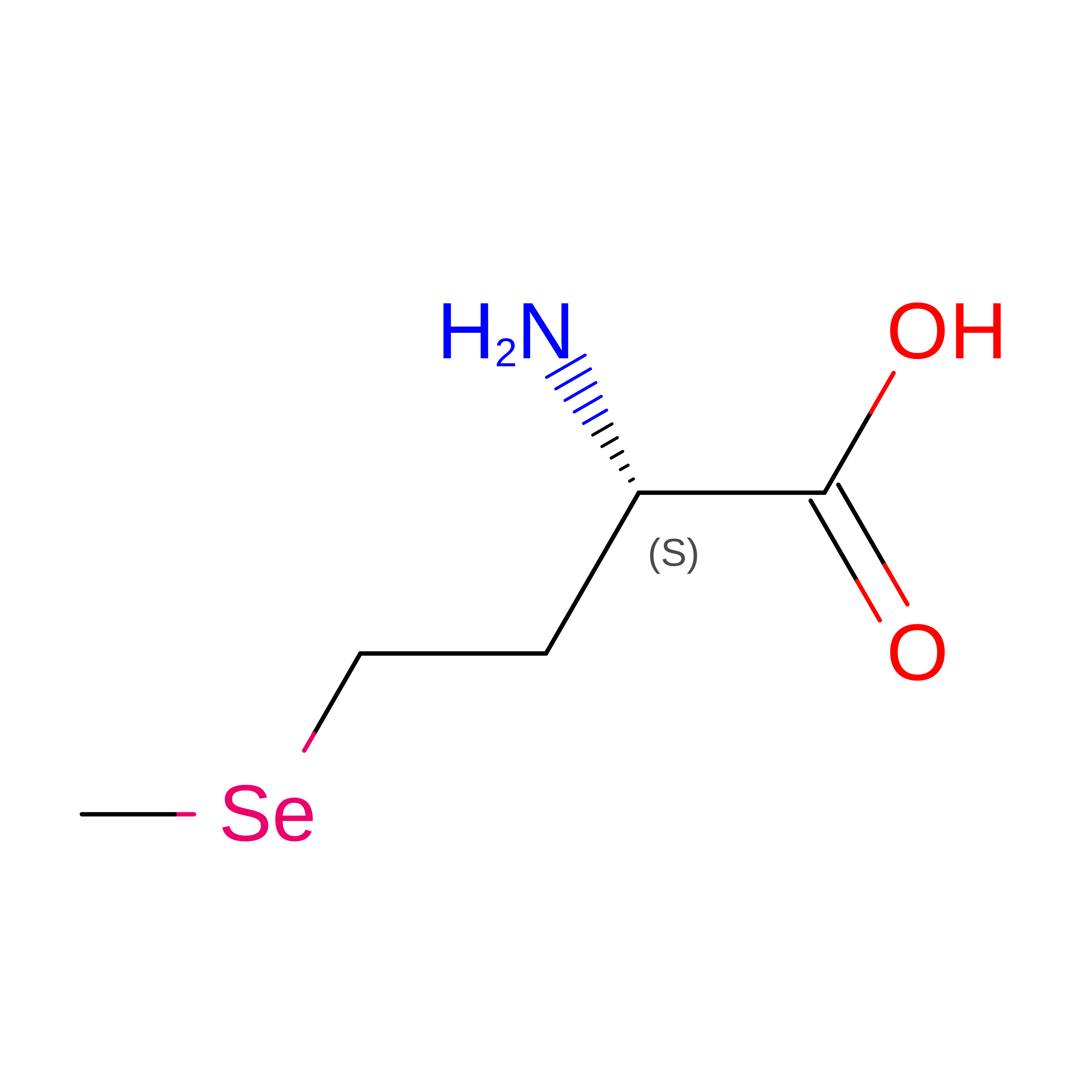
L-PEPTIDE LINKINGC5 H11 N O2 SeMET

Experimental Data & Validation

Experimental Data

  • Method: X-RAY DIFFRACTION
  • Resolution: 1.90 Å
  • R-Value Free:  0.226 (Depositor), 0.231 (DCC) 
  • R-Value Work:  0.195 (Depositor), 0.203 (DCC) 
  • R-Value Observed: 0.196 (Depositor) 
Space Group: P 41
Unit Cell:
Length ( Å )Angle ( ˚ )
a = 62.522α = 90
b = 62.522β = 90
c = 156.64γ = 90
Software Package:
Software NamePurpose
DENZOdata reduction
SCALEPACKdata scaling
PHENIXrefinement
PDB_EXTRACTdata extraction
HKL-2000data collection
HKL-2000data reduction
HKL-2000data scaling
SOLVEphasing

Structure Validation

View Full Validation Report


Entry History 

Deposition Data

Revision History  (Full details and data files)

  • Version 1.0: 2015-03-11
    Type: Initial release
  • Version 1.1: 2017-11-22
    Changes: Refinement description
  • Version 1.2: 2024-10-30
    Changes: Data collection, Database references, Derived calculations, Structure summary